France. Leaving a store with a postcard, a beautiful catalog or a few gifts in your pocket… Today, taking a souvenir with you is an integral part of the museum experience, in the same way that boutique bookstores have become an essential part of the visit. From a row of a few scattered works and accessories, brought together without much coherence, to a display of varied and carefully selected products: museum shops have changed a lot since their establishment in the 1980s. “Fifteen years ago, they were a bit limited to postcards, a few books…, we shouldn’t talk too much about commerce. There has been a great evolution in their perception since then! From customers of course, but also from institutions which have become aware of the important role they play in the visiting experience”corroborates Lorraine Dauchez, founder of the company Arteum, which has managed museum bookstores and boutiques since 2013.
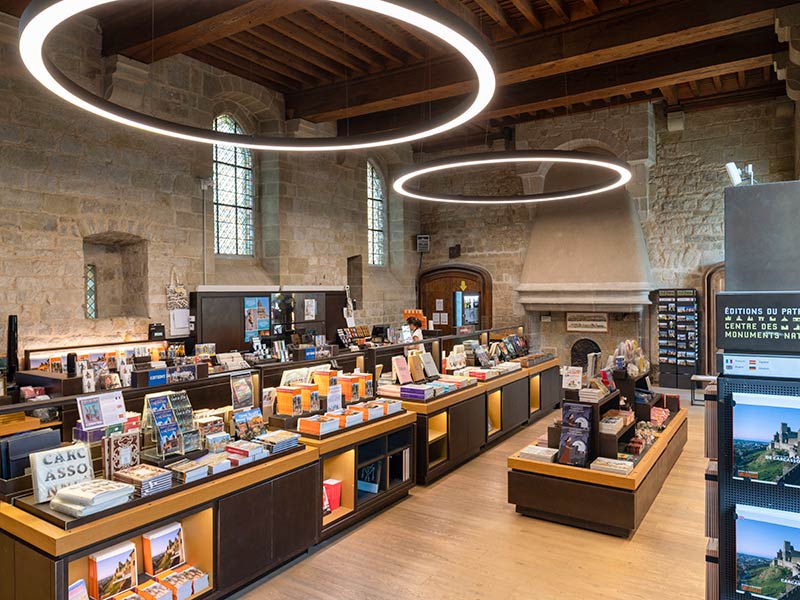
Far from being flourishing a decade ago, the market has since become buoyant. The stores are more efficient, better located, and offer a much more sophisticated offering. If there is a world of difference between the immense bookstore-boutique of the Louvre and the small sales counter coupled with the museum ticket office, with which many small structures still have to make do, it is clear that the presence of a boutique worthy of the name has become widespread. That of a space exceeding twenty square meters, equipped with dedicated staff and driven by strategic thinking.
Between commerce and mediation
How to explain this paradigm shift? Why this need to offer, as much as possible, a functional and attractive sales space? First of all, the obvious: the commercial potential represented by the boutique bookstore. The financial windfall it brings can be significant depending on the attendance of the place and the offer offered. But beyond the economic criterion, the store also has experiential value. Conclusion of the tour, the last image we retain of the site, it contributes to the influence of the museum, to making it a place of life. And above all, it plays a role of mediation. In view of our collections and our commitment, we began to rethink the store’s offering, attests Manon Lecaplain, director of the Sainte-Croix Museum in Poitiers (whose revenue from the bookstore-boutique represents around 50% of the annual turnover). For example, we removed works that did not suit us in their discourse to bring in others, more in line with our purpose – references in terms of gender studies with regard to women artists for example. »
Faced with the demand for a more relevant offer, the sector has become more professional. Store managers, experienced in marketing techniques, rely on the place’s collections, its history, its cultural program, its visitors, etc.“The main thing is really to adapt to the place. If a site dates back to a very specific historical period, we create a universe of products around it, explains Bérengère Ghiglionda, head of the boutique bookstore department at the Center des monuments nationaux (CMN). Territorial anchoring is also an important axis. Above all, we are developing an offer linked to the permanent route, but we are also offering more and more regional food products, products based on local know-how, etc. »
Destination places
It is this tailor-made offer, this assembly of products that one would not necessarily find elsewhere, which makes the store an attractive space, frequented by a clientele who sometimes do not even stop by to see the works. The question of access is fundamental here: bonded or customs-free store? Is it possible to cross the threshold without having to pay for your ticket? “Despite a world of “retail” in difficulty, I am convinced that boutique bookstores have a very promising future, precisely because they can become destination places! Obviously, visitors discover them mainly during their visit to the museum, but they will also return there because they are looking for an inspired product”underlines Virginie Perreau, sales and marketing director in charge of the boutique bookstores at the GrandPalaisRmn. Designer jewelry and designer objects at the boutique bookstore of the Museum of Decorative Arts in Paris, collections on Arab art and literature in that of the Arab World Institute (IMA), specialized bibliography at the National Maritime Museum… Many boutique bookstores intend to establish themselves as a reference in their field. “Our offering is very focused on contemporary art, design, architecture, explains Marianne Berger-Laleix, deputy general director of the Palais de Tokyo, whose bookstore-boutique gives pride of place to the work, in its offering as well as during the meetings and signings organized on site. When the sales space was redeveloped, the idea was really to combine these two parts, that of the bookstore and that of the boutique. There are more book proposals, that’s for sure, but also more derivative products, design products, lithographs…”
Diversify to be more profitable
The whole issue of assortment policy comes into play here. Find the right balance between a sought-after and cutting-edge offer, but diversified enough to please as many people as possible. Too many books are synonymous with low profitability, too many products derived from a lack of scientific standards.“About fifteen years ago, the “souvenirs” section was somewhat reduced to a literal representation of the museum’s icons. Today, where books are still present, it is clear that products are taking an increasing share in turnover,” agrees Virginie Perreau of the GrandPalaisRmn, where books represent 30% of turnover. This diversification of the offer is due to an observation: we are not a bookstore, but a bookstore-museum boutique. So the whole point is to be able to have both sides by offering bibliographical references that echo our collections, but also small objects that visitors can leave with.” adds Manon Lecaplain, director of the Sainte-Croix Museum in Poitiers. Today, the multi-product offering is the norm.It’s difficult to make a store profitable if it’s just a bookstore. Adding objects is what allows you to increase your profitability and ensure good use of the place. Our role is to ensure that we sell a book and an object each time. Hence the interest, precisely, in linking the whole”agrees Lorraine Dauchez, founder of Arteum.
Postcards, tote bagsmagnets, posters, textiles, decorative objects, children’s collections… There is no shortage of options and are aimed at all wallets, winning the favor of a clientele who, far from disdaining reading, at least expects a rigorous selection. Publishing in museums is a vast subject. The general public no longer buys huge sums or catalogs raisonnés, it has to be very thematic. We are asking more and more questions about the relevance, particularly financial, of offering editions, points out Julie Pellegrin, director of the Dobrée Museum in Nantes. And all the more so since it is difficult to edit responsibly. However, we pay great attention to CSR (corporate social responsibility) standards. »And for good reason, if it is not new, ecological concern is today at the heart of customer expectations. Proposing a quality offer means favoring local, “made in France”, taking a close look at the provenance… Criteria that have become essential in the strategy of museum bookstores-boutiques.