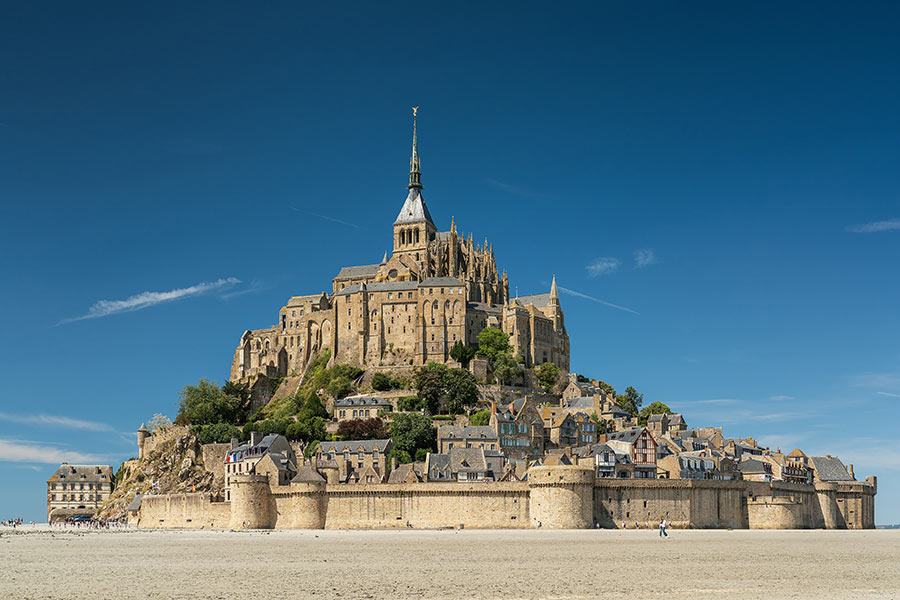
Heard by the Senate Culture Committee on Wednesday May 27, 2026, Marie Lavandier, president of the Center des monuments nationaux (CMN), detailed the orientations of her “CMN 2030” roadmap, based on improving visitor reception, preventive maintenance of monuments and increased citizen involvement. But it was the question of the future of Mont-Saint-Michel which quickly dominated the discussions.
For several months, the hypothesis of a transfer of management of the abbey to the Public Industrial and Commercial Establishment (Epic) of Mont-Saint-Michel has fueled the CMN’s concerns. Created in 2019 to manage access, parking, shuttles and site infrastructure, this Epic claims an increased role in the governance of Mont. A claim supported by several Norman elected officials and reinforced by the observations of the Court of Auditors, which pleads for unified management of the site.
Questioned at the opening of the hearing, Marie Lavandier did not confirm the existence of imminent arbitration by the State. However, she recalled that the agreement linking the CMN and Epic had just been extended until June 30. A way of recognizing that a decision remains awaited at the highest level of the executive.
Beyond the sole case of Mont-Saint-Michel, the president of the CMN sought to demonstrate that the issue concerns the entire French heritage model. The abbey is one of the five monuments whose revenues help fund the CMN’s equalization mechanism, alongside the Arc de Triomphe, the Sainte-Chapelle, the Pantheon and the Conciergerie. These few locomotives finance the maintenance and opening to the public of around a hundred monuments, half of which are located in rural areas and could not achieve financial balance through their revenues alone.
“The departure from Mont-Saint-Michel would constitute a major explosion”warned Marie Lavandier. A formula taken up by several senators who see this issue as a test for the state’s heritage policy. Pierre Ouzoulias denounced a contradiction consisting of entrusting the CMN with monuments that are increasingly costly to restore while considering withdrawing one of its main sources of income. Sylvie Robert questions the State’s ability to compensate for a loss estimated at between 7 and 8 million euros per year.
Norman elected officials, however, developed a radically different reading of the file. For them, the problem is not so much that of national solidarity as that of financing the entire Mont. Senator Béatrice Gosselin thus recalled that Epic only receives 675,000 euros under the current agreement while it must face considerable investments for shuttles, reception equipment and even site infrastructure.
This criticism joins the arguments already developed by local authorities and analyzed by Le Journal des Arts last January. The Epic must in fact commit nearly 38 million euros in investments between 2026 and 2030, while several communities wish to reduce their financial contribution. At the same time, attendance at the abbey continues to increase and successive price increases have increased its operating surplus, fueling demands for more favorable redistribution to the territory.
Faced with these criticisms, Marie Lavandier defended the CMN’s record. She recalled that the establishment had invested 35 million euros on the site in fifteen years and planned an additional 50 million for the coming years, in particular for the restoration work on the abbey. She also contested the idea of competition between the two structures, emphasizing that the general director of the Epic simultaneously exercises the functions of administrator of the monument on behalf of the CMN.