New York. In front of the MoMA, a visitor says, a little jaded: “We’ve already seen everything about Duchamp, right? » We would almost have acquiesced. That’s without counting the retrospective which takes place until August 22 in the New York temple of modernism. It proves, on the contrary, that we still have something to learn, or to understand, from someone who wanted to be unclassifiable. What we learn undoubtedly has more to do with the artistic approach than the works themselves.
Paintings, sculptures, films, photographs, drawings and prints, 300 works by Marcel Duchamp (1887-1968) are brought together for the occasion. They cover the six decades of activity of the artist, American by adoption since 1915. The rooms of the exhibition are arranged in chronological order, they also turn out to be thematic, not by the desire of the house curators, Ann Temkin, Michelle Kuo and Matthew Affron, but by the very nature of the artist. From room to room, we understand the obsessive character of Duchamp who goes from phase to phase, from quest to quest, from medium to medium, even boasting of denying what he has just done in order to direct his thoughts towards other research. Even if it means leaving certain works unfinished, such as Large Glass that he himself declared, in 1923, “definitely not finished”. Work that he completed decades later, in 1936, devoting himself to one of his specialties: the spirit of contradiction.
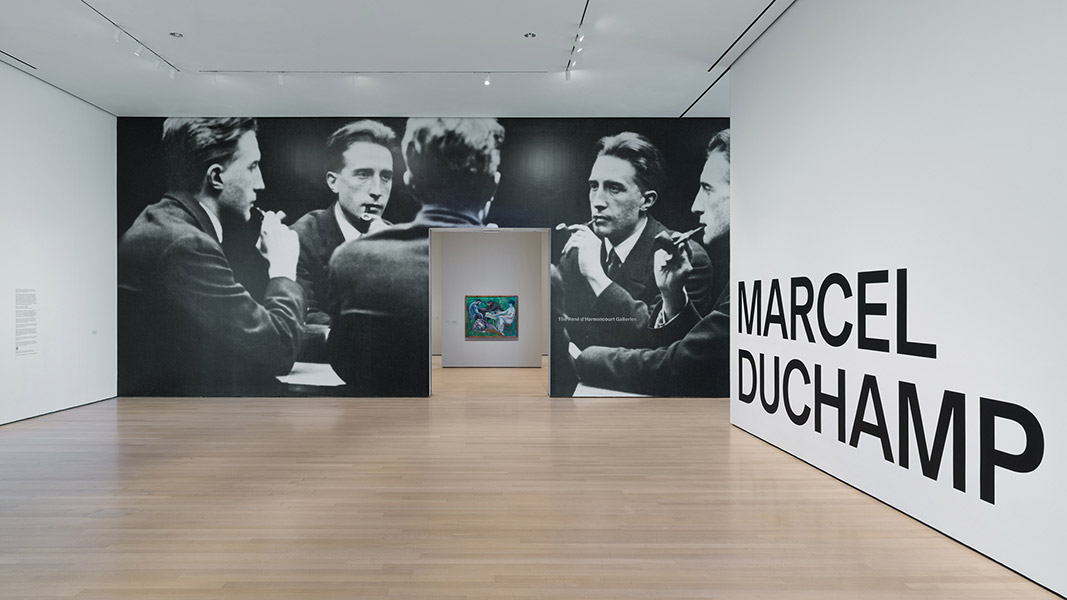
View of the “Marcel Duchamp” exhibition at MoMA.
© Jonathan Dorado / MoMA
© Adagp Paris 2026
A journey between inspiration and invention
To explore the rooms of the MoMA is therefore to enter the head of Marcel Duchamp and navigate the twists and turns that make it up. Sometimes curious, sometimes innovative, sometimes impertinent. At each period of his life, he seems destined to stand out from the others. The first rooms of the exhibition show how this desire to differentiate oneself was sedimented during his youth. His first paintings were figurative, then, curious by nature, he was inspired by avant-garde artists: Cézanne and the Cubists. The exhibition clearly articulates the back and forth between inspiration and invention. The bride coming down the stairsin its two more or less fragmented versions, demonstrates Duchamp’s pictorial mastery and his narrative will. The two paintings hang a few steps from the Large Glass, loaned by the Philadelphia Museum which, free from any influence, stands out as the manifest work of the artist. The narrative, which is also at the heart of this work, that of a bride and her suitors, is no longer supported by the visual, the visitor must trust the artist in the face of these broken glass panels, its lead wires and the dust that compose it. Highlighted by the scenographic choices, this work of art is an enigma which opens up all the possibilities to Duchamp’s followers. A sort of indefinition of art which would free creation from any norm.
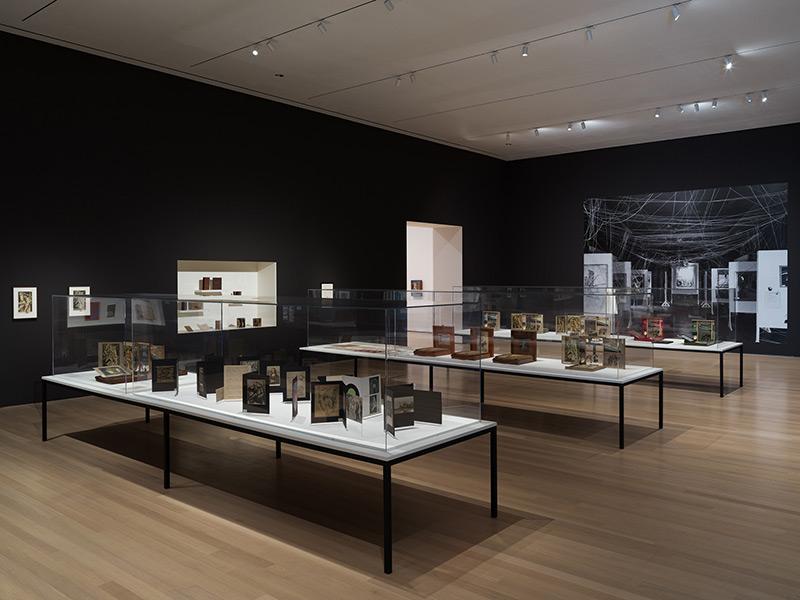
View of the “Marcel Duchamp” exhibition at MoMA.
© Jonathan Dorado / MoMA
© Adagp Paris 2026
Kinetic or mechanical works, graphic, filmic works, Duchamp himself explores an infinity of artistic objects shown throughout the course. We note, in certain rooms, a conflict between the large quantity of small objects that must be exhibited at eye level and the gigantic ceiling height of the New York museum. The exhibition obviously focuses on the Readymade. It offers a dual perspective: the studio work, like the Bicycle wheel on a wooden stool and the work multiplied, a reproduced object, simply diverted from its function and placed at the heart of the museum. Duchamp’s attraction to the multiple is obvious, it resonates with the writings of Walter Benjamin (1892-1940), his contemporary. One of the rooms brings together Readymade placed on bases or hung from the ceiling. They receive dramatic lighting which adds ghostly doubles to them in a sort of Platonic shadow play.
Duchamp is a theoretician, an influencer of his time. More than an artist, he wanted to be an inventor. The exhibition is dedicated to proving this. Numerous documents relate his creative process. He, who said “Everything important I have done…can fit in a small suitcase”wrote a large number of notes, sketches, sketches which he considered to be the instructions for his works. One of the most successful rooms in the exhibition, to which the walls painted anthracite gray give the air of an archaeological museum, exhibits the remains of these reflections. The documentary sources are arranged under glass casings, including one of the 320 copies of the Green Box which explains the Large Glass through a series of documents and a miniature reproduction. In the intimate atmosphere of the room, the visitor immerses himself in the artist’s reflections. Other devices show what Duchamp called the “Portable Museum”boxes designed between 1935 and 1941 which reproduce in miniature works produced previously. With his boxes, Duchamp, ego in place, wanted to design a personal retrospective at a time when he was not yet exhibited in museums. It is therefore almost in the psyche of the artist that we discover his ambitions and his theories.
View of the “Marcel Duchamp” exhibition at MoMA.
© Jonathan Dorado / MoMA
© Adagp Paris 2026