Since last June 21, four German cities in the Ruhr region – Duisburg, Essen, Bochum and Gelsenkirchen – have hosted Manifesta 16, an event that this year has involved the transformation of a dozen churches built mostly after World War II, and in recent decades fallen into disuse, into spaces that host proposals linked to contemporary art and architecture, social design and community gathering.
Coinciding with the 30th anniversary of this European Nomadic Biennial, Manifesta 16 Ruhr has set itself the challenge of reimagining the existing neighborhood infrastructure in these centers to support new forms of collective life in an era marked by social fragmentation, inequality and polarization. Instead of considering these empty or underused churches solely as architectural heritage to be preserved, the exhibition will investigate how these spaces could become new civic pillars that generate greater closeness between those who populate their neighborhoods.
In a region characterized by a polycentric urban structure and changing social realities, especially after the decline of industries linked to steel and mining, the project will explore how culture can contribute to strengthening social cohesion, recovering public space and fostering ties between citizens.
More than 20,000 churches in Germany are expected to remain empty or deconsecrated over the next decade (many of them erected around the 1950s, in a period of demographic growth and reconstruction), so Manifesta 16 Ruhr wants to put the future of these buildings on the national agenda.
Through new artistic commissions, community initiatives or collaborative research, this exhibition will offer a dozen examples of the conversion of these temples into exhibition spaces, gardens, concert halls, art schools, textile workshops, cultural centers and spaces for participation.
Thus, Julian Irlinger, Athina Koumparouli, ElizabethPrice, Emil Walde and Abbas Zahedi interact with the Kulturkirche Liebfrauen of Duisburg, analyzing the parallels between its six decades of history and those of this region (a constant in these exhibitions) and Sara Bichão, Lilli Lake, PELE and Augustas Serapinas will do the same with the Markuskirche of Essen, whose structure evokes that of the ship itself of Noah that would transport the parishioners, through the dangers of the world, towards salvation. These artists imagine what that ship would collect today and what it would not from the past; Where would he take us?
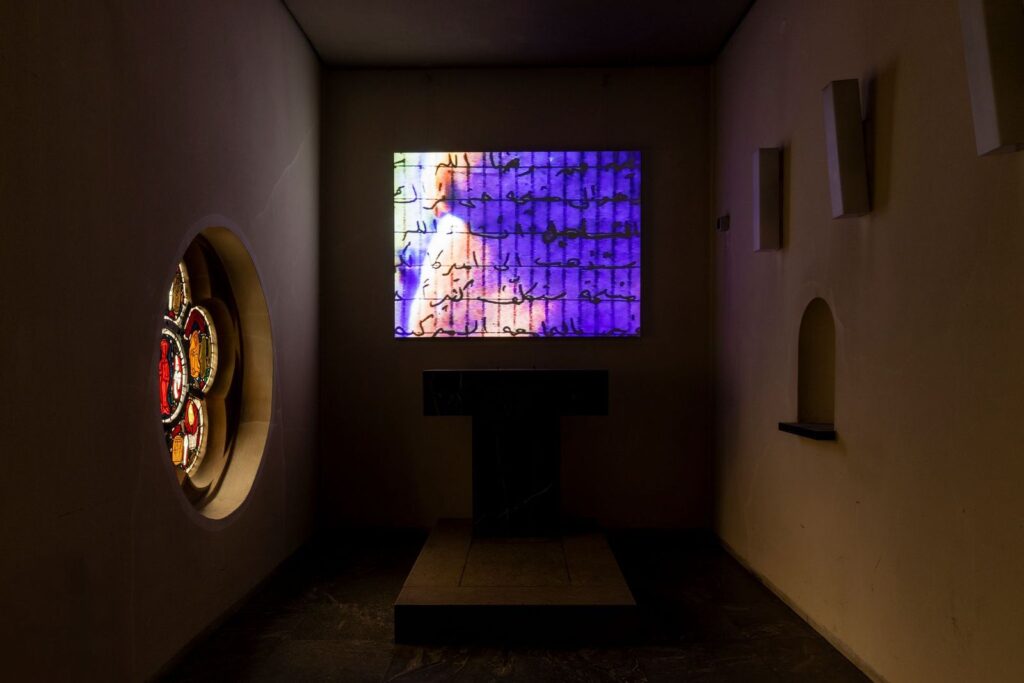
Mona Hatoum. Electrified (St. Gertrud)2026. © Manifesta 16 Ruhr / Rainer Schlautmann
St. Gertrud, also in Essen, combines ancient foundations with a sober, modern interior. Rebuilt after the Second World War, today it has become a center for teaching and artistic practice; Halil Altındere, Ayşe Erkmen, Mona Hatoum, Pravdoliub Ivanov, Šejla Kamerić, JarosławKozłowski, Olaf Metzel, Donja Nasseri, NavidNuur and Nasan Tur will exhibit here works that, like the building itself, start from objects, images or familiar situations, and then alter them through displacement, fragmentation or distortion. Several works allude to political realities, systems of power or collective memory, but indirectly, through gesture, irony or reduction.
In the same city, the church of St. Marien, built in the sixties, is located in a district marked by industry and migration; Its parishioners were, in fact, a community of miners. Its demolition is already scheduled, so the exhibition prepared here has something of a swan song: Jason Dodge, William Engelen, KatharinaFritsch, Annika Kahrs, Jarosław Kozłowski, Alicja Kwade, Mira M. Yang, SUPERFLEX, EvitaVasiljeva and Amanda Ziemele, in their projects, have reworked, translated or recontextualized pre-existing materials, images or situations linked to daily life, industrial production or culture shared visual.
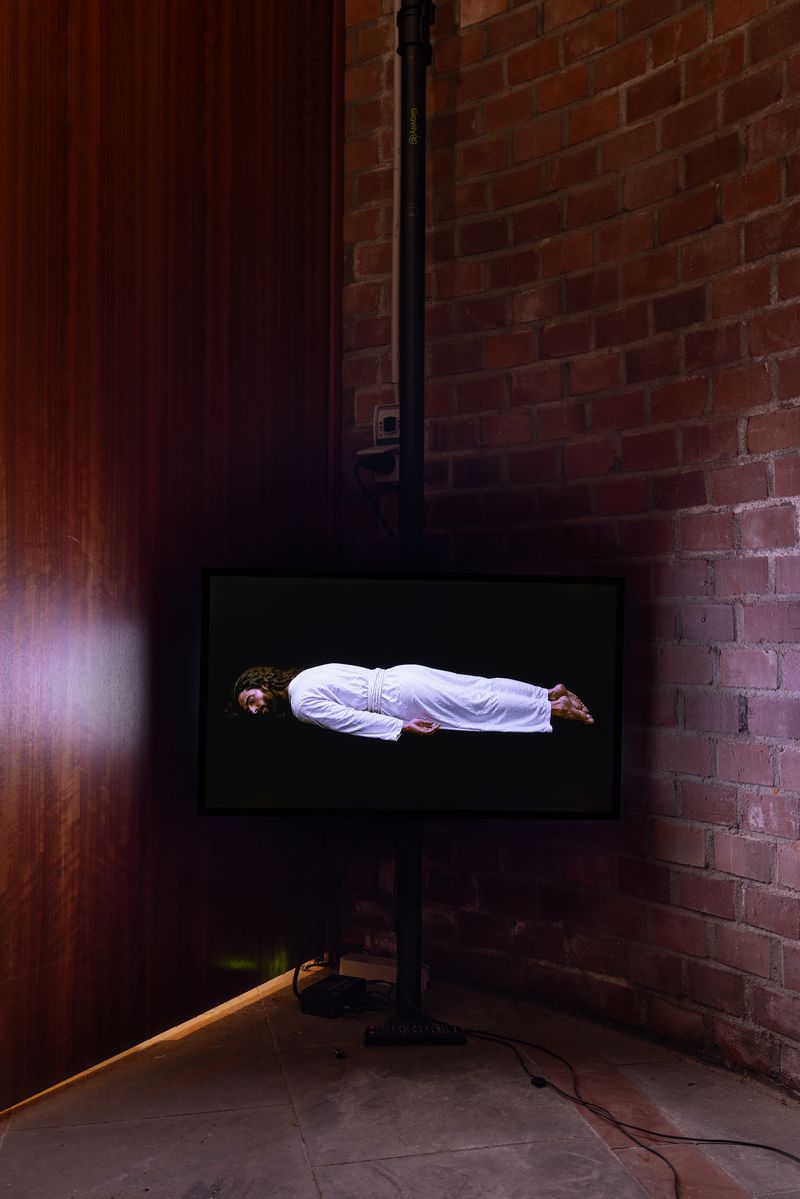
SUPERFLEX. Sleeping Jesus2026. Manifesta 16 Ruhr/ Ivan Erofeev
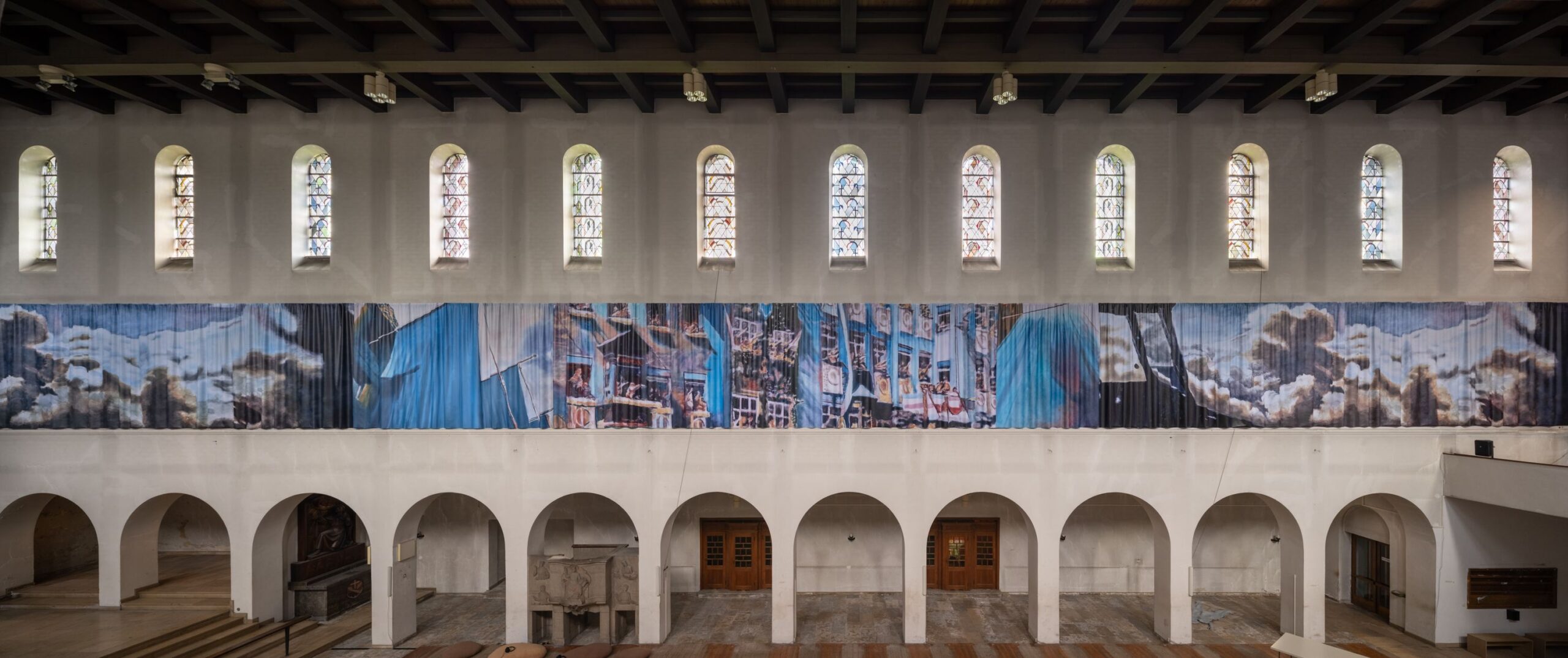
In Gelsenkirchen we will have to visit St. Josef, a neo-Gothic temple full of now latent iconography. In collaboration with the Catalan collective Penique Productions, a large inflatable membrane covers the interior, fills the nave and neutralizes that symbolic charge: the space becomes a continuous and immersive environment, neither sacred nor profane, but open, where previous meanings are suspended and new uses emerge. Havîn Al-Sîndy, Curro Claret and Dúo Barber-Palacios have participated.
In the same town we should go to the St. Anna – Hatay Engin Music Hall, where Emre Abut, Cana Bilir-Meier, Constructlab, İhsan Ece, Philipp Gufler, CihangirGümüştürkmen, Nejla Gür, Gašper Kunšič, Jannis Psychopedis, Mesut-Sabuha Salaam, Ming Wong and Hanefi Yeter study the relationship between music and the expression of gender and sexuality in different cultures, alluding to the diversity of origins of the immigrants who arrived in Germany in the mid-1950s through formal contracting agreements between governments. What they sang, played and listened to became a kind of traveling archive; It captured what had been left behind and, at the same time, opened space for something new to emerge in an unknown place.
When those immigrant workers planted their first gardens, something new took shape: their own piece of land in a foreign place. A land that they could work with their hands, from which tomatoes and beans grew and on which cherry trees and other fruit trees could be grown. In St. Bonifatius – Ferdane SatırTea Garden, Mehmet Aksoy, Begzada Alatović, ÖzlemAltın, Atiye Altül, Akbar Behkalam, BureauBaubotanik, Vlassis Caniaris, İsmail Çoban,Yıldırım Denizli, İhsan Ece, Füruzan, AbuzerGüler, Nejla Gür, Judith Hopf, Merve Kaplan, Justin Lieberman, Julia Logothetis, MihályMoldvay, Jannis Psychopedis, Metin Talayman, Rıza Topal, Yıldız Tüzün, Nil Yalter and Hanefi Yete take up motifs and derivations of those gardens: flora and fauna, food, coexistence, home furniture and the contrast between working underground, in the case of miners, and live on their own land.
The last space chosen in Gelsenkirchen is Thomaskirche – Hava GüleçLiving Room and here also immigration, in this case female immigration, will be remembered, through their textile works, which they developed under the label guest workers. They are honored by Mehmet Aksoy, Bettina Allamoda, Atiye Altül, Ayzit Bostan, Fatma Ceylan, Yıldırım Denizli, Gülbin Ünlü, Hava Güleç, Mehmet Güler, Abuzer Güler, Nejla Gür, Muhlis Kenter, AzadeKöker, Julia Logothetis, Asimina Paradissa, Judith Raum, Dennis Siering, Nesrin Tanç, Weberei Kai, Serpil Yeter and Hanefi Yeter.
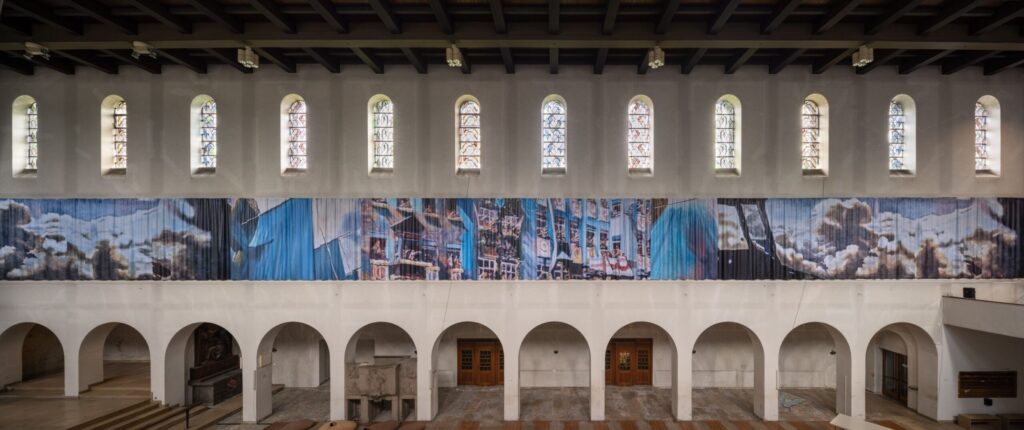
Luc Tuymans. KINO2026. © Manifesta 16 Ruhr/ Ivan Erofeev
In Bochum there are four temples to visit: Christ-König, St. Anna, Gethsemane-Kirche and St. Ludgerus. In the first, Miroslav Bałka, Mehtap Baydu, Mabe Bethônico, Aline Bouvy, Cudelice Brazelton IV, Bérénice Gaça Courtin, Niklas Goldbach, Nicolas Grospierre, Albe Hamiti, Eva Koťátková, Katarzyna Kozyra, Małgorzata Mirga-Tas, Anka Sasnall, Wilhelm Sasnall and Luc Tuymans They dive into the social and historical context of the building, built in the 1930s under the overwhelming forms of authoritarianism, demolished in 1944 and progressively converted into a cultural center.
St. Anna, in the heart of a steel mill employees’ neighborhood, was also designed in the 1930s as a place of worship and a pillar of the neighborhood. Damaged during the Second World War, rebuilt, renovated and adapted to changing needs, it remains a consecrated space, but open to the public: today it is shared by many, from the Schauspielhaus Bochum and a local amateur theater group to a recent sound exhibition and, occasionally, a choir. The works exhibited here dialogue with this open space, as well as with the history of the region, marked by industry and mining. They correspond to Pedro Cabrita Reis, Kateryna Lysovenko, Pınar Öğrenci, Mykola Ridnyi, Wilhelm Sasnal and Marion Stokes.
The Gethsemane Church, meanwhile, was built between 1949 and 1950 by members of the local Protestant community, on the foundations of a parish hall destroyed during the Second World War. It was never conceived as a grandiose building: it was one of the many Notkirchen (emergency churches) designed by the architect Otto Bartning as part of a relief program after the war; so many churches had been lost and so many refugees had arrived that new places of worship were needed in large numbers.
Like many postwar churches in the Ruhr region, it was built quickly and easily—with reclaimed bricks and prefabricated wood—for a developing neighborhood of industrial workers and their families. In German, these churches are called Pantoffelkirchen (sneaker churches), because they could be accessed with casual shoes.
The works on display here allude to the work and migration that shaped this region, the meaning of home and belonging, and what endures when the structures that held communities together begin to change. Its authors are, again, Mirosław Bałka, Mehtap Baydu, Zuza Golińska, Miedya Mahmod, Marina Naprushkina, Julia Nitschke, Mikołaj Sobczak and Cassidy Toner.
Finally, St. Ludgerus embodies that logic of Pantoffelkirche: It was a church conceived to serve the immediate neighborhood, integrated into daily life and understood as a domestic extension of the community. Today that proximity is maintained, but its function is not. The Catalan collective Cabosanroque, together with Josep Bohigas, Manifesta creative mediator, has transformed it into an atypical stadium: a space where the rules of the competition are suspended and rewritten; The sports structures—goals, hoops, markings—activate the place as a field of action. There are no spectators, the results lose relevance and success is silenced.
In parallel to the main biennale, Manifesta 16+ extends that approach to the entire Ruhr region through a program of sixteen further collaborative initiatives that will transform religious buildings in six more cities (Bottrop, Herne, Bochum, Dortmund, Marl and Mülheim).
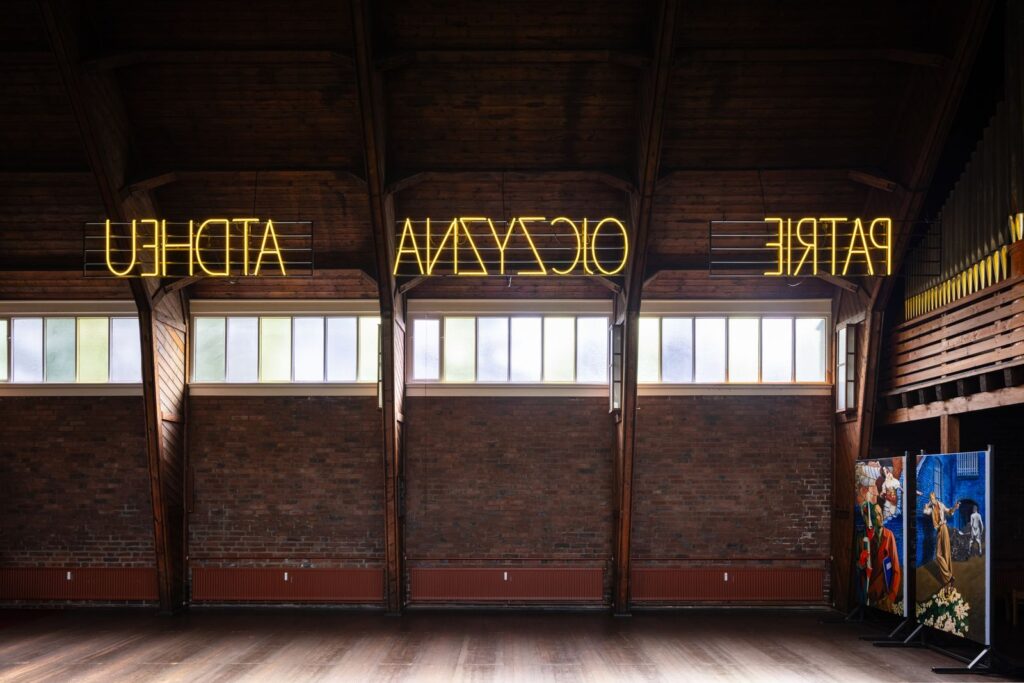
Miroslaw Balka. Heimat2026 © Manifesta 16 Ruhr