Toledo,
For the first time in Western art, painting and sculpture elevated the optical suggestion of movement to the category of a central problem, especially when addressing issues that developed over a temporal arc. The El Greco Museum and the Sephardic Museum host the “Maniera” exhibition, an exhibition (also the first) that Toledo offers to Mannerist painting and Italian influence illuminated in the city during the 16th century, during and after the Cretan’s career – there have been several dedicated to the authors who preceded that style there.
In the first center, the tour begins with Juan de Borgoña, the painter of French origin who enjoyed great success at the beginning of that century. There has been much discussion about the possibility that he made a formative trip to Italy, where he could have learned about the work of Domenico Ghirlandaio, with whom he has been most closely related.
In Toledo he worked mainly in the Cathedral, where he was the favorite painter of Cardinal Cisneros, for whom he carried out his best works, which we must interpret as an introduction to the models of the Italian quattrocentto: we are talking about balanced compositions, architectural backgrounds with a classical imprint and serene figures with a harmonious use of color and light. Even so, Burgundy also adapted to the taste of the city’s potential clientele, who in many cases continued to be attached to the aesthetics of Flemish painting that was still dominant.
After the death of the Frenchman, those who had trained in his workshop would gradually adopt the new Mannerist language, thus breaking with the classical postulates. The previous proportion and balance would give way to the elongation of the figures, movement and agitation; and serene gestures, drama and expressiveness. Giorgio Vasari, in The livesI would name that one manner modern: a new way of painting, typical of the last years of Raphael and the work of Michelangelo, who tried to achieve funnythe utmost perfection.
Juan Correa de Vivar or Francisco de Comontes, who trained alongside Burgundy, are examples of this: they incorporated extravagant, energetic figures with bright tones into their creations – often large altarpieces. The Italian models reached them mainly through prints, and among their authors we can mention Marcantonio Raimondi, who spread the designs of Raphael and Giulio Romano throughout Europe.
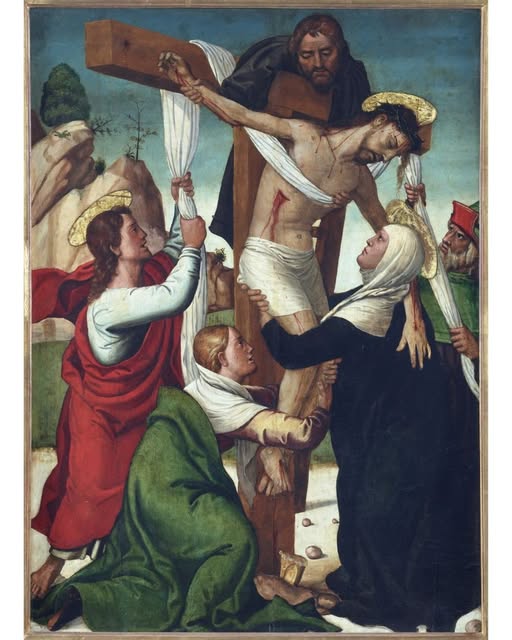
In the last third of the century, a new generation of artists would broaden the vision of the Toledo school. At that stage we must mention Hernando de Ávila, Luis de Velasco, Blas de Prado or Luis de Carvajal, trained together with Correa de Vivar or Comontes. In their works they will want to eliminate the excesses of manner: they will leave aside the superfluous, anecdotal or exotic in favor of concision and clarity in the representation of the sacred story, taking into account the principles of the Council of Trent. In this context, the Monastery of El Escorial and the artists who came from Italy to decorate it became the artistic epicenter of the moment and the dissemination of their works meant the adoption of a new mannerism, adapted to the Counter-Reformation, which was called contramaniera. The use of more austere forms did not imply the abandonment of diverse colors and attention to detail, which led to the representation of very realistic still lifes, predecessors of the baroque still life.
At the end of the 16th century there were still models that came from Juan de Borgoña and were combined with the influence of Raphael and Michelangelo, filtered by the reformed mannerism of El Escorial. In this context, the arrival of El Greco in 1577 marked the immersion of Venetian painting, its loose brushstrokes and vivid chromaticism. This heritage is identified in the exhibition with the last chapter of the manner Toledo.
After the Greek did not see his aspirations of becoming Philip II’s court painter fulfilled and his Martyrdom of Saint Maurice (1580-1582) was rejected – because it was a very artistic image in its composition that did not contain the confessional iconographic propaganda that the monarch desired – the painter found an open door in Toledo.
He was not, we advance, new to this city: in 1578 he had had a son here with Jerónima de las Cuevas, a boy named Jorge Manuel. In 1585 he rented three housing units in the old palace of the Marquis of Villena, where he lived after the early death of his wife, until 1590, and again after 1604. That palace disappeared, but it is believed that it was probably located in the area of the Jewish quarter, on Paseo del Tránsito, where his museum is located today.
A document dated 1589 called the artist a “neighbor” of Toledo, but before that his relationship with the city became very evident in The burial of Count Orgazwhich was commissioned in 1586 by the parish priest of Santo Tomé, which was El Greco’s own parish. In reality, behind that commission there was a certain economic interest: when the Count of Orgaz, Gonzalo Ruiz, died in 1327, he provided in his will for an annual donation from the citizens of Orgaz in favor of Santo Tomé, but his successors did not want to continue with it and the clergyman hoped, with an inscription and this work, to renew the past privilege. Its main argument was the representation of a miracle that elevated the count almost to the rank of a saint: according to the legend, Saints Stephen and Augustine appeared to bury him.
The painting, as is known, is divided into two areas: in the lower one, El Greco makes us witnesses of a ceremony like those that would usually take place in Toledo in his time; The Count of Orgaz is carried to the tomb by the two saints (we identify Saint Stephen by the representation of his martyrdom in the dalmatic), while on the right the patron Andrés Núñez surely appears, praying the requiem. At the top, an angel leads the soul – represented as a child – to heaven, through clouds that form a kind of womb. And on high above the Universal Judge awaits him with Saint John, the Virgin and other saints.
El Greco’s new artistic orientation, his abandonment of the conceptions of the Roman Renaissance that he still defended in his first Spanish compositions, can be seen in the use of light, used symbolically: in the celestial sphere an uneasy reflection dominates, while in the earthly sphere the observer is faced with a homogeneously illuminated scene in which the torches do not cause a real effect.
Very similar, in its conception, to the portraits of The burial is he Portrait of gentleman with hand on chestwhich has been dated to the same years: 1583-1585. Its restoration revealed a work of rich color in the background and vestments, which follows the Venetian tradition. Like Titian, and unlike the painters of the Madrid court, El Greco chose a loose line with which the brushstrokes can be recognized in the finished painting. In the rigid posture of the person represented, in his gesture of oath and in the renunciation of any external symbolism with the exception of the golden hilt of the dagger, we wanted to see an allusion to the honor of the model.
A greater wealth of sources exists from his representations of other Toledo personalities: Fray Hortensio Félix Paravicino y Arteaga and Jerónimo de Cevallos. The first was a Trinitarian monk of Italian descent who, when very young, had taught rhetoric in Salamanca; He also composed sonnets in which he praised the art of El Greco. The second studied Jurisprudence in that same city and was a lawyer in Toledo; Through a posthumous inventory we know that he hoarded a Saint Francis from the Greek.
Later, between 1608 and 1614, El Greco portrayed Cardinal Tavera, who had held important ecclesiastical and political positions during the reign of Charles V, among others, that of Grand Inquisitor and Regidor of Castile.
If we look for context, when El Greco (around 1577) made his first commissions in Toledo, this city was in a process of transformation after Philip II moved the court to Madrid in 1561. Around 1570, an urban reform began that sought to transform the medieval layout to achieve larger public spaces, a situation that includes the remodeling of the Plaza de Zocodover by Juan de Herrera and a new channeling system to supply fresh water to the Alcázar. The View of Toledo that he painted around 1597-1599 was intended as a reference to the past history of the city and as an index of its new image.

El Greco’s special relationship with Toledo is also manifested in the fact that he added motifs of the city again and again in his paintings of saints, such as in the great altarpiece of the Chapel of San José: to the right of this there is a view very similar to the aforementioned one of the city.
The commission to decorate that chapel was one of El Greco’s most important projects in Toledo after Saint Dominic the Ancient. The contract that he signed in 1597 included the two altar paintings (above that of Saint Joseph, a Coronation of the Virgin) and the decoration of the frame, and the sketch for the two lateral figures of Old Testament kings, David and Solomon, is also attributed to the artist; father and son. An inscription under David refers to Toledo: Jesus will reign eternally over the city, like the fruit of a seed.
Next, El Greco also received the commission for the two side altars: to the left of the main altar hung Saint Martin and the beggar and right in front the Virgin with the child, Saint Martina or Saint Thecla and Saint Agnes, until the two paintings were sold to an American collector.
The Castilla, the Covarrubias, Paravicino and Arteaga, Cevallos… made up a small elite who appreciated in this author a painter who responded to their religious conceptions and who also valued his own portrait. If El Greco had been a court painter, he would have had to renounce those contacts, but the artist did lose in Toledo the possibility of debating issues linked to art theory with other authors. Pacheco referred to him as a great philosopher, with keen observation, who wrote about painting, sculpture and architecture: comments made by the artist have recently been found in an edition of Vitruvius by Daniele Barbaro and in Vasari’s second edition of 1568. This last volume was received from his friend Zuccari.
These annotations reveal that El Greco did not sympathize with the mathematical-theoretical current, which demanded a serious study of proportions and rejected the monumental classicism that, following in the footsteps of Michelangelo, had many followers in Spain. And also that the observation of nature was a basis for him: he criticized Raphael for adopting too many elements of classical antiquity and Buonarrotti for his undifferentiating use of color. In Titian, however, he glimpses the most important painter of his time, for “the grace of his colors” and his ability to imitate nature.
The Sephardic Museum, for its part, houses the work The Transit of the Virgin (1546-1550), by Juan Correa de Vivar, from the Prado Museum for the occasion. It thus returns to the Tránsito Synagogue, its original location, almost two centuries later.
This piece was commissioned by Íñigo de Ayala y Rojas, commander of the Knights Calatravos, for his funerary chapel in the church of the priory of San Benito, which had been the synagogue of Samuel ha-Leví. Designed in harmony with the Plateresque arcosolium that housed the commander’s tomb, its elongated format, the compositional sobriety and the solemn tone of its figures underline this notion of spiritual transit. Over time, the temple became known as the Iglesia del Tránsito, in reference to this same work, which after the confiscation was transferred to the Trinidad Museum and then to the Prado.

“Maniera”
GRECO MUSEUM
Paseo del Tránsito, s/n
Toledo
From November 12, 2025 to February 15, 2026
SEPHARDI MUSEUM
C/ Samuel Levi, s/n
Toledo
From November 12, 2025 to February 15, 2026