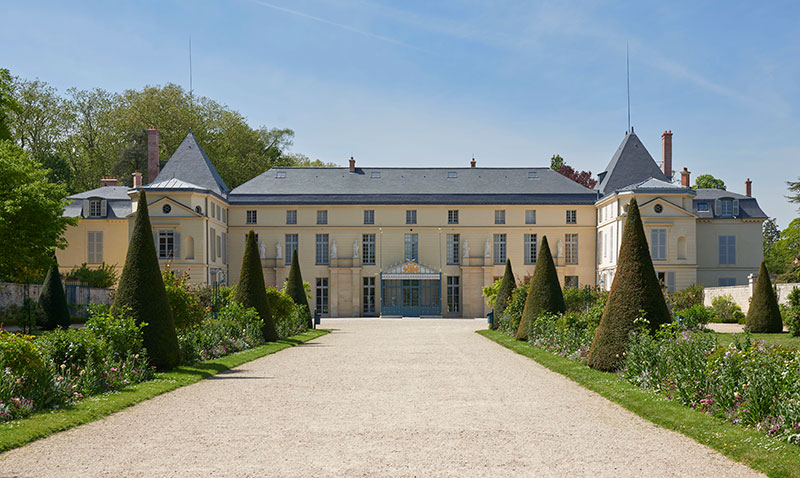
Rueil-Malmaison (Hauts-de-Seine). While the paths of the Château de Malmaison are adorned with colorful flowers, a more lasting change is emerging: the restoration of the exterior of the building. For a little less than four years, from October 2022 to April 2026, the residence which belonged to Joséphine de Beauharnais (1763-1814), first wife of Emperor Napoleon I, underwent an in-depth renovation. Degraded roofs and frames, doors and windows in poor condition, frames that have become leaky, etc.: “the aim of this project was firstly to ensure the restoration of the enclosure and the roof”, summarizes Élisabeth Caude, director of the Malmaison and Bois-Préau castles. Under the leadership of the architect François Jeanneau, and under the project management of the Operator of heritage and cultural real estate projects (Oppic), the interventions were structured in successive phases: the north pavilion in 2023, the south pavilion in 2024, then the central part in 2025. All while certainly adapting the tour circuit, but without closing the castle however. “A true feat”, welcomes Élisabeth Caude. With a total cost of just under 14 million euros, entirely financed by the Ministry of Culture, the project also included the restoration of ornamental elements. Those of the sculptures, but also that of the entrance pavilion signed Charles Percier (1764-1838) and Pierre Léonard Fontaine (1762-1853), an architectural evocation of the imperial military tent, whose trimmings, crosspieces and golden metal cabochons have regained all their brilliance.
But the most visible transformation concerns the facade, whose cement covering has given way to a pale yellow plaster. The previous coating, which imitated cut stone work, had deteriorated significantly since its installation in 1936. “We had to treat the skin of the building. Not only because this cement coating was unsightly, but also because it favored the trapping of humidity in the walls and therefore the rise of capillaries. explains Élisabeth Caude, adding that this “threatened the interior decorations of the house”,starting with the graceful Pompeian dancers who have adorned the walls of the dining room since consular times.
A recourse to iconographic sources
In addition to ensuring better conservation, the new facade of the castle responds to a concern for historical authenticity. The motto: restore the Château de Malmaison to its period appearance, from the time when the residence, after being acquired by Joséphine Bonaparte in 1799, served as a residence for the First Consul and his wife, but also as one of the seats of the French government between 1800 and 1802. A rigorous work of study and comparison of the existing representations of the facade began: the watercolors of Victor Jean Nicolle (1754-1826) thus constitute valuable sources for reconstructing the original state. In accordance with these drawings, the facade now alternates longitudinal joints and smooth coating in places. The frames only have large tiles on the ground floor, according to the installation at the time for economic reasons. “We did not try to imagine a dreamed, accomplished Malmaison. The goal was to try to transcribe the iconographic documents into reality, with visual relationships that are aesthetic. insists Élisabeth Caude.
This same ambition guided the choice of color for the facade, similar to that of Nicolle’s watercolors. Here again, a little investigative work was carried out. “We have ruled out, by deduction, the painting painted by Pierre Joseph Petit (between 1802 and 1807) which showed a slightly more yellow color. The shadow surrounding the small figures suggests that the scene takes place at sunset, giving the facade an orange effect which did not reflect reality. argues Élisabeth Caude. A reality which therefore takes precedence over fantasy.