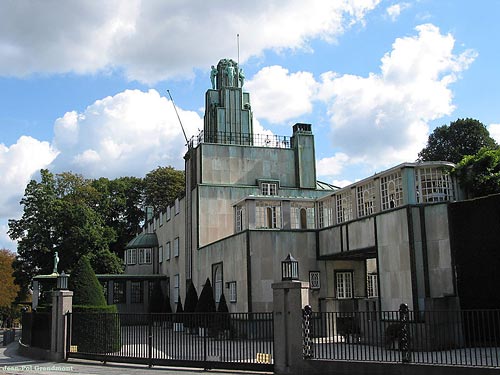
Brussels (Belgium). Since 1911, the Stoclet Palace, Josef Hoffmann’s masterpiece, has stood majestically on the edge of Avenue de Tervuren in Brussels, arousing desires and curiosities fueled by the fact that the general public, or even lovers of art and architecture, have never been able to open its doors to admire the furniture of the Viennese master and the frescoes of Gustav Klimt. The sumptuous residence has no longer been inhabited since the death of Baroness Anny Stoclet in 2002. Listed in 1976 (and the garden in 2005) and listed as a UNESCO World Heritage Site in 2006, the only building still intact from Josef Hoffmann and the Viennese secession has been the subject of countless legal conflicts around the irreconcilable notions of heritage interest and law to private property. In April 2024, the Brussels authorities thought they had won a round in the conflict between them and the branch of the family, which now owns the site, by publishing a regional order imposing “to occasionally (15 days per year) open exceptional properties to the public, namely properties included on the UNESCO World Heritage list”, aiming without saying it at the Palais Stoclet.
Openness prevents “peaceful enjoyment”
This is without taking into account the stubbornness of the owners who filed an appeal to annul this decision before the Constitutional Court. In its judgment 72/2026, it has just annulled the order of the regional authorities. If the Court emphasizes that the desire to make heritage more accessible to the public is indeed in the general interest, it also specifies that the obligation to be open to the public could, in practice, complicate the conservation of this exceptional property by exposing it to the risk of material damage.
The Stoclet Palace in Brussels.
The Court also considers that the partial opening of the property prevents its “peaceful enjoyment and habitual use by its owner”. It then indicates that the physical presence of third parties in a property potentially intended for purely private use could prevent the owner from maintaining social and family relationships there. Furthermore, the Court notes that the Brussels legislator would not have considered the existence of less restrictive measures such as a virtual visit. Which is, to say the least, prickly given that the family had, initially, attempted to prohibit the presentation of a virtual tour of the Stoclet Palace, in the exhibition dedicated to Josef Hoffmann at the Royal Museums of Art and History in 2023. Finally, the Court questions the fact that half of the revenue from the tours that the order provided for to be returned to the owner is reasonably proportionate to the disruption of enjoyment or possible loss of value imposed on it. Brussels Secretary of State in charge of Heritage, Ans Persoons takes note of the decision hoping that dialogue and trust will make it possible to find a solution, “so that one day, with respect for all stakeholders, this treasure of Brussels heritage can finally open its doors to the public.”