Construction on the new White House reception room can continue. On August 21, the President of the Supreme Court, John Roberts, temporarily suspended the entry into force of a decision of the federal court of appeals in Washington which was to interrupt the above-ground work. This administrative measure does not prejudge the decision that the high court will take on the emergency appeal filed by the Trump administration. However, it allows companies to continue a project that the White House claims to already be around 65% complete.
The legal battle began after the demolition, in the fall of 2025, of the east wing, which must be replaced by an 8,400 m² building. The National Trust for Historic Preservation, an organization created by Congress in 1949, took the case to court in December. He argues that the executive could neither demolish part of the White House nor undertake construction of this magnitude without express authorization from Congress.
On March 31, a federal judge ruled in his favor at first instance. According to him, the funds intended for the maintenance and improvement of the presidential residence cannot authorize the reconstruction of an entire wing. He ordered work on the ballroom to stop, while making an exception for those strictly necessary for safety. On August 7, the District of Columbia Court of Appeals upheld this analysis by two votes to one. The judges recalled that a law prohibits the construction of a building on federal lands in Washington without express authorization from Congress.
The Trump administration then went to the Supreme Court, shifting its argument. Originally presented as a large reception hall avoiding the installation of tents during state dinners, the project is now described as an integral part of a “military complex” including secure underground infrastructure. The Justice Department maintains that stopping work would compromise presidential security. The National Trust counters that previous decisions authorize the continuation of underground works necessary for safety and accuse the administration of accelerating construction in order to make any rehabilitation materially impossible.
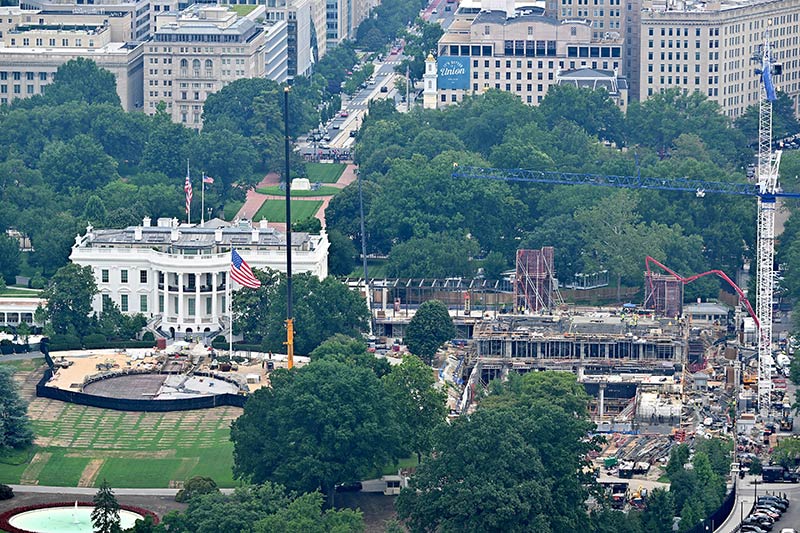
Construction site of the White House ballroom, status of work as of July 10, 2026.
Financing increasingly difficult to sort out
The legal procedure joins a second controversy, this one financial. When the White House announced the project a year ago, it estimated it at around $200 million (a little less in euros) at no cost to the taxpayer: funding is provided by Donald Trump and private donors, with the “Secret Service” (the service in charge of the President’s security) having to take charge of the security adaptations. The publicly put forward cost then rose to 300 then 400 million dollars.
But internal documents from Clark Construction, a major American construction group responsible for the site, obtained by the Washington Post provide another measure of the project. An estimate from March 5, 2026 put the entire operation at 600 million dollars thus financed: 293 million from private sources, 155 million from the Secret Service, 149 million from the White House Military Office and 3 million from the Executive Residence. Or a little more than half coming from public funds. The White House maintains that the 400 million corresponding to the reception room is covered by Donald Trump and his donors, and that the federal appropriations only concern security.
An investigation published on August 12 by the Washington Post further expanded the scope. According to budget documents consulted by the daily, the administration plans at least $927 million in work on the White House grounds: East wing, new visitor control center, heliport and developments at Lafayette Square in particular. Most of it would be financed by public funds. It is therefore not a question of the cost of the ballroom alone, but these arrangements complicate the separation between the room financed by donations and the infrastructures associated with it.
Private financing itself raises questions. The White House communicated the identities of several dozen companies, billionaires and foundations that contributed to the project, without making public the amount paid by each. Public Citizen, a major American public interest and consumer advocacy organization established in 1971, calculated in June that 14 of the 27 corporate donors then identified had obtained, in the previous six months, more than $50 billion in federal contracts. This disturbing observation does not prove that there are quid pro quo, but fuels demands for transparency on a system combining private sponsorship, public procurement and executive decisions.