Lyon. The Lyon Biennale is, by its age, its notoriety, its attendance and its geographical deployment, one of the major events devoted to contemporary art in France. This 18th edition, entitled “Moving from one dream to another”, is the last supervised by Isabelle Bertolotti as artistic director, before her retirement. She entrusted the curatorship to Catherine Nichols. From the work carried out by this art historian as curator of the traveling biennial “Manifesta 14”, in Pristina (Kosovo) in 2022, Isabelle Bertolotti had indeed appreciated the transdisciplinary approach in connection with the City. Because if the Lyon Biennale, with this year 120 artists of 42 nationalities, claims an international dimension, it also wants, she reminds, “anchored in the territory”. Of nearly 400 works to be seen in eleven locations across the metropolis (including three main ones: the Grandes Locos, the macLYON and the Fabric Museum), more than half are either new commissions or specific adaptations. In addition to the number of visitors it attracts (around 280,000 for the previous edition), it is in fact the capacity of the event to produce new pieces that allows it to appear in the world’s Top 10 events of comparable format – in the same list as the Venice, Whitney, Gwangju, Sharjah Biennials, etc.
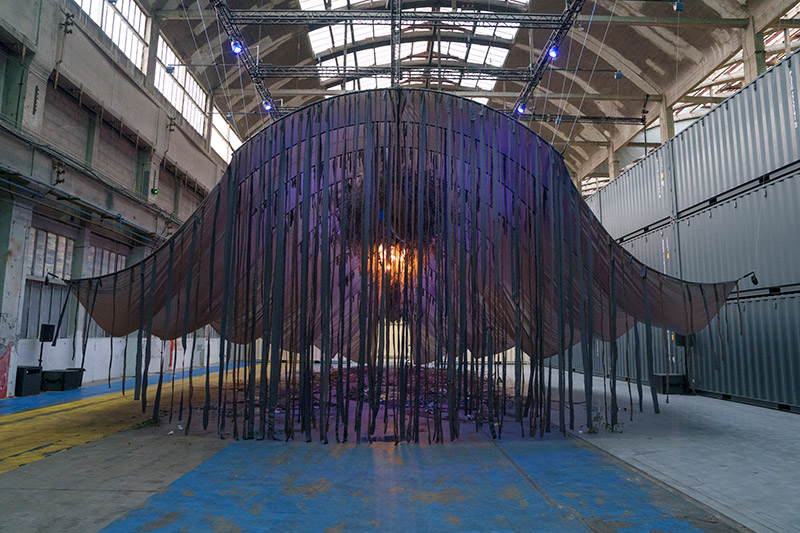
The 2024 edition, curated by Alexia Fabre, left its mark with the creation of the immersive installation Resonance Project: The Cave, by Oliver Beer, in perfect harmony with the place and its audience. This time, no emblematic flagship work seems to impose such obviousness. The Biennale, however, includes several monumental pieces. And even if it does not have the premiere of its creation (in 2022, at the Horst festival, in Vilvoorde), the ghostly whale by Laure Prouvost (Hovering Caress Bitter) (see ill.), full of mystery and ambivalence, gives it great energy at the start of the journey. Also at Grandes Locos, in the complex technical performance category, the architecture orchestrated by Joël Andrianomearisoa occupies nearly 600 square meters, assembling more than 40 kilometers of wires and ropes from around twenty cities linked to his life and work. The scale of the installation corresponds to that of the former railway workshop, while recalling the textile history of Lyon and encompassing it within a larger geography.
Mette Sterre, for her part, imagines a sort of giant diorama of office life, populated by mannequins wearing masks teeming with elastic bands (see ill.). During the activations, visitors will be invited to race through this strictly banal setting on wheelchairs on wheels. Further on, the monstrous electronic maze composed by Akwasi Bediako Afrane (Dance of Dialogue) attracts attention with the ingenuity of its device and its DIY side, inversely proportional to its excess. The installation, which anyone can start by pedaling a bicycle connected to its cable circuits, integrates into its production a collaborative dimension, which is found elsewhere in this edition and which is one of its common threads. Several pieces in fact involve the public right down to their production.
18th Lyon Biennale of Contemporary Art, Les Grandes Locos: Mette Sterre, Hummelmania Paradise Extreme Dreams Depend on Teams2026, mixed media.
© Blandine Soulage
This is the case, for example, of that of Kokou Ferdinand Makouvia: the artist delivers one of his most spectacular installations to date to the Fabric Museum, where he occupies an entire room. Combining high, immaculate walls of cut cardboard with copper and clay suspensions and large ceramic shapes, he creates an organic landscape open to the vibrations of the material shaped by anonymous hands. As for the choral audiovisual installation We Are Together Becauseby Mikhail Karikis, it is the result of a two-year project with a group of Portuguese teenagers on the occasion of the 50th anniversary of the Carnation Revolution. Finally, still at the Fabric Museum, of which it occupies a vestibule, Mercedes Azpilicueta’s colorful playground stimulates the playful imagination of 7 to 77 year olds, while questioning the rules of sharing public space.
Sharing places to invest
In each of the three main exhibition locations, visitors will also find a space called “The Permanent Party”, in reference to Robert Filliou and his idea of art as a collective process, placing friendship, exchange and shared activity at its center. Furnished with second-hand furniture, these spaces, decorated with large Cyan collages, will host conversations, performances, meetings with artists… according to a deliberately flexible program. At Grandes Locos, the exhibition curator An Paenhuysen (founder of The Boxing Gallery, dedicated to happenings), will thus develop with the National School of Fine Arts of Lyon (Ensba Lyon) a “Department of Filliousophy” open to the public. “ The idea is to create places that people can use quite freely and spontaneously, rather than a program that they just consume.”underlines Catherine Nichols.
It remains to be seen whether the formula will take beyond the seduction of the story. With a literary background, the brilliant Catherine Nichols has no equal when it comes to putting into words intentions whose implementation can prove disappointing: such as the inflatable sculptures by Monira Al Qadiri, supposed to reproduce the molecular structures of petrochemical compounds, suspended at the Musée des Confluences. The Biennale also fails to establish itself in public spaces, undoubtedly more constrained in Lyon than in Pristina, where Catherine Nichols knew how to invest them so well. The intensity of this edition thus varies throughout the course. And it is ultimately in the context of the museum that it shows itself in its best light. At macLYON, strong images are born thanks to careful scenography and happy connections, for example between an artist and the collections of the Musée des Confluences. Like this dialogue on the threshold of the world of the living between the paintings and sculptures of Pol Taburet and a gallery of taxidermied owls. The emotion is then there.
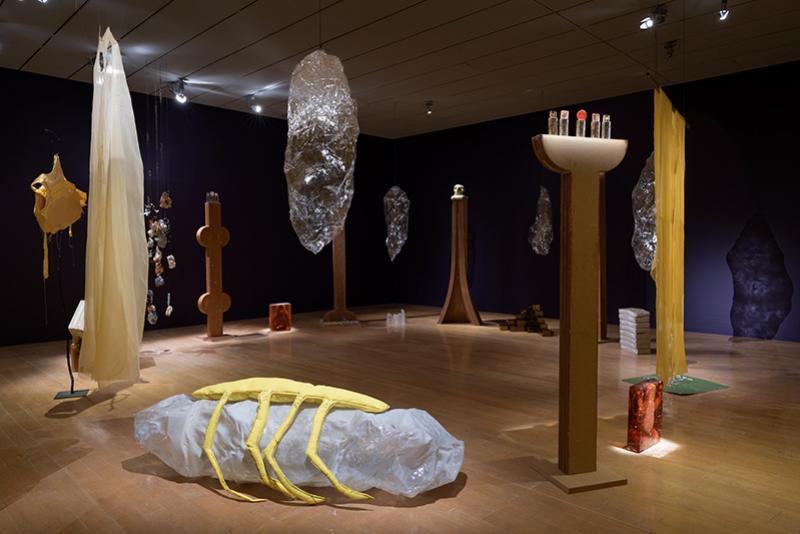
18th Biennale of Contemporary Art of Lyon, macLYON: Mikala Dwyer, The Divisions, Subtractions and Additions: Session for the Spiderworms2026, wood, plastic, resin, bronze, ceramic, insects, silk and silicone,
© Blandine Soulage
© Adagp Paris 2026