An Argentine resident in Berlin, Tomás Saraceno trained in Architecture and Art in Buenos Aires, Frankfurt and Venice and has been exploring the relationship between the contemporary individual and the environment for several decades, not from the belief that his work helps change the world, but from the conviction that creation can generate alliances and interactions with other disciplines that contribute to promoting knowledge and respect for nature.
Two decades ago he set up his studio in Frankfurt and in 2012 he moved it to Berlin, which was home to the former AGFA photographic paper factory; there he has given shape to some of his most famous projects, such as Air-Port-City/Cloud Citya utopia of flying metropolises composed of habitable cell-like platforms that migrate and recombine as freely as the clouds themselves. They are part of their analyzes on the possibility of a future aerial existence and have generated an international community that includes creators and professionals from very diverse areas who work for the creation of contexts free of borders and fossil fuels; is called Aeroceneand with his help Saraceno managed, a few years ago, to achieve the world record for the first and longest manned flight powered solely by solar energy.
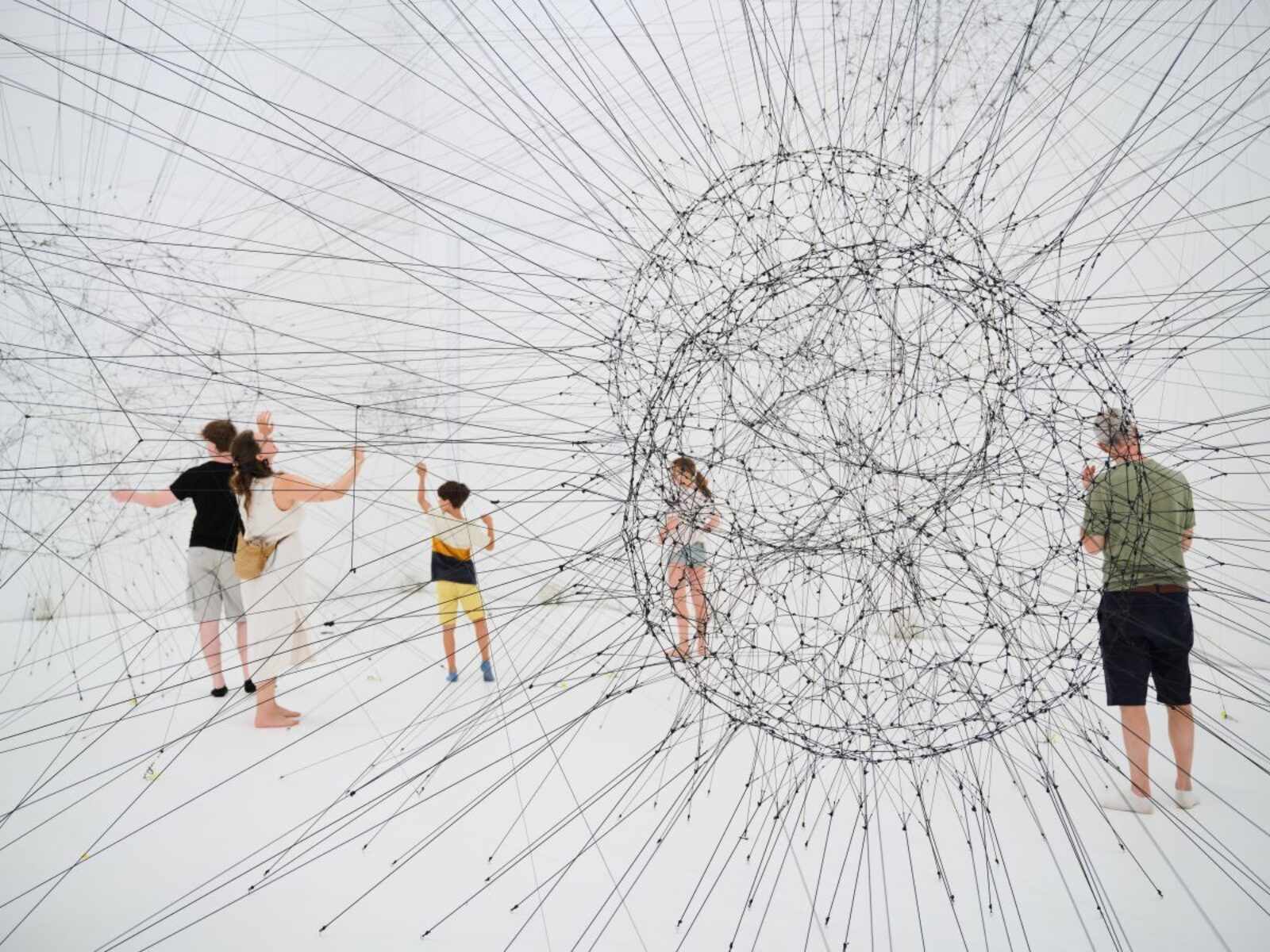
These developments are not unrelated to this author’s deep interest in spiders, which has led him to create an entire department in his workshop for the research of these animals and to use spider webs as material for his pieces, delving into the process involved in making them and the possibilities of their expansion.
Tomás Saraceno. Ancestral Futures. Haus der Kunst. Photography: Agostino Osio
Haus der Kunst now traces a journey through his career in the exhibition “Ancestral Futures”, which can be visited until February of next year and, in addition to dissecting those long-term investigations into spiders and aerial life, incorporates a piece linked to the purposes of land art that will be permanently installed in this center: The water sanctuaryalso carried out collaboratively, together with the indigenous communities of the Salinas Grandes, in the northwest of Argentina.
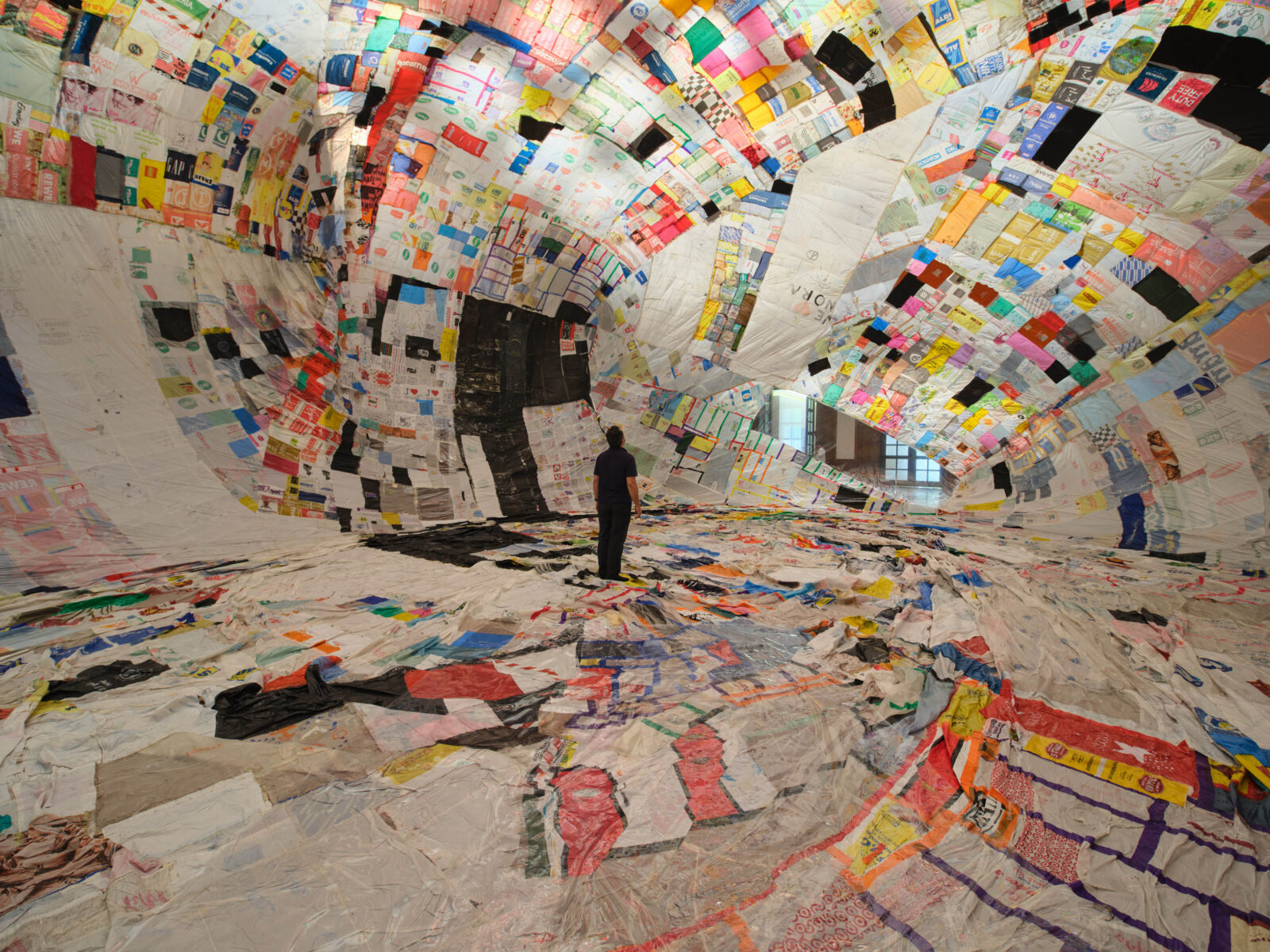
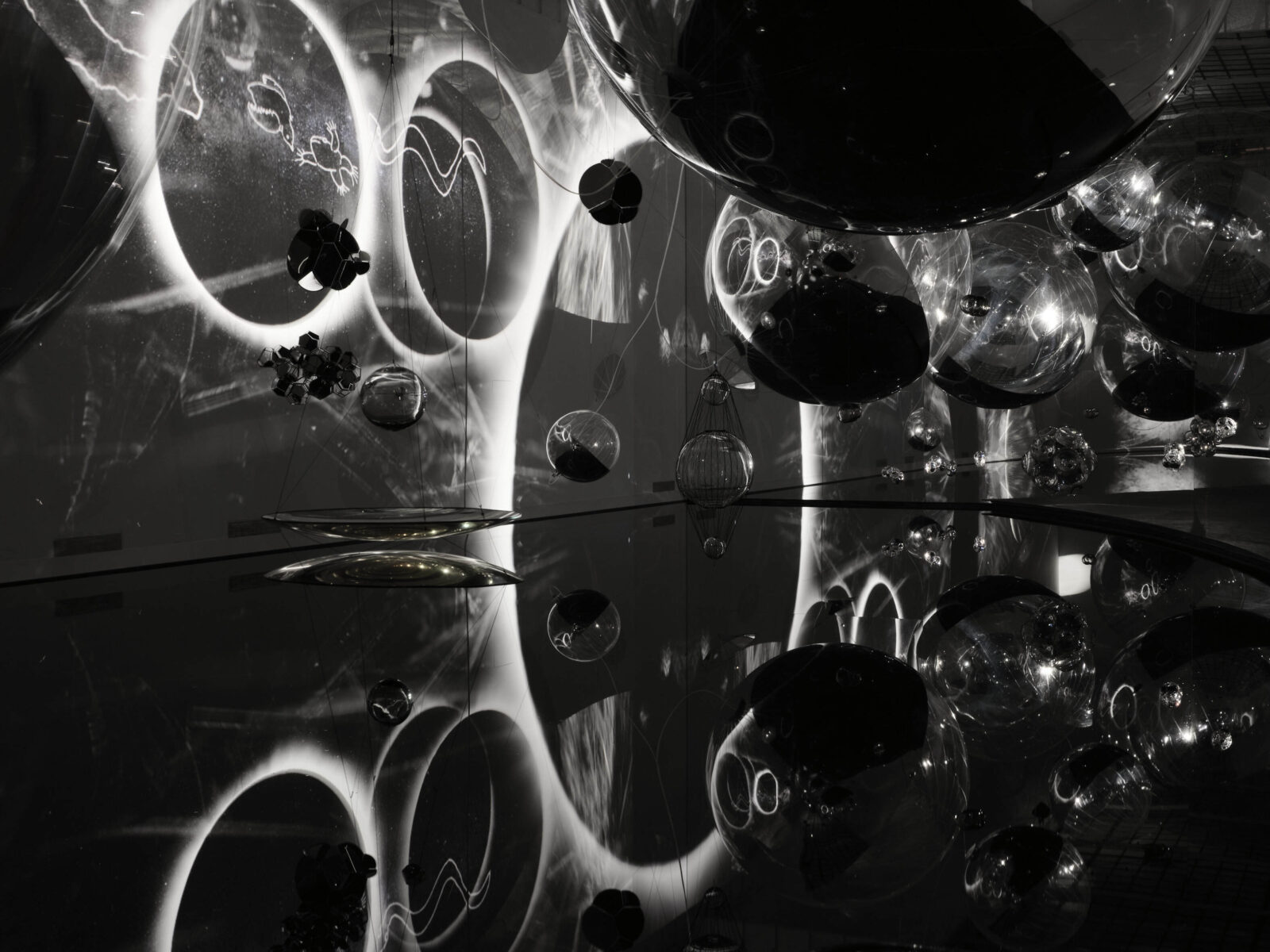
The exhibition, which extends throughout the building that houses this Munich museum, includes air-powered sculptures, multispecies habitats and spatial environments that transform the experience of the rooms by the public, invited to reconsider the ecological and social forces that participate in the current energy transition. The sculptures made by the members of Aerocene They use air, solar radiation and infrared energy to imagine new forms of life on Earth not dependent on fossil fuels, while the works integrated into their proposal Arachnophilia They examine the material, behavioral and acoustic systems of different species, based on this long-term research on the structures woven by spiders.
It is not the first exhibition at Haus der Kunst in which the works are not only arranged on floors and walls. In 2023 and at the “Nebel Leben” exhibition, Fujiko Nakaya made a mist of fog descend from the roof and filter through the windows so that the outside world penetrated the building and the interior of the center overflowed; On this occasion, the German spiders have also played their part in the preparation of this initiative. What started as a hands-on exchange—finding spiders living there for the installation Ride a Wind and Draw a Line— gave rise to a broader dialogue between the institution and the artist about vibrations, permeability, and about the possibility of conceiving a temporary exhibition as a network of relationships rather than as an ephemeral architecture composed of works of art and information.
Tomás Saraceno. Ancestral Futures. Haus der Kunst. Photography: Agostino Osio
This museum had been considering for some time how to ensure that visitors also got to know the center through experiences that accumulate over time and remain active long after the visit ends. If a traditional art collection preserves objects, the objective now was to try to build something more intangible: a collection of experiences and memories, that viewers can carry in their memories after attending exhibitions, concerts, performances, sounds, conversations… and that they may reactivate. In this sense, memory itself becomes a medium that interacts with an architectural body that unfolds like an archive, but which is actually a score.
And few artistic practices have delved into the links between memory, the transmission of knowledge and their interconnection like Saraceno’s, which is why “Ancestral Futures” starts from a simple premise: everything is connected. The Argentinian has navigated between networks (literal and figurative), atmospheric systems, aerosol structures and collective forms of organization as ways of understanding how relationships produce meaning from these links; The title of the exhibition suggests, therefore, that futures are not invented out of thin air: they arise from inherited knowledge, existing connections and our ability to glimpse forms of coexistence that have often gone unnoticed.
Whether working with spiders, scientists, architects, environmental activists, or, increasingly, with native communities, Saraceno always returns to the same question: what can be perceived when we shift our attention from individual entities to the relationships that sustain them? Much of his work suggests that the most significant forces often remain invisible and this exhibition finds one of the clearest expressions of this in Algo-r(h)i(y)thms (2019), installed precisely where the fog of Nakaya dissolved the distinction between architecture and landscape.
Developed through long-term exchanges with researchers working in bioacoustics and animal behavior, this installation is inspired by the sensory world of arachnids: visitors walk through a network of suspended ropes that functions as a vibrational environment, emphasizing how they engage in a world organized through vibration, rather than through sight. For spiders, vision plays a secondary role: they perceive through oscillations that travel through their webs; For them, these are a sensory organ, a way of knowing the environment through oscillation. This project translates that condition into a unique form of bodily perception, inviting visitors into a world where experience depends on resonance and transmission, and also offers a key to interpreting the exhibition: each work of art, and each body of knowledge, acquires meaning through its link with the rest. What seems separate is revealed to be embedded in a whole.
“Ancestral Futures”, likewise, seeks to test a different exhibition syntax: the works of art are interspersed with rooms dedicated exclusively to knowledge, so that scientific research, indigenous knowledge, environmental realities and community testimonies inhabit spaces of the same scale and importance as the works themselves. These rooms do not offer contextual information or complementary teaching material, but rather function as interpretive enclaves, with the galleries as extended wall texts. Thus, one room can illuminate a work of art seen in previous rooms and another can change the meaning of what comes next. Knowledge is woven into the very structure of the exhibition.
As for the Water Sanctuaryit was devised through assemblies and collective decisions and its future will belong to those who imagined it together. The exhibition, in short, questions what we can perceive when we stop observing isolated objects and start paying attention to the links between them, not always evident but never absent.
Tomás Saraceno. Ancestral Futures. Haus der Kunst. Photography: Agostino Osio
Tomás Saraceno. «Ancestral Futures»
HAUS DER KUNST
Prinzregentenstraße 1
Munich
From July 17, 2026 to February 7, 2027