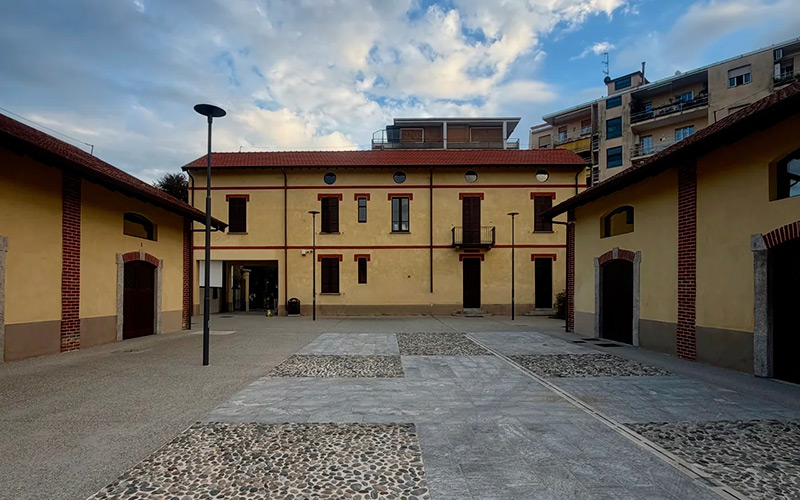
Housed in the former slaughterhouse in the town of Arona, in Piedmont, the Fanny Usellini Museum of Modern and Contemporary Art opened its doors on September 26. The project was born from a donation from the daughter of the painter Gianfilippo Usellini, who lived in Arona, to the municipality. The collection of 556 works, sculptures and paintings, constitutes the funds of this new museum.
In preparation since 2019, the museum was an opportunity to convert the unused buildings of historic slaughterhouses, built in the 20th century. The project required 2.2 million euros, financed by the Cariplo Foundation to the tune of 900,000 euros. 570,000 euros were contributed by the Piedmont region and the rest was financed by the city, “without resorting to debt”specifies Mayor Alberto Luigi Gusmeroli.
The 1,770 m2 plot includes outdoor spaces, which the museum intends to take advantage of. Following a multidisciplinary vocation, concerts, festivals, film screenings and artistic and educational workshops are planned. Presented as a “social inclusion hub”the museum also includes a café-restaurant employing people with disabilities.
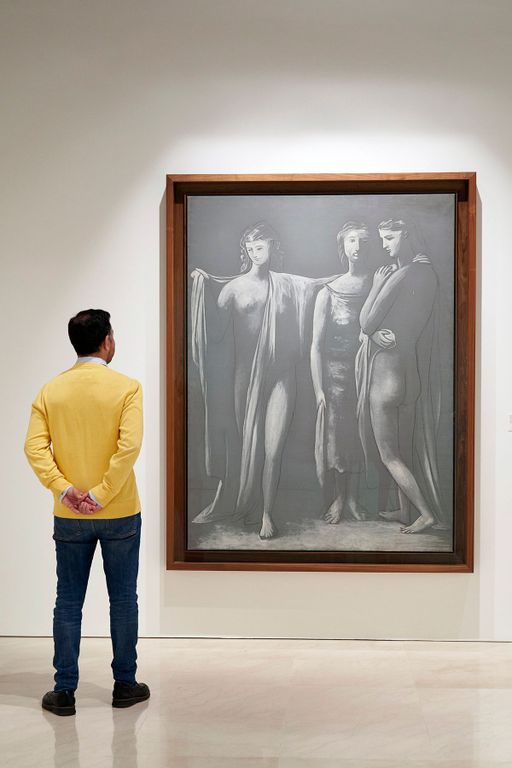
In addition to the works of Gianfilippo Uselini, the Uselini collection covers the entire 20th century. It gives pride of place to Italian futurism, with works by its founder Filippo Tommaso Marinetti, but also by some of its members such as Francesco Cangiullo or Ugo Giannattasio. The surrealists were not left out, represented in particular by Salvador Dalí and Giorgio de Chirico, but also by the couple Bruno Capacci and Suzanne Van Damme. Andy Warhol and Marc Chagall are also among the headliners. A number of African art objects are also among the donations.
However, despite the big names, the total value of the donation, around 1 million euros, suggests that it mainly includes secondary works. Gianfilippo Usellini (1903-1971), born in Milan and died in Arona, trained at the Brera Academy, where he then taught decoration and frescoing. Close to the Italian Novecento without having formally joined the movement, he developed a painting nourished by metaphysics, magical realism and references to the Quattrocento. Painter but also fresco artist, mosaicist, illustrator and scenographer, he participated in the Venice Biennale in 1926 and created several large public decorations. His family owned a house in Arona, where he stayed regularly before moving there during the war and dying there in 1971.