Aix-en-Provence (Bouches-du-Rhône). Paul McCartney was not referenced until now for his photographs. At least in France. No more, Park Chan-wook. “Paul McCartney. Photographer, 1963-64: Eyes of the Storm” at the Granet Museum, in Aix-en-Provence, and “Park Chan-wook. On a Calm Morning”, at the Lee Ufan Foundation, in Arles, reveal their practice of the medium and question, in turn, the reasons and the interest of their images as of these two exhibitions with different content and register.
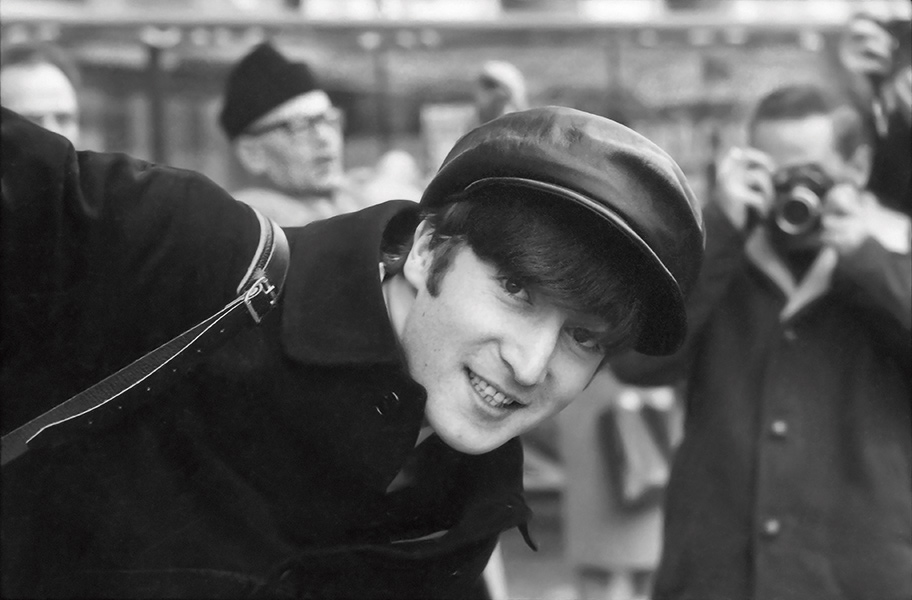
McCartney’s photographs document the Beatles’ first international tour, which began in December 1963 in Liverpool, continued in London then Paris, and ended in the United States, New York, Washington and Miami in February 1964. Kept for nearly sixty years in the songwriter’s personal archives, the negatives and contact sheets emerged in 2020 as part of the preparation of a monograph dedicated to his wife, Linda McCartney, photographer of the rock scene. Anglo-Saxon, disappeared in 1998. “These photos had never been printed. Only a few had been shared publicly, notably that of a contact sheet appearing on the poster designed by Richard Hamilton in 1968 for the “White Album, The Beatles”. When Paul McCartney and his team approached the National Portrait Gallery in London with an offer to exhibit some of the photographs, it was immediately apparent that this was an exceptional body of work, of great historical and cultural value, in need of a larger-scale exhibition.says Rosie Broadley, chief curator and director of the museum’s 20th century collections. In 2023, the exhibition inaugurated the reopening of the institution.
Its recovery by the Granet Museum therefore reveals Paul McCartney, an amateur photographer, capturing with a newly acquired Pentax 35mm, what caught his eye during this tour. Portraits of John Lennon, George Harrison, Ringo Starr and their entourage, scenes in hotel rooms or in dressing rooms, or even in the streets of Paris or New York, seas of groupies and professional photographers, form a tender and mischievous diary of the group and the enthusiasm it provokes. A few self-portraits and portraits of Paul McCartney slip in, the camera moves between them. An era, a youth are told. In Florida, the choice of color film prints the discovery of the sun and the blue of the Miami sky and the moments of relaxation by the swimming pool or the ocean. From Liverpool to Miami, the aesthetic of the snapshot evolves, takes more freedom in its framing and reserves some very beautiful photos. Paul McCartney finds the answers to his technical questions among the professional photographers who follow him. Above all, his images have the value of unpublished documents, living testimonies that are reinforced by the curatorship and the scenography of the exhibition. His interest in photography dates back to childhood, the first camera acquired by the family, his practice of the medium with his younger brother who would become a professional photographer and images published in the press. His approach remains that of an enlightened amateur.
Park Chan-wook, Think DeepMarch 2024, Paju, Korea.
© Park Chan-wook
An aesthetic approach
Park Chan-Wook’s first photo exhibition in Europe reveals a whole new world. The photographs selected, taken between 2012 and 2025 in parallel or during filming, go beyond the simple documentary approach and demonstrate a true aesthetic and professional approach: from the ordinary – a landscape, a tree, a fish market, a captured face – emanates a strangeness, a mystery which catches the eye, holds it. Parasols folded and grouped together forming an assembly of ghosts; tarpaulin covering who knows what in the sculptural form of a Pietà; bouquet of flowers wrapped to the point of suffocation in a cellophane film… the imagination is challenged, the interpretation open.
For the South Korean director, screenwriter and producer, president of the jury of the last Cannes Film Festival, photography is a solitary exercise which “obeys instinct, chance and accident”. “ My photographic work consists of trying to find, or discover, beauty in things that are completely useless, in landscapes that people don’t pay attention to, or, for example, in anything that is completely abandoned in a corner, he specifies. This work is completely different from my work as a filmmaker, because I don’t touch anything in my photographs. » The content itself differs. “No scenes of sex, violence, cruelty or class struggles, unlike in his films”notes Valérie Duponchelle, curator of the exhibition. Park Chan-Wook says he “ began photographing seriously in 1982, when, as a student, he joined the university’s photo club.. He continued discreetly, not without talent. In color or black and white, the accuracy of the framing and composition – combining shapes, light, material and texture – confirms a seasoned eye which seduces, imprints a way of seeing and places the filmmaker among those who are also photographers like Wim Wenders. Recently, exhibitions and books in South Korea have highlighted this little-known part of the author of Old Boy, Decision to leave andNo other choice. The exhibition in Arles makes you want to unwind the thread from the beginning.