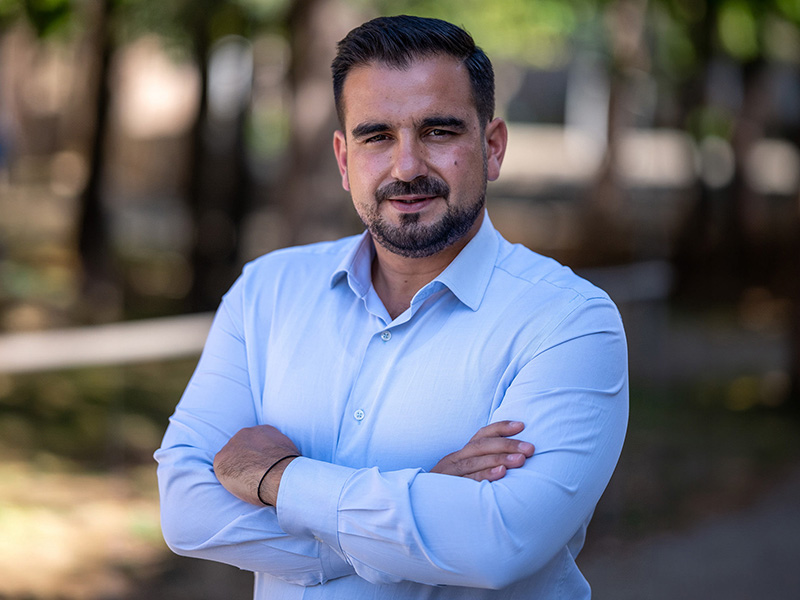
Benoît Jimenez (37 years old) grew up in Garges-lès-Gonesse, where he did all his schooling. Former educator and president of the local football club, he joined the UDI in 2012, became deputy mayor in 2014, then mayor in 2020. Re-elected in 2026, this center-right elected official is also regional councilor of Île-de-France and vice-president of the Roissy Pays de France conurbation. In 2025, Dominique de Villepin chose him to chair his movement, Humanist France.
Your predecessor was at the origin of the gathering in this place. What was its objective, and what state was the project in when you arrived in 2020?
The building project aimed to add new equipment to the historic performance hall, which dates from 1995, including a cinema, a multi-purpose room, the conservatory and theater rooms. When I become mayor in June 2020, the work ends. But I wonder: what ambitious cultural project to install in these almost brand new 10,000 m²? There was indeed a project, but absolutely nothing was budgeted. How many more agents? How much will this cost? And above all, what consistency should be given between the equipment? None of this had been decided.
What was your ambition for this equipment?
I really wanted to use this place, these facilities combined into one, as an element that transforms the city. I also wanted to make culture a transformative element in the development of Garges-lès-Gonesse. I didn’t want to make this flagship just another “house of the arts”. The ambition was to develop something that could speak to the inhabitants of the region, and to young people in particular.
How did you meet Nils Aziosmanoff, and what role did he play?
I met Nils Aziosmanoff, who chaired Le Cube in Issy-les-Moulineaux and who had demonstrated this ability to make several disciplines interact with each other. I was quite captivated by his way of hybridizing subjects. I was convinced that this would please the population of Garges. The digital subject and digital arts make it possible to bring people in.
What are your main reasons for pride today in relation to the results of the Cube?
In the first year, we had 50,000 visits. Today we are almost double, with 90,000 visits per year. My great pride is to see all these children who come to the Cube, with schools or associations. It is a real place of sociological mixing. When I’m at the Cube, I sometimes hear young people say: “We come and stay at the Cube”. I find this term extraordinary. It’s an environment where you feel good. We have also debunked the preconceived idea that facilities are degraded in working-class cities: the public takes great care of them and is extremely respectful.
Precisely, during the riots in the summer of 2023, how did residents react around the Cube?
The same evening of the riots, when the city hall was burned, we feared that Le Cube would be targeted. Rumors were circulating. And spontaneously, that same evening, late in the afternoon, residents came to stay all around the equipment to protect it. During my wishes for the year 2024, I honored them in front of eight hundred people.
Dominique de Villepin, whose “Humanist France” movement you chair, came to visit Le Cube Garges. What did he think of it?
Dominique de Villepin was quite impressed by the social character of the cultural subject. He sought to see how to renew culture so that it does not belong only to a few, and how to make “culture for all and by all” a reality. At Cube Garges, he found a place where research, artistic expression, economy and ecology intersect.