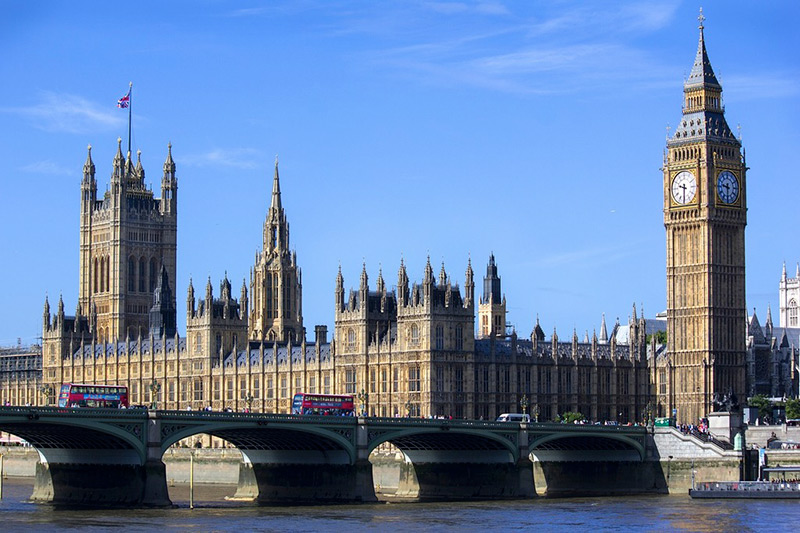
Every year of delay in renovating the Palace of Westminster could cost up to an extra £420 million (€503 million), the Public Accounts Committee warns (Public Accounts Committee) from the House of Commons in a new report released on November 4. The deputies denounce the persistent inability of parliamentary officials to decide on the terms of the construction site, while the state of deterioration of the building, seat of the British Parliament and part of a UNESCO world heritage site, poses increasing risks to its occupants. The report mentions in particular the possibility of a major fire, likely to compromise the functioning of the institutions.
The work has been the subject of studies for several years. On February 5, 2026, the Restoration and Renewal Client Boardan organization bringing together representatives of the two Chambers, has published financial estimates for four renovation scenarios. Two of them are now being offered to parliamentarians for further study. The first provides for the complete evacuation of the palace during a large part of the work. Its cost is estimated between 11.1 and 15.6 billion pounds (13.3 to 18.7 billion euros), for a duration of 19 to 24 years. The second, which would allow part of the parliamentary activities to be maintained in the building, would last from 38 to 61 years and would cost between 19.5 and 39.2 billion pounds (23.4 to 47 billion euros). These estimates, still preliminary, include future inflation and significant provisions for risks.
These amounts are incommensurate with the approximately 700 million euros devoted to securing and the first phases of restoration of Notre-Dame de Paris after the fire of 2019. But their breakdown, detailed in the report last February, reveals that heritage conservation only represents a fraction of the expense. In the complete evacuation scenario, the base cost of the program amounts to 6.4 billion pounds (7.7 billion euros), including 3.8 billion (4.6 billion euros) for work directly carried out in the palace, excluding provisions for risks and inflation.
The Palace of Westminster in London.
Of this last envelope, the restoration of the historic structure, masonry and decorations is estimated at 748 million pounds (896 million euros), or 20%. The replacement of technical installations, on the other hand, represents 1.75 billion pounds (2.1 billion euros), or 46%. The building notably includes 23 kilometers of pipes and some 400 kilometers of electrical cables, a large part of which is dilapidated and difficult to access. Fire protection would require 446 million pounds (534 million euros), health and safety work, particularly linked to the presence of asbestos, 245 million pounds (294 million euros), and improving accessibility 298 million pounds (357 million euros).
To these expenses are added the costs of preparing the building and assisting with the work, estimated at 1.2 billion pounds (1.4 billion euros), as well as 762 million pounds (913 million euros) for the management of the program, still in the complete evacuation scenario.
Maintaining parliamentary activities in the palace would considerably complicate interventions, by imposing work in stages, with security and operational constraints. Above all, the duration of programs amplifies the effects of inflation. In the high hypothesis of the partial maintenance scenario, this alone represents 20.5 billion pounds (24.6 billion euros), to which are added 10.7 billion pounds (12.9 billion euros) of provisions for risks and uncertainties.
The November 4 report does not present a new overall estimate for the project. It examines the credibility of the projections established in February and the consequences of the accumulated delays. The vote of the two Chambers on the scenarios to be explored in greater detail and on a first phase of work, initially expected before Easter 2026, has still not taken place. According to Parliament’s administrative officials, its postponement until the end of the year could already add up to 290 million pounds (347 million euros) to the bill.
The committee is also concerned about the increase in incidents and the increase in maintenance costs for the building, currently estimated at 1.5 million pounds (1.8 million euros) per week and likely to soon reach 2 million (2.4 million euros). Fire surveillance patrols take turns day and night in the palace.
MEPs also question the cost and timetable of the temporary installations. The first phase of the program, planned over seven years and capped at 3 billion pounds (3.6 billion euros), includes in particular preparatory work and the development of premises intended for the two Chambers. Moving the Lords to the Queen Elizabeth II Conference Center would require £417 million (€500 million) to adapt the building. The renovation of the northern parliamentary area, intended in particular to accommodate MPs, represents some 2 billion pounds (2.4 billion euros). However, these premises would not be available before 2034 at the earliest, while initial forecasts envisaged evacuation in 2032.
The Palace of Westminster was already ravaged by fire on October 16, 1834, a disaster immortalized by William Turner. Most of the current building was rebuilt in the 19th century in the neo-Gothic style by Charles Barry and Augustus Pugin. Several medieval remains have nevertheless survived, notably Westminster Hall, built at the end of the 11th century under William II, son of William the Conqueror. The palace has hosted parliamentary assemblies since the end of the 13th century and has been the permanent seat of Parliament since the 16th century.
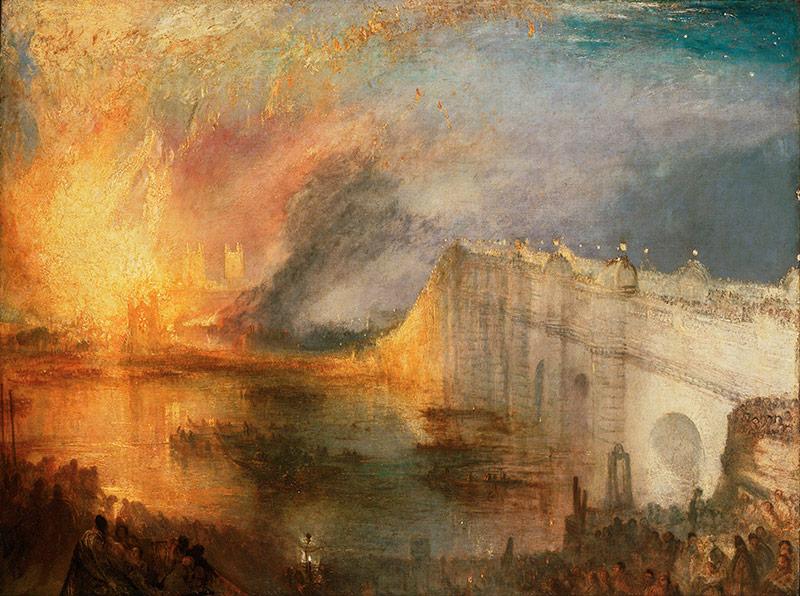
Joseph Mallord William Turner (1775-1851), The burning of the Houses of Lords and Commons, October 16, 1834 (1st version), c.1834-35, 92 x 123 cm, oil on canvas.