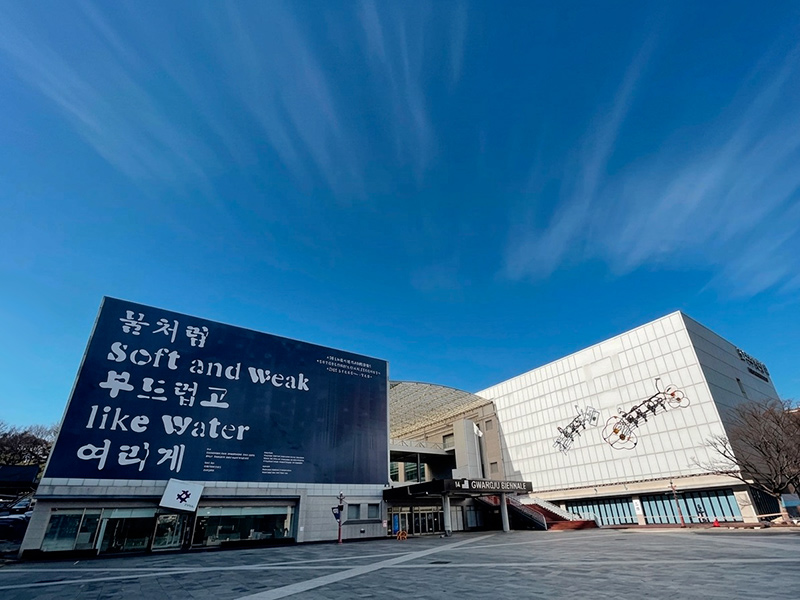
The 16th Gwangju Biennale opens this Friday, September 4 without its Chinese pavilion. The day before, its commissioners announced the withdrawal of their participation to protest against the use of the name “Taiwan Pavilion » by the South Korean organizers. The decision, taken unanimously according to Commissioner Ruan Yuelai, comes after several weeks of reversals around the name given to the Taiwanese participation. The Chinese pavilion, Iron Silk Road, was to bring together 18 artists and collectives.
The origin of the conflict lies in the very status of the Taiwanese flag. Versions differ on the initial agreements. According to the Taiwanese Ministry of Culture, the National Taiwan Museum of Fine Arts (NTMoFA) presented its project under the name “Taiwan Pavilion” and received confirmation of its acceptance on April 2. The participation contract was then signed with the Gwangju Biennale Foundation on April 23, with preparatory discussions continuing to use this name until June. The Foundation disputes this chronology and affirms that a contract concluded on January 12 linked the two institutions within the framework of an institutional pavilion and not a national one.
Despite this discrepancy, the chronology of the name change is now established. After using “Taiwan Pavilion » During preparation, the Foundation begins in June to present the project as the “NTMoFA Pavilion”. The explicit reference to Taiwan then disappears from the demonstration materials.
The dispute becomes public on August 15. The curator and nine Taiwanese artists denounce the change and demand the reestablishment of “Taiwan Pavilion”, believing that the disappearance of the name is a matter of political censorship. Chang Wen-Hsuan, one of the participating artists, interviewed by Le Journal des Arts, contests the administrative explanation put forward by the Foundation: “The Gwangju Biennale simply claimed an administrative error. The situation changed when China intervened. Political censorship – which the Biennale has denied – is therefore obvious”.
Ten days later, another reversal. On August 25, the Foundation agreed to return to “Taiwan Pavilion”. She explains today that she made this decision after accusations of censorship and for fear that the controversy would disrupt the main event. “We wanted to avoid this becoming a diplomatic issue”admitted Youn Bum-mo on the opening day. For Chang Wen-Hsuan, recovery is “the most ideal outcome that we, participating artists and curators, could imagine, especially in the current geopolitical context”.
It is precisely this return to the name “Taiwan Pavilion” which provokes open intervention from Beijing. On August 27, the Chinese ambassador to South Korea, Dai Bing, informed the mayor of Gwangju of his “regrets” and its “concerns”. The next day, the Chinese artists and curators interrupted the assembly of their pavilion. The municipality then tried to appease Beijing: on August 31, it apologized to China for the communication deficiencies surrounding the affair and reaffirmed its adherence to the South Korean policy of “one China”. However, she specifies that the name “Taiwan Pavilion”, used within the framework of the Biennale, does not mean that it recognizes Taiwan as a state.
These assurances were not enough. On September 3, during a press conference at the Ha Jung-woong Museum of Art, Ruan Yuelai announced the withdrawal of the entire Chinese pavilion. The Chinese embassy and consulate indicate that they have taken several steps with the city and the Foundation to obtain its withdrawal.
The affair now extends beyond the artistic field. The visit to Gwangju of a delegation from the Chinese city of Guangzhou, scheduled for September 6 and 7, has been canceled. The city of Zhoushan, Zhejiang, also gave up participating in the Yeosu World Island Expo. The dispute comes as Beijing has for several months intensified its diplomatic and military pressure on Taiwan, over which the Chinese government claims sovereignty.
On the opening day, Youn Bum-mo acknowledged the failure of the conciliation attempt. The general director of the Biennale, who says he hoped for Chinese participation until the last moment, judges the situation “regrettable” and announces a reform of the flag system. The current distinction between national and institutional pavilions, he explained, is likely to produce new ambiguities and will have to be thoroughly revised. The 16th edition this year has 16 national pavilions and 11 institutional pavilions. It lasts for 72 days, until November 5.
The Gwangju precedent is not isolated. In 2002, China obtained the disappearance of the name “Taiwan” from the signage of Taiwanese participation in the São Paulo Biennale by threatening to withdraw. Foreign delegations then lent letters of their own names to recompose the word “Taiwan”. Twenty-four years later, the balance of power was reversed in Gwangju: the name remained, and it was the Chinese delegation that left. Chang Wen-Hsuan attributes this outcome less to official action from Taipei than to external mobilization: “The real force that brought about the reestablishment of the Taiwan flag is global civil society, not the Taiwan government, nor us alone”.