Grenoble (Isère). The Isère Department For several years maintained a relationship of cooperation with south-eastern Senegal where the populations of the “Bassari country” (Department of Kédougou) live, a locality entrance to UNESCO World Heritage in 2012. For this exhibition presented at the Dauphinois museum, associations of Bassari populations have contributed to the choice of objects and the editorial staff of certain texts or cartels, “in a process of usual inclusion in the museum ”
indicates its director, Olivier Cogne. The exhibited pieces come from collections carried out on site, collections from the Quai Branly museum and those of the Théodore-Monod museum from IFAN (Fundamental Institute of Black Africa, Dakar). And two Senegalese commissioners worked at the exhibition with Olivier Cogne, El Hadji Malick Ndiaye (Théodore-Monod Museum) and Aimé Kantoussan (Museum of Black Civilizations, Dakar). The subject is therefore as close as possible to the populations of the Bassari country where communities live “On the sidelines of the rest of Senegal”, According to Olivier Cogne. A geographical isolation which has enabled the continuity of traditions and rituals among these populations, in particular the age classes and their ceremonies of passage: in addition to the ornaments and usual objects, the course includes a device of figurines to be manipulated to understand the age classes in each community (the term “bassari” covers five groups of populations). It alternates audiovisual archives, refined windows and color photographs of the 20th century, with attention paid to the social context: cartels thus include a photo of the object carried or manipulated (necklace, mask, cap). Ritual ceremonies occupy a large place here, because“It is a region of masks, and you have to make visitors understand that the mask worn becomes an animated being”
.
Scenographic proximity to the subject
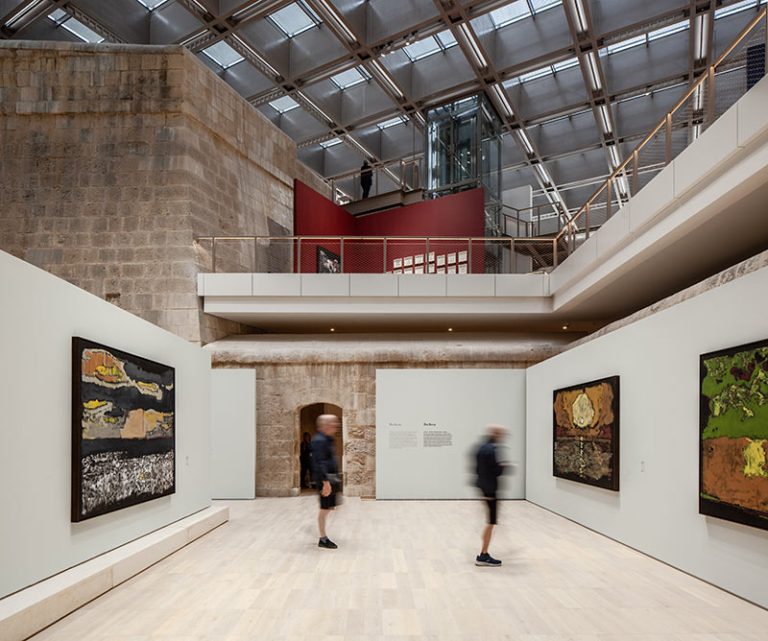
Everything is done to make Bassari cultures close to the Bassari cultures, and the very colorful scenography of Héloïse Thizy Fayolle participates in it: the room dedicated to seasons and agriculture has two colors (blue-green and beige) corresponding to the alternation between the rainy season and the dry season, with plant decorations on the ceiling and crafts (basketry, pottery). Echoing the notion of beauty, large portraits of men and women are presented in ceremonial outfit on bright red walls whose color recalls that of Bassari pearls. Sound terminals that broadcast traditional Bassari music and individual testimonies on social organization contribute to making this scenography“Immersive”
. Faced with modernization, the Bassari populations seek to keep their traditions, and the beautiful photographs of masks and costumes by Julien Masson at the Festival of Ethnic Minorities illustrate its transmission.
ERRATUM – Thursday July 17, 2025 Contrary to what has been published in the
JdaN ° 659, it is not the city of Grenoble but the department of Isère which maintains a relationship of cooperation with south-eastern Senegal.