
Paris. “Mystery”, “legend”, “myth”, “icon”: the curators of the exhibition presented at the Institute of the Arab world use all the terms to identify Cleopatra beyond the caricature which it is the subject of Antiquity. The historian Christian-Georges Schwentzel thus recalls that “The Roman authors invented a Cleopatra caricature, often obscene, and from the angle of his relations with men”. The exhibition, of which Claude Mollard is the main commissioner, tries to go beyond the clichés to access the real Cleopatra, of which very few authentic traces remain and whose historians ignore the physical aspect. “We have no details on his wessemble or his hair, and her beauty is not mentioned by Julius Caesar or by Cicero”, thus underlines Christiane Ziegler, honorary director of the Department of Egyptian Antiquities of the Louvre. To overcome this lack, currencies are shown during the reign of Cleopatra (52-30 BC), “A distribution support for a realistic image” of the queen, indicates Christian-Georges Schwentzel. Often austere, the presentation of currencies is made attractive by the scenography of Clémence Farrell. Besides the ocher and midnight blue tones “Inspired by the colorimetry of Egyptian monuments”, This scenography plays on the monumentality of an hollowed out module where the coins in large format are projected.
Recovered by orientalism
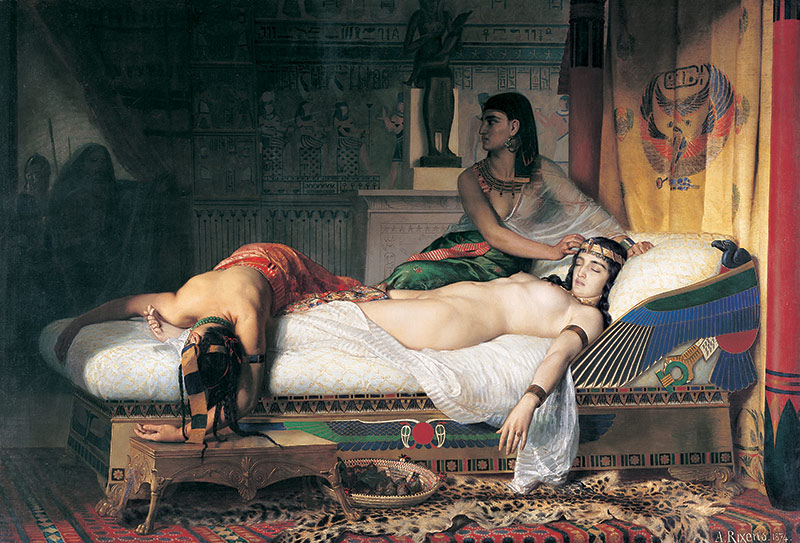
The rest of the route rehabilitates Cleopatra through a few late sources (Arab historians), and presents a mosaic of interpretations of this iconic figure. From his nose supposed to be long (according to a quote from Pascal), multiplied in the humorous installation of the contemporary artist Esmeralda Kosmatopoulos, to his suicide, via his hair and his political role, the image of Cleopatra is metamorphosis. The selection of canvases from the 17th to the 19th century (Cabanel, Tiepolo, Rixens) thus reveals the obsession of European painters for the scene of his suicide [voir ill.]with nudity and profusion of exotic fabrics. Here walls arranged at 45 degrees and recto verso promote a confrontation of works without chronology, “A decompartmentalization of the gaze” According to Clémence Farrell. “After being rehabilitated in the Renaissance as a woman of power, Cleopatra is recovered in the XIXe century by orientalism and firefighter painting that accentuate its eroticism ”, Analysis of co-commissioner Nathalie Bondil.
More than eroticism, it is the character of Cleopatra that the sequence highlights: three adjoining screens project films from the 1920s to today – strangely, few Arab films appear in the selection. In view of the screens, two hexagonal windows with a brilliant black background and a reconstituted scene have costumes worn by actresses and actresses who embodied Cleopatra (Sarah Bernhardt, Monica Bellucci), as well as haute couture pieces inspired by the Egyptian Queen. The reflections on a black background produce a kaleidoscope effect which completes to convince visitors that Cleopatra cannot be understood.
From Egyptian nationalism of the 1930s to television advertisements of the 1990s (detergents, sports betting, cars), the queen is used as a symbol of female power tinged with humor, but it is frozen in a rigid hairstyle and falsely Egyptian outfits: it has become an icon. Some accessories from the Opera created in 1927 by the poet Ahmad Chawqi illustrate the attempt to create a modern Arabic Cleopatra cleared of stereotypes. This part would have deserved to be more developed as a counterpoint to the image of Cleopatra in the West.
In the last room, fairly cramped as conceded the scenographer, contemporary works give an overview of the feminist interpretations of Cleopatra, thus of the photography of Cindy Sherman. The course ends on the massive sculpture of Barbara Chase-Riboud, a throne in bronze plates surrounded by brilliant black walls, metaphor for the role of Cleopatra’s state chief. The exhibition therefore sails quite skillfully between stereotypes, reappropriations and historical truth, without however highlighting the Arab sources on Cleopatra and its myth.


