Madrid,
We can understand the work of Nacho Zubelzu as an extensive study on nature and rural culture: this Cantabrian artist creates from observation, vision, empathy, memory and interpretationas he explained to us when he joined our roster: In my work you can find echoes of philosophy, anthropology and archaeology. My delight is the manual aspect of the creative work and the physical construction of the pieces, which is, in origin, in close relationship with nature and travel.
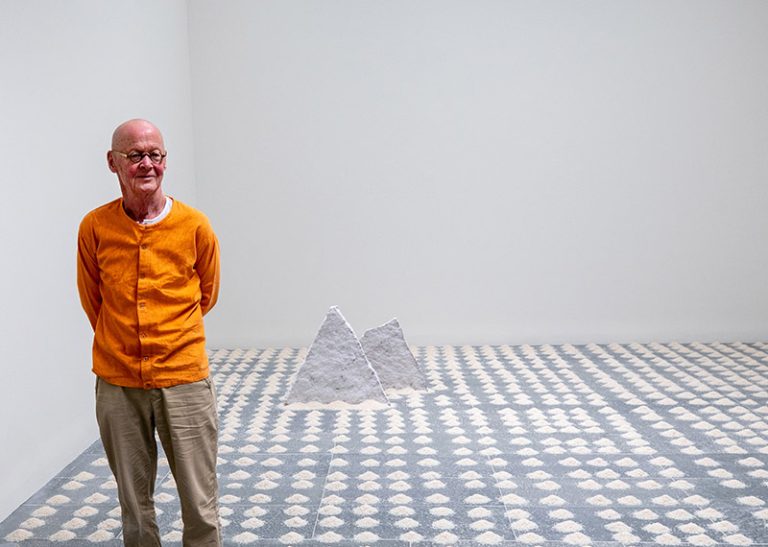
Starting today we can visit its most recent exhibition at the Tamara Kreisler Gallery in Madrid: “Salt, snow and sugar”, which has around twenty compositions conceived not only to be contemplated, but also to generate other types of sensations, thermal and even linked to flavour. These pieces are based on their experiences and memories: from their childhood experiences in the Campóo valley; activating his memories has meant, in his case, doing the same with his senses.
The works selected for this production maintain an evident thematic affinity – derived from the author’s introspective examination, the review of his childhood imagination and his travels – and a chromatic cohesion – related to the use of white, common to the three subjects of the title, intertwined in his childhood – but they differ in the creative processes from which they are born, although always in relation to an intimate work.
We will find in Tamara Kreisler, on the one hand, recent works, sometimes large format, that give continuity to her series of transhumances -he himself makes that movement, attracted by the transit of living beings, the passage of time that remains and goes, the magnetism and poetic richness of signs, symbols and tracesas he explained to us. In Zubelzu’s production, driving cattle through the ravines is equivalent to childhood melancholy, anthropological traces, smells, blizzards or tracks in the snow.
Common among their shapes are those with scales that interlock with each other; In their partial superimpositions, they structure a cuticle of white, with its shadows, which has been manually cut (with scissors) and which for the artist evokes vital impulses. We can interpret them as sculptural drawings that provoke rhythms and counterrhythms that articulate spaces.

Other works in the exhibition fit his line of orographyrelated to the Japanese concept of Kintsugithe art of making the fragile beautiful and strong. These creations are flat; They are executed on paper, usually with ink and pen. It does not abandon the scales and waves, as it is never lacking in nature itself: in fish, reptiles, birds or butterflies. On paper, these waves create zigzags and twists and turns that are the product of the repetition of a gesture with which Zubelzu appropriates the space, again using artisanal procedures.
We can approach these drawings as abstractions composed of trompe-l’oeils that, in this case, do not give rise to baroque illusions, but to intimate territories or organic landscapes alluding to the root.
A third creative path represented in this exhibition is made up of another dozen drawings in pen and ink on paper, now figurative: they represent partially burned wooden stakes and, therefore, the ephemeral, the most fleeting of life.
Zubelzu’s production continues to be nature and metaphor.


Nacho Zubelzu. “Salt, snow and sugar”
TAMARA KREISLER GALLERY
C/ Hermanos Álvarez Quintero, 6
Madrid
From January 15 to February 21, 2026