Paris. Thousands of students pass by its imposing facade every day, in the heart of the Latin Quarter. However, the interior of the Sorbonne chapel remains hidden from view. Inaccessible for several decades, it should not remain so for much longer: restorers have been hard at work for several months to restore it to its former glory and allow its reopening in a few years.
Cracks, humidity, deteriorated decorations… Since the violent storm of 1999, the chapel has been closed and is slowly deteriorating. Faced with the most urgent, the Paris City Hall launched, between 2004 and 2008, a campaign costing 8 million euros relating to closed and covered areas. The facades and roofs were then restored, and the breaches were sealed to stop the infiltrations which threatened the vaults and decorations. Inside, however, only a few safety nets are stretched to prevent falling plaster. The very first operations were only undertaken in 2024, when the City and the Safeguarding French Art foundation launched a subscription to restore the tomb of Cardinal Richelieu, a masterpiece sculpted by François Girardon (1628-1715) which sits in the choir. A report was also commissioned to assess the cost of the necessary work, then estimated at 10 million euros.
To raise this sum, the City and the Chancellery of the universities of Paris are applying to the World Monuments Fund (WMF), an American NGO working for the protection of heritage sites around the world. “If we were lucky enough to be able to attack the site fairly quickly, it is thanks to the mobilization of the World Monuments Fund,” rejoices Véronique Milande, chief curator of religious and civil works of art at the City of Paris. In fact, if it is up to the municipality to provide financial support for the project, the WMF will be responsible for raising funds, which will also be supplemented by subsidies from the Drac (regional directorate of cultural affairs) Île-de-France. However, the budget has not been finalized to date. “Previous estimates are too old to rely on. A new diagnosis will be established once the project manager has been appointed,” specifies Véronique Milande, adding that the call for tenders will not be launched before next summer.
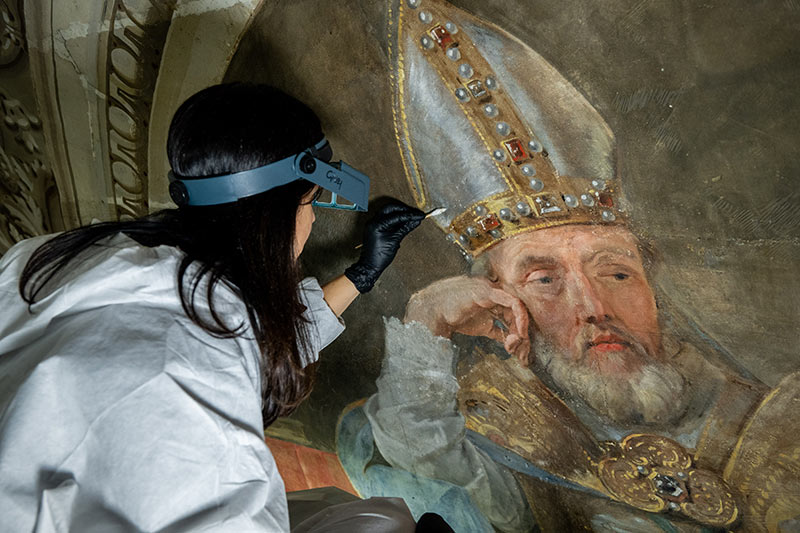
Restoration of the frescoes of the Sorbonne chapel.
© Benjamin Girette
Exceptional decorations
However, the work has already been started. After the monumental doors at the entrance to the chapel, it is the turn of the four medallions located at the base of its dome to be restored. Since January, these pendants representing the Fathers of the Church, painted by Philippe de Champaigne (1602-1674, (see ill.)), have been carefully examined and cleaned. “These are exceptional paintings, especially since the majority of Philippe de Champaigne’s wall decorations have now disappeared,” underlines the curator. Made between 1641 and 1644, at the time of the construction of the chapel, the medallions were the subject of several repaintings and were, for some, degraded by infiltration. “We did stratigraphies to understand the superposition of the layers, the components, to know the materiality of the pigments, explains restaurateur Alix Laveau. One thing is certain, we will unrestore the additions of the XXe century. Then we will have to address the problem of the restoration of the 19the century, taking stock of what is to be preserved and what is feasible. » At the same time, the restorers are working on the paintings by Louis Charles Timbal (1821-1880) which decorate the two arms of the transept.
A vocation as a place for exchanges and meetings
These interventions, which should be completed by the end of summer, mark the prelude to a second phase of the project. Renovation of the dome, restoration of the vault (also by Philippe de Champaigne), recutting of capitals and replacement of stones, consolidation of the organ gallery, upgrading to safety and accessibility standards…“During the diagnosis and selection of companies, this work should be launched, at best, in two or three years,” believes Véronique Milande. The complete reopening of the chapel is therefore not envisaged before 2030, a period used to develop its future cultural program. Alternately a place of worship, an artists’ studio and an amphitheater, the chapel then served as an exhibition space until its closure. The City and the University Chancellery hope to restore its vocation as a cultural place, dedicated to exchanges, conferences and meetings. “The idea is to exploit the place again in the most varied way possible. It is important that the Sorbonne can regain possession of this chapel that generations of students have not been able to see, while making it a space of expression for artists, musicians…” A future that still remains to be imagined.
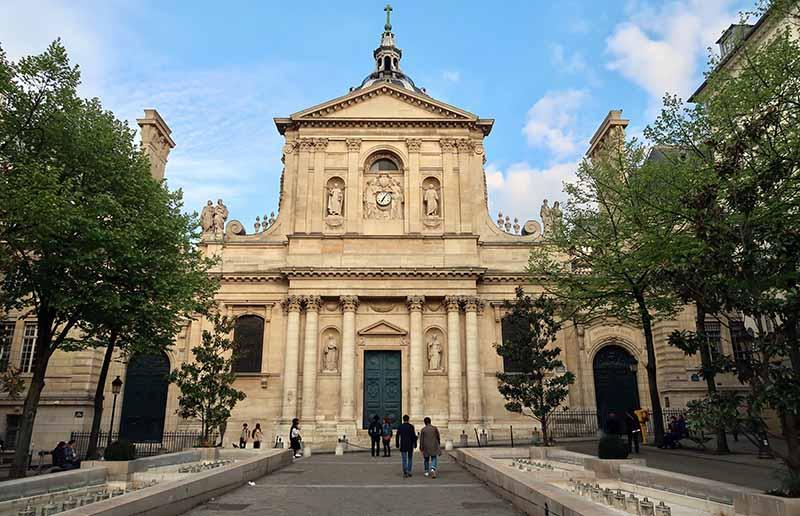
Facade of the Sainte-Ursule chapel at the Sorbonne University in Paris.
© Celette, 2019.