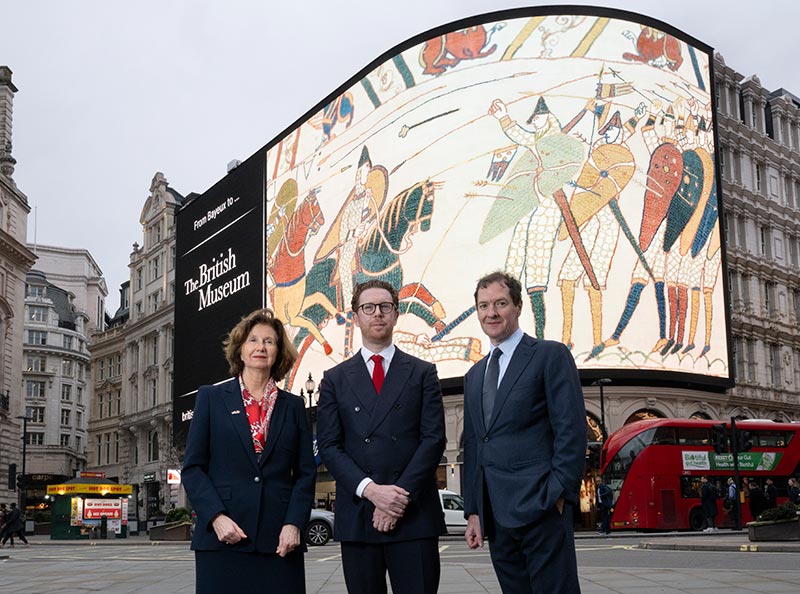
The British Museum will unveil the Bayeux Tapestry on September 10 during an exhibition which will run until July 11, 2027. It will be installed in the Sainsbury Exhibitions Gallery, a room large enough to accommodate the 68.38 meters of the embroidery. This loan coincides with the closure for renovation of the Bayeux Tapestry Museum. Its reopening is scheduled for October 2027, the millennium year of the birth of William the Conqueror.
The ticket office will open to the general public on July 1, 2026. The sale will take place in three phases, from July 2026 to January 2027. The full price is between £25 and £33 (approximately €29 to €38) depending on the time slot and the day. National Art Pass holders will benefit from a reduced rate of £16.50 (approximately €19), while visitors wishing to support the museum can pay up to £36.50 (approximately €42).
Entrance will remain free for those under 16. Slots reserved for school groups will also be offered during the week. Members of the British Museum’s three circles of patrons, who contribute between £3,500 and £12,000 per year (€4,000 to €13,900), have had access to tickets since May.
The tapestry will be presented flat for the first time in more than two centuries, in a custom-designed display case allowing it to be viewed in its entire length. In Bayeux, since 1983, it was displayed vertically, an arrangement that contributed to weakening the linen threads and fabric. Upon its return, the Bayeux Museum is now planning a presentation inclined at 60 degrees.
Visitors will have 40 minutes to explore the exhibition. Digital devices will accompany the 58 embroidery scenes, its 627 characters and its 737 animals. Lighting will be kept at a very low level to preserve colors and avoid fading. Traffic will be in continuous flow in order to limit crowds.
3D projection of the scenography imagined by Opera Amsterdam for the presentation of the Bayeux tapestry at the British Museum.
© Trustees of The British Museum
The exhibition will also bring together several exceptional loans intended to contextualize the work. Among them are the Junius II illuminated manuscript from the Bodleian Library in Oxford, from which the creators of the tapestry are said to have drawn inspiration to represent clothing, ships and everyday objects, silver coins from the Chew Valley hoard, held by the South West Heritage Trust and Somerset Council, as well as the charter of William the Conqueror on loan from the London Archives. The director of the British Museum, Nicholas Cullinan, and curator Michael Lewis insisted on the desire to show that the Norman Conquest did not only affect the elites, but also the people.
The museum also inaugurated an outdoor installation called “Tapestry of Trees”, designed by landscape designer Andy Sturgeon. Visible until June 2, it brings together 37 silver birches (the same number of trees as in the tapestry) accompanied by plants typical of Sussex from 1066, such as rosehip, hazel, male fern and foxglove.
The UK government has provided an £800 million (€917 million) guarantee under the Government Indemnity Scheme to cover any loss or damage during transport and exhibition. The British Museum hopes to welcome at least 7.5 million visitors in ten months, which would be a world record for a temporary exhibition.
The transfer nevertheless aroused opposition. The painter David Hockney, aged 88 and based in Normandy, published an article in The Independent in January calling the transfer “madness” and a “vanity project”. He denounces the irreversible risks incurred by weakened linen fabric and wool threads, vulnerable to variations in temperature, humidity and light.
The British Museum, for its part, has assured that it has an “expert” conservation team in the handling of this type of work and recalls its close collaboration with French specialists. The tapestry had already been moved discreetly in September 2025, mobilizing 90 people for 7 hours and 15 minutes to reach a temporary storage location before being transported to London.