Paris. Chloé Ariot, in charge of the sculpture collection at the Rodin Museum, wants to dispel any misunderstanding about the exhibition which she is curating with Marc Bormand, curator in the Sculptures department of the Louvre: “From a “Rodin – Michelangelo” project, we finally created a “Michelangelo – Rodin” project.” Because their work did not bear “only on a Michelangelesque Rodin”, subject already addressed during the artist’s lifetime, but, “what [les] was interesting here, it was to compare the art of the two sculptors” .
Certainly, the result is the same: Auguste Rodin (1840-1917) appears as the heir of Michelangelo (1475-1564). However, the visitor is never led to think that he has imitated him. He copied it during his apprenticeship, like all the young artists of his time, from the plasters he could see in Paris and especially from theDying slave (1513-1515) and theRebel slave (id.), the two large marbles preserved by the Louvre. It is clear, however, that during his trip to Italy in 1876, Rodin had a revelation, love at first sight. Beyond the admiration he felt for him, he recognized himself in Michelangelo. In their introduction to the exhibition catalogue, the two curators do not speak of filiation but of a “artistic couple”.
The demonstration is masterful, although it was not easy to construct. Since Michelangelo’s marbles are not on loan, the exhibition only includes three sculptures by his hand, each of them Slave… And Christ on the cross (wood, circa 1562-1563), as well as around thirty drawings from the more than 200 works presented. But the creations of other sculptors, who worked in the master’s entourage, help illustrate the point. It is thus Deposition of Christ (c. 1565), an earthen relief attributed to Jacopo Del Duca, one of his students. Sometimes plaster casts were summoned, such as that of Moses made in 1838 by Antonio Banchelli and which Rodin studied at the École des beaux-arts in Paris. Its connection with his plaster titled Monumental Balzac (1898) is one of the highlights of the exhibition. As the subtitle of this one indicates, “Living Bodies”, the aim is to show that the study of the model was the foundation of the work of the two artists, who then broke away from realism to give shape to their imagination.
The Shadow by Auguste Rodin (1840-1917), designed for The Gates of Hellnext to theApollo conquers Python by Giovanni Francesco Rustici (1474-1554).
Photo Audrey Viger
The “non-finite”
The course addresses the themes or aesthetic choices in which their works come together. For example, they share the reference to Antiquity, even in their common taste for the traces left by the passage of time on antiques. Michelangelo, the first, dared to sculpt torsos, amputated figures, works mixing polish with the roughness of not finished. We know that Rodin is a past master in the same art, also adopting body deformations, gender hybridizations, expressive contortions, heroization. For one, these licenses were called “mannerism”, for the other, “symbolism”. The juxtaposition of the works shows that it is the same approach by the two artists and not the adoption by Rodin of formal choices found in Michelangelo.
This freedom became a school, in the 16th century after Michelangelo and in the 20th century after Rodin. The curators wanted to take into account the generations following the period of “critical purgatory” that Rodin experienced until the end of the 1950s. They chose works by Joseph Beuys, Jana Sterbak, Giuseppe Penone and Bruce Nauman. From the first, Skin (1984) “resonates, four centuries apart, with the remains of Saint Bartholomew by Michelangelo” and constitutes a “plastic echo to Balzac of Rodin represented by his plaster dressing gown alone”, specifies Marc Bormand in the catalog. The work Vanitas: flesh dress for anorexic albino (1987), by Sterbak, responds to the criticisms of Michelangelo and Rodin. Walking a Line (2019), by Nauman, is “his latest achievement on the body in contrapposto and in motion ». As for theAlbero di 7 meters (1999, “Tree of 7 meters”) by Penone, it corresponds to the technique of Michelangelo who professed that his sculpture revealed the pre-existing form in the marble. “There is a link that is not just a whim on our part, but really a conceptual link that unites these works into a coherent whole”explains Chloé Ariot. It is not certain that the majority of the public will be sensitive to this transmission from the two elders to contemporary artists.
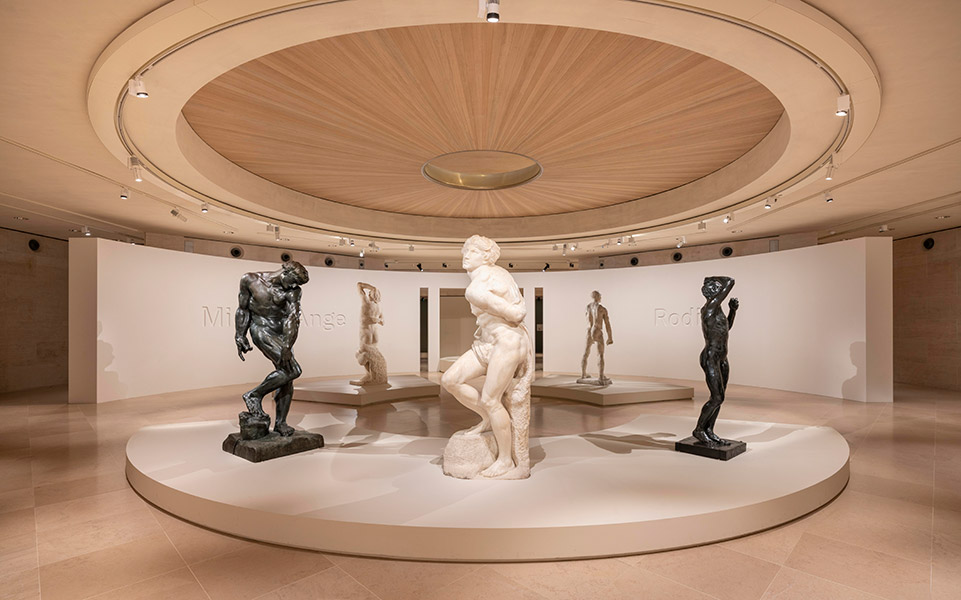
Penone’s sculpture, however, emphasizes the fundamental difference between Michelangelo and Rodin. The first carved the marble in a long struggle with the material while the second modeled and left to his practitioners the difficult and thankless work of interpretation in the stone. Rodin, who formed and assembled clay and plaster, was a director. There is no doubt that he would have appreciated the scenography of Laurence Fontaine which opens and closes the exhibition with a striking dance of statues in the rotunda of the Louvre [voir ill.].
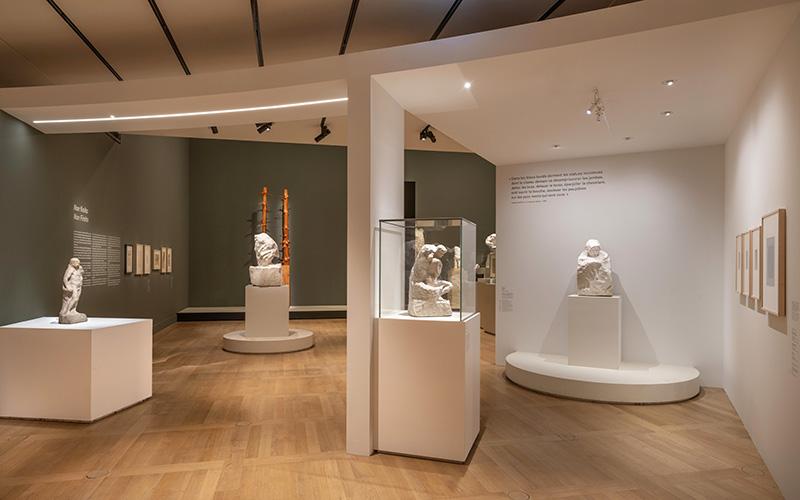
View of the exhibition “Michelangelo Rodin. Living bodies” at the Louvre Museum.
© Audrey Viger