More than two hundred artists and thirty-one editions make up the balance in figures of Itinerariesthe annual exhibition that the Centro Botín de Santander dedicates to international creators who each year receive scholarships awarded by the foundation of the same name. With the aim of promoting diverse representation in terms of generations, languages and contexts, its bases do not establish requirements regarding age and nationality; Thus, among the latest protagonists of this proposal we find authors born between the sixties and the nineties and of Spanish, American and Mexican origin.
Those now selected correspond to the scholarship winners in 2024, chosen by a jury composed of Laura Vallés Vílchez, Alicia Ventura, June Crespo and Nuno da Luz; These are Elena Aitzkoa, Sahatsa Jauregi, Mar Reykjavik, Naomi Rincón-Gallardo, Inmaculada Salinas and Lorenzo Sandoval. The particularity of this call is that it offers artists to develop their initial ideas for a year, so that they can deviate from their first paths and perhaps open up to others: closed projects are not recognized, but potential ones, and stories, systems and materials can be speculative. Even the voices represented could be more than anticipated.
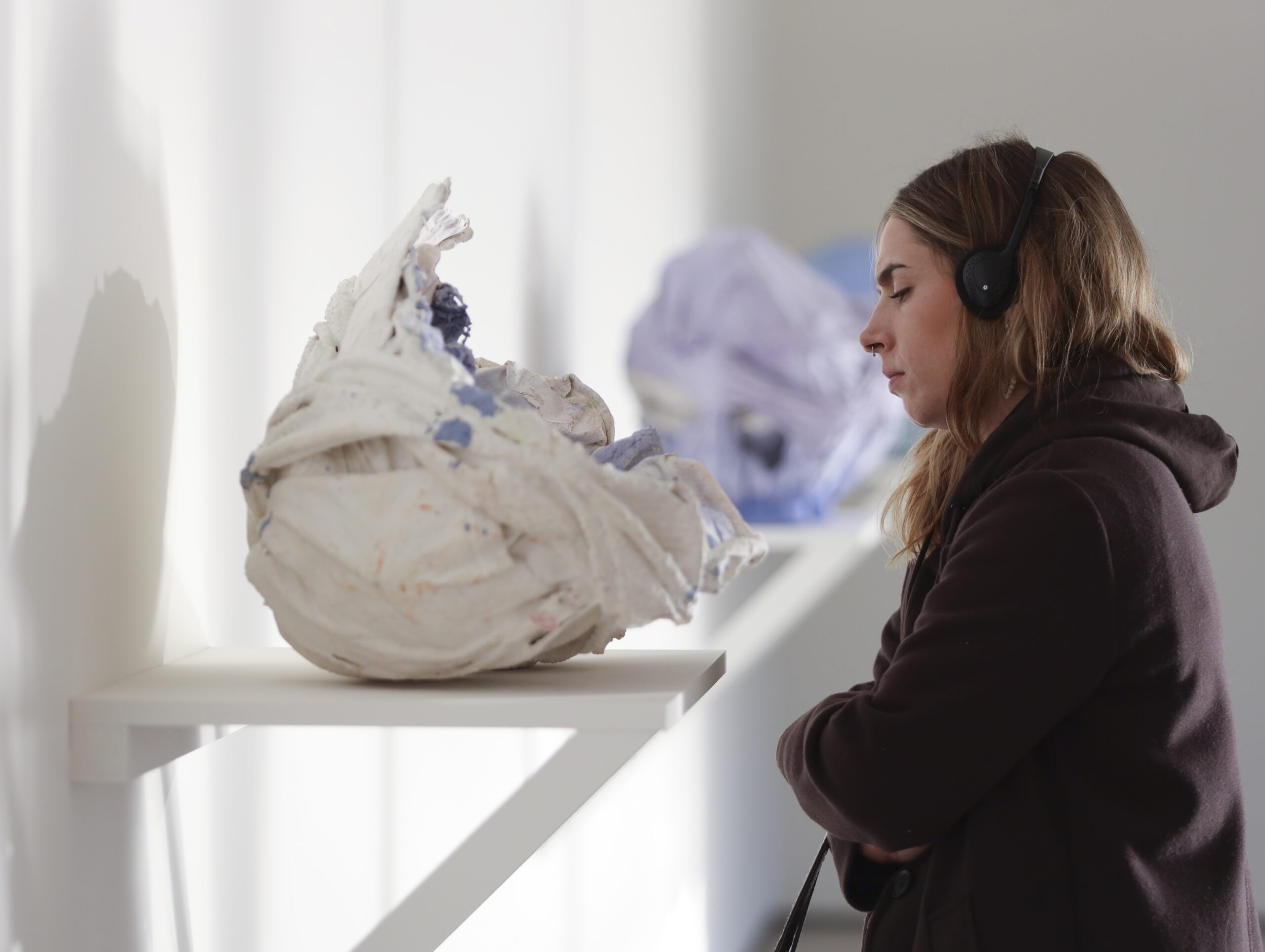
The production of Elena Aitzkoa from Alava is multiform: she works in sculpture, drawing, poetry and performance and, in both mediums, she conceives her creations as ecosystems that are nourished by physical and emotional elements from her environment and her own life experience. At the Botín Center he has chosen to show sculptures; Hers are made, above all, with textiles soaked in liquid and pigmented plaster, a procedure that involves the artist moving through different states of matter: what we finally appreciate as a solid piece only exists thanks to what happened before, when its physical base was still liquid and malleable. These works also have clay, branches, stones and everyday objects.
We will see four in Santander landlarge-format pieces arranged on the floor, and seven atmospheresthat is, lighter sculptures that hang on the walls. These compositions bring together other smaller sculptures inside, giving rise to a diverse group in which the individual and the collective come together. The atmospheresBy the way, they will come out hanging at chest height so that we can experience the receptive quality of the air circulating around us. Its color and shapes suggest lightness and elevation.
Aitzkoa explains that the nature that is closest to him inspires him: I recognize as a total source of inspiration the territory that is revealed in the Sierra de Arrato, where I live and work. Far from being an idyllic image, what we loosely call “landscape” is a community of living beings protected by geological formations and a climate. Worlds within other worlds.
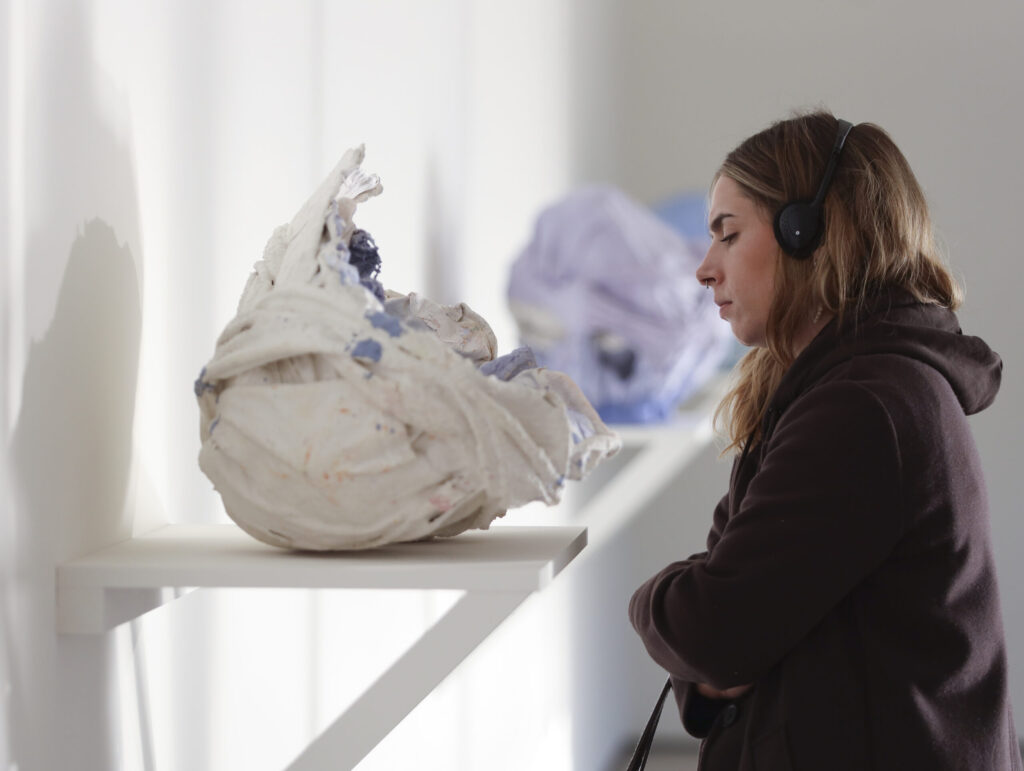
Elena Aitzkoa. The condition of Earth2026
Jauregi, born in Salvador de Bahia and recently very recognized in contemporary art fairs, also starts her creations from objects and people who are close to her and the links between them. With metal, steel and welding, he generates sculptural pieces that we can read as beings in mutation: the one exhibited at the Botín Center consists of a circular steel structure that rotates on its own axis and that we have to interpret as a performative mechanical organism, a spectacle made material or a deployable machine of complex movements and extensions whose function we do not know until the piece is used. Therefore, it will be activated by the performance company Tripak.
Its circular shape is not accidental; alludes to devices and architectures that fostered encounter or surveillance, such as Roman amphitheaters or panoptic prisons.
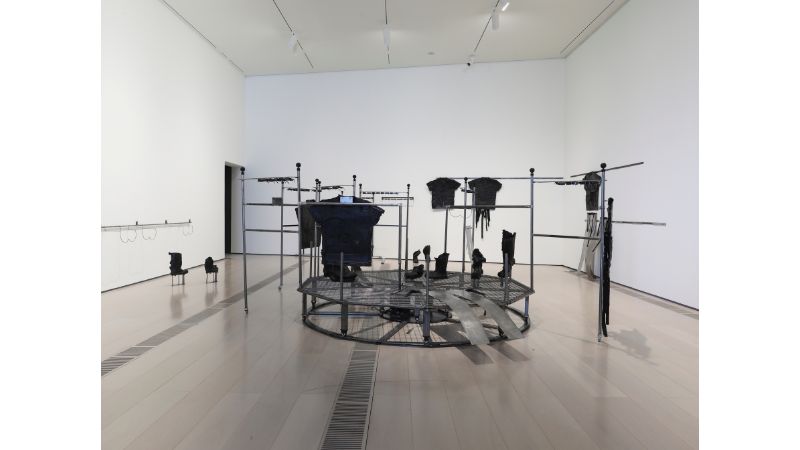
Sahatsa Jauregi. The back a scaffold2026. Photography: Belén de Benito
As for the Valencian Mar Reykjavik, during the scholarship period she developed a residency at The Swedish Contemporary Art Foundation in which she investigated the possibilities of translating a text, not taking into account its content, but rather the sounds or rhythms it can evoke. For Reykjavik, affects also intervene in a translation between languages.
His project at the Botín Center is called In a train going to Tanto: This is a film that is broadcast on four screens simultaneously. In it, many other people—Carin, Josse, Ofelia and Dakota—read and interpret a script written taking into account the languages they use—Swedish, Valencian, English, Spanish, Meänkieli (a language spoken in the north of that Nordic country) and Swedish sign language—and based on different “affective translation” operations.
The script was written in the Swedish capital, in 2025, based on these exercises and those languages that the participants put into play. The film shows a day of rehearsing and reading this text; It is not a conventional film, since it includes the conditions of its filming, the environment and the emotions of those involved; That is, what is not normally revealed in the cinema.
Rincón-Gallardo, born in North Carolina, who works primarily in videos and performances, brings to Santander Patlache Anthillan audiovisual fable based on the image and description of a figure called Patlache, from the Florentine Codex, an encyclopedic work about the society and culture of the Nahua peoples of central Mexico, made in the 15th century by Bernardino de Sahagún with the help of Nahua indigenous scribes and informants.
In this video, two characters imagined from this image of the codex enter a world of creatures that go beyond the human, and merge with the animal, the vegetal and the monstrous, inspired by Mesoamerican deities. The seated figure observing Patlache follows a carrier ant that leads her towards a cactus with breasts and a carnivorous flower, to be initiated into her future as another ant.
Inmaculada Salinas, for her part, remains faithful to painting and drawing, although she incorporates photography and text into these disciplines. He uses patterns that he repeats insistently and that emerge either from primary gestures or from materials that have survived the centuries, such as encyclopedias, romances or family snapshots.
Precisely, on the occasion of this scholarship, this Sevillian author investigated the indoctrinating and preventive romances dedicated to the so-called “bad women”; In the procedure of drawing these texts, he finds an option to give space to those who could not express themselves freely under those warnings. The series he has created include engravings from old encyclopedias, war scenes or private photographs that give dynamism to what was understood to be univocal and fixed. And the recurring presence of spirals, mountains and roads speaks to us, not of distant landscapes, but of non-linear paths towards knowledge.
Finally, Lorenzo Sandoval from Madrid has linked in this project the irrigation systems born in Al Andalus with the origin of cybernetics, through circuits. At the Botín Center he dissects a sculptural series made up of seven elements, corresponding to the seven chapters of a film that he also exhibits here. In both cases he relates algorithmic diagrams, made by cyberneticians, with graphic elements taken from archaeological, museographic and contemporary processes related to the history of the use of water and orchards. In addition, each one includes a ceramic piece, made together with the Fajalauza Foundation, and some textiles made in collaboration with Zineb Achoubie.
As for the fiction film, it narrates the trip of Fátima, a Moroccan anthropologist, to various areas of southern Spain and Morocco looking for architectural references linked to the irrigation ditch system. He used the illustrations that appear in the book about Bayad and Riyad, an illustrated manuscript from the 12th century made in the Andalusian period, especially the illustration of a hydraulic wheel that led him to begin his journey in Alcantarilla (Murcia), where one of these wheels is located. In the library of his Huerta Museum he found seven letters hidden in a book, written by an agronomist in the nineties and addressed to his great-granddaughter Luz, whom he had not yet met.
They were gold; According to Sandoval, In these letters, the agronomist talks about the dignity of slow work and how it is in danger from the voracity of the industry. It talks about trees and birds, how they are part of the same ecosystem as water, people, insects and the moons that determine irrigation. It talks about how the universe vibrates in every wave of water that moves.
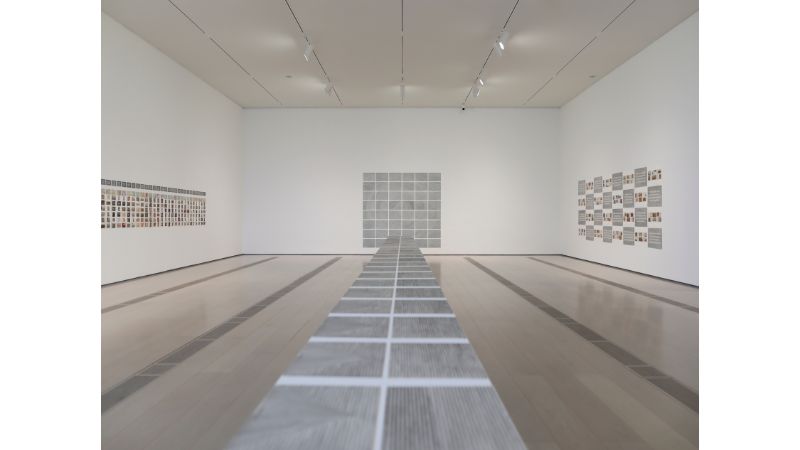
Inmaculada Salinas, If they give you ruled paper, write on the other side, 2025
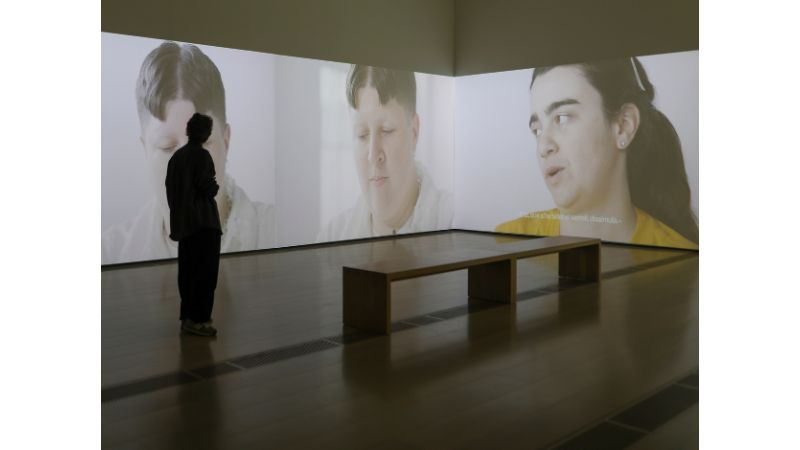
Mar Reykjavic. In a train going to Tanto2026. Photography: Belén de Benito
«ITINERARIES XXXI»
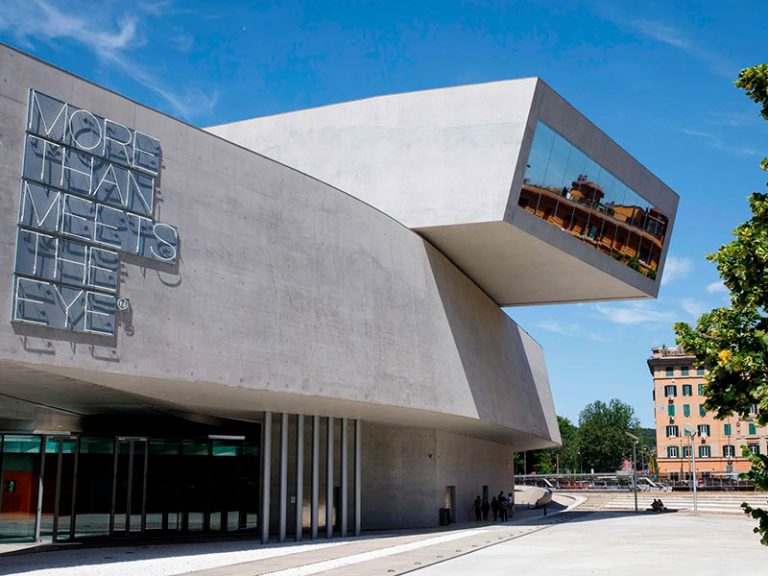
LOOT CENTER
Plaza Emilio Botín, s/n
Pereda Gardens
Santander
From November 21, 2026 to April 25, 2027