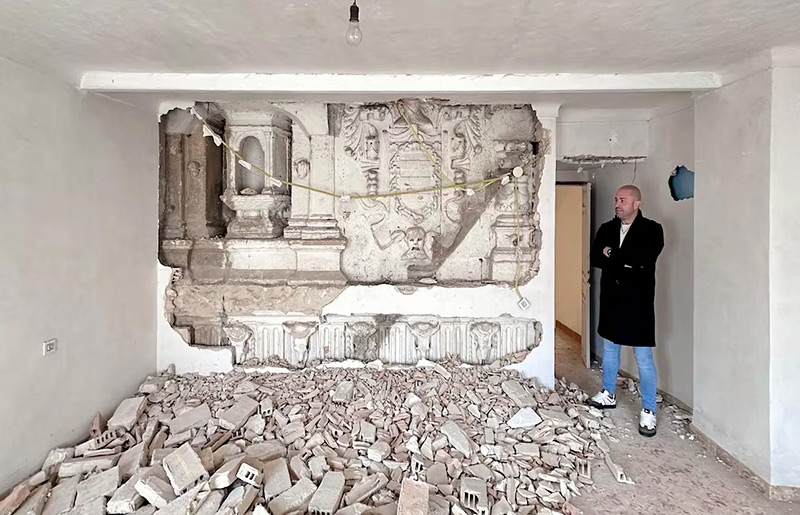
Discovering a historical monument in your home can bring big dividends in Spain. But the administration must still agree to pay the reward provided for by law. In Úbeda, in Andalusia, the owner of a house who uncovered an imposing Renaissance facade in 2016, attributed to the architect Andrés de Vandelvira, had to initiate a long legal battle to have his rights recognized. Ten years later, an expert appraisal valued the monument at more than 1.1 million euros, paving the way for calculating its reward. The facade is still waiting to be restored and made accessible to the public.
On November 20, 2016, Juan Francisco León Catena began work on a recently acquired house in the historic center of Úbeda. By tearing down partitions, he discovered an imposing stone facade dating from the 16th century, belonging to the old church of the Pero Almides hospital, a charitable establishment founded in 1347. The territorial delegation of Culture attributes the work to Andrés de Vandelvira, emblematic architect of the Spanish Renaissance, confirming its heritage importance.
In 2018, the Andalusian Autonomous Government (Junta) rejected the owner’s request for a reward, on the grounds that the gate would feature a coat of arms of the Messia family benefiting from heritage protection. The judges will, however, consider that the administration has not sufficiently demonstrated that the gate was part of a protected building, nor that the alleged presence of this coat of arms made it possible to exclude the right to reward. The Junta’s reasoning is based on an exception to the principle of financial reward for chance discoveries, included in the regulations for the protection and enhancement of the historical heritage of Andalusia, which provides that when a discovered element is integrated into the architectural structure of a building belonging to the Andalusian historical heritage, the discoverer is no longer entitled to obtain this reward. A decision contested by the owner, who took legal action.
On June 30, 2020, the Superior Court of Justice of Andalusia (TSJA) ruled in favor of Juan Francisco León Catena, on the grounds that the Junta would not have sufficiently demonstrated that the portal was part of a building protected as Andalusian historical heritage, nor that the coat of arms of the Messias justified the application of the exception. The plaintiff’s right to a reward is thus formally recognized, and the judge ordered the administration to initiate the procedure for determining it. After appeal by the Junta, the court decision is confirmed by the court and becomes final in 2025.
On November 12, the report of the evaluation commission, made up of two administration technicians and an expert appointed by the owner, retained a value of approximately 1.1 million euros for the portal. The final amount of the reward, which must be calculated on the basis of this evaluation, however, remains to be determined. Furthermore, the municipality plans to demolish part of the house and the adjacent municipal building, then restore it, in order to make the discovery accessible to the public.
Article 44 of Law 16/1985 of June 25 on Spanish Historical Heritage provides for a reward for chance discoveries, corresponding to half of the value attributed to the property, divided equally between the discoverer and the owner of the land. Juan Francisco León Catena being both the discoverer and the owner, the justice specified that he should benefit from 50% of the value of the part located in his house and 25% of that located in the neighboring property, belonging to the municipality.
In France, no comparable reward mechanism proportional to the value of the property is provided for chance discoveries. However, the Heritage Code provides, when a real estate vestige discovered by chance gives rise to exploitation, a lump sum compensation or an interest for the inventor in the results of this exploitation.