The modesty of the means can be seen in the presentation, sometimes cobbled together, of this exhibition organized by the Psychoanalytic Society of Paris (SPP) for its centenary. But behind a scenography which struggles to highlight its subject, the subject does not lack interest. Founded on November 4, 1926, the SPP is the founding institution which contributed to the establishment and development of psychoanalysis in France.
The course is divided into two clearly distinct parts: one traces the history of the SPP, closely linked to that of psychoanalysis in France; the other brings together recent works of art related to the discipline. This division departs from usual museographic practices, which tend rather to punctuate historical or scientific journeys with contemporary works. “Epidemics, taking care of the living” at the Musée des Confluences or “Migrations, a human odyssey” at the Musée de l’Homme provided recent examples (2024-2025). This unconventional choice nevertheless has the merit of clarity.
As in any historical exhibition, you must take the time to look at and read the numerous documents which trace this history, but also its prehistory. The vestibule thus recalls the decisive role of Jean-Martin Charcot (1825-1893), who guided Freud (1856-1939), then a young neurologist, towards the study of hysteria. Then another major figure appears, Marie Bonaparte (1882-1962), great-grandniece of Napoleon I and princess of Greece and Denmark. Analyzed by Freud in Vienna from 1925, she is one of the nine founders of the SPP. She maintained a long and abundant correspondence with him, extracts of which were read by two actors during the centenary conference, coordinated by Bernard Chervet.
Jeanne Susplugas, Hate (2010-2018).
© Adagp 2026
Rich in documents until the 1990s, the route runs out of steam in its last part. To the point that a visitor remarked that it seemed like nothing was happening anymore. However, it is quite the opposite: psychoanalysis is today going through a period of scientific, institutional and political questioning. Its place in health establishments, the public financing of practices that rely on it and its therapeutic legitimacy are the subject of increasing attacks.
The historical part, however, reserves some great discoveries. Thus “ELIZA”, a computer program designed at the Massachusetts Institute of Technology (MIT) in the 1960s by Joseph Weizenbaum. Capable of simulating a conversation with a psychotherapist, it appears to be one of the ancestors of conversational agents such as ChatGPT. Another curiosity: a drawing made in 1853 by Charcot under the influence of hashish, consumed experimentally.
The artistic part bears more the mark of its curator, Antoine Perpère, assisted by Éric Corbobesse, member of the SPP. In 2013, the first signed a notable exhibition at the Maison Rouge on the relationship between artistic creation and psychotropic substances, “Under Influences”. But at the town hall of the 13th district of Paris, which is hosting the exhibition, he had to deal with a space far removed from those of Antoine de Galbert’s foundation and with the impossibility of hanging the works on the walls.
He therefore improvised a presentation on tables, covered with ordinary household plastic film to prevent the pieces from scattering. “A veil that covers the unconscious”he jokes. Fourteen tables, as many “clinical cases”explains the commissioner. Either. If some display an identifiable theme, such as witticisms, illustrated in particular by Ben’s sentences, or the scopic drive, others offer freer variations on the psyche and its psychoanalytic interpretation.
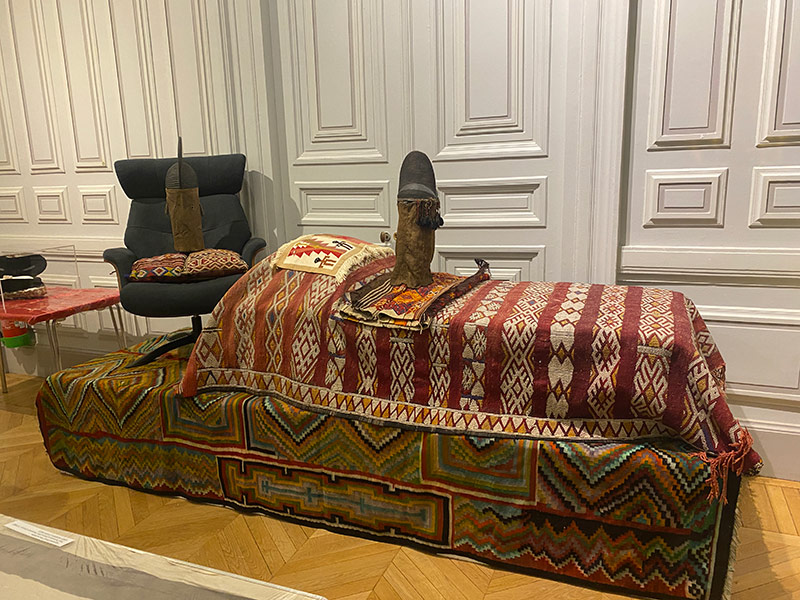
Sexuality naturally occupies an important place, notably with Once upon a time there was a purple cock (1996), by Esther Ferrer (born 1937). Other works explore mental space more broadly, such as Hate (2010-2018), by Jeanne Susplugas (born in 1974). In a corner of the room, obviously, there is a couch accompanied by a psychoanalyst’s chair, where African masks represent the analyst and the analysand.
Unfortunately, there is no catalog allowing us to keep an in-depth trace of this ephemeral exhibition. It remains to be hoped that a museum will take up the subject to give it more scope, as the Center Pompidou-Metz did in 2023-2024 with Jacques Lacan, one of the figures of the split of the SPP in 1953!