Italy. It is not only France that can claim a cultural exception. Italy too and not only for the unparalleled richness of its artistic heritage. While France boasts the Center Pompidou in Paris and the United Kingdom shines with the Tate Modern in London, the peninsula which claims its rank as a “cultural superpower” cannot compete. It has no national museum dedicated to contemporary creation capable of competing in terms of overall impact, collections and attendance.
The first explanation for this anomaly is historical. Unlike France or the United Kingdom, heirs of a strong political and cultural centralism, Italy is a country whose unification dates back to 1861. It thus remains profoundly polycentric. Its museum landscape thus reflects the richness of the royal or princely collections, the fruit of the mosaic of kingdoms, republics and principalities which made up the peninsula. This explosion does not only concern ancient Art, but also contemporary Art: the Maxxi and the GNAMC in Rome, the Madre in Naples, the MAMbo in Bologna, the Castello di Rivoli near Turin, or even the Triennale and the Museo del Novecento in Milan are all museums which aim to offer the public the artistic production of the 20th and 21st centuries. This fragmentation prevents the emergence of a single flagship institution. “A multitude of cultural “chapels”, but no Vatican of contemporary art”ironically comments a member of the Ministry of Culture.
A cultural preference for ancient art
“Italy already has too many structures to manage equivalent to the Center Pompidou or the Tate dedicated to ancient art », Adds the critic and art historian Marco Tonelli. They are the ones who benefit first from public resources. Due to a lack of massive resources concentrated on a single national center, a contemporary art museum that can compete at the international level is proving impossible. “ There is political ignorance on this subject with a ruling class which does not take care of it and does not want to be interested in it, because its attention is focused on cultural tourism which exalts the past, deplores Marco Tonelli. PFor the State, Contemporary Art thus remains the poor relation of public policies. The institutional void was therefore filled by major collectors, captains of industry and fashion designers via the Prada, Pinault, Guggenheim and Kapoor foundations in Milan and Venice. »
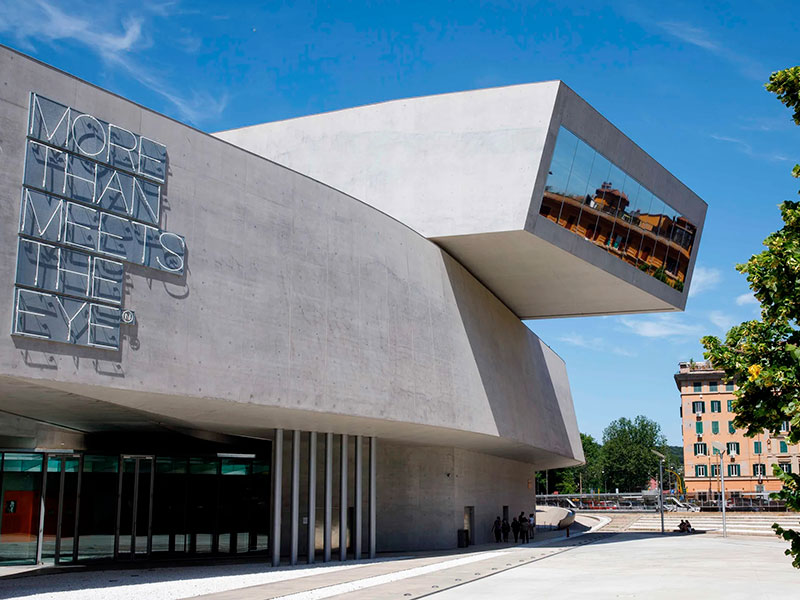
An attempt to remedy this situation was made at the turn of the 2000s. Designed at the end of the 1990s, the Maxxi (National Museum of the Art of the XXI century) in Rome, is one of the most ambitious cultural projects in contemporary Italy. After more than ten years of chaotic work and a total cost of around 150 million euros, the museum opened its doors in May 2010. The building is unanimously hailed as a masterpiece of deconstructivist architecture. International criticism describes it above all as a magnificent empty shell. “The Maxxi has failed to become the great global beacon of contemporary art that it aspired to be, notes Fabio Cavallucci, historian and curator of contemporary art. With its curved walls, inclined planes and monumental black staircases crossing the void, it is extremely difficult to exhibit works there. He was born just before the 2008 financial crisis hit Italy hard. The State has drastically cut operating budgets for culture, preventing it from acquiring a permanent collection of international scope. »
Italy, a giant on the world stage when it comes to ancient and ancient Art, turns out to be a dwarf when it comes to Contemporary Art. A real paradox since the Venice Biennale undoubtedly remains the oldest and most prestigious contemporary art event. Ready for self-commissioning, the transalpine press was pleased to note that not a single Italian was represented there this year. “The opposite would have surprised us” was the most frequent comment from observers who point out the triple marginalization of the peninsula. On the one hand, the general commissioner of the event – often foreign – uses Italy as a simple setting for the benefit of a global story, relegating local creation to the background. On the other hand, the attempted response within the National Arsenal Pavilion frequently turns into cacophony: for lack of a clear vision, this space is transformed into an illegible political battlefield, shunned by criticism. Finally, add to this the weakness of the internal market. The lack of major galleries and influential collectors deprives young artists of the financial and institutional support necessary to establish themselves against their American, British or German competitors.
The 1980s thus marked the last great moment of global influence for the peninsula thanks to the Transavanguardia (“Trans-avant-garde”). At that time, artists like Clemente, Cucchi and Chia conquered New York galleries. “This decline is not a question of talent, but of structures and vision, believes Fabio Cavallucci. Italy suffers from a lack of bold public investments and an absence of coordination between institutions. The country has retreated into a form of provincialism and sterile self-sufficiency, incapable of building solid careers for its young creators on a European or global scale. »
Faced with this observation, the Ministry of Culture launched the Italian Council in 2017, wanting to imitate the British Council. The idea was to directly finance the production of contemporary art works by Italian artists, on the condition that they are presented abroad and then acquired by a public museum in Italy. “ It’s a failure, regrets Marco Tonelli. The call for projects is a bureaucratic nightmare, the funds are scattered across dozens of small grants, but above all there is no network strategy. Italy is sorely lacking in major international curators installed in key positions abroad. » The absence of an equivalent of the Pompidou Center or the Tate on the peninsula is therefore not an anomaly, but reflects the propensity of a country to admire itself in the mirror of its past.