Paris. Developed with the assistance of the artist herself, the exhibition at the Museum of Modern Art in Paris retraces fifty years of creation by Simone Fattal (born in 1942 in Damascus, Syria) in a non-chronological manner. “We chose to focus on his inspirations through a succession of sets of works from different periods,” explains co-curator Jessica Castex. A few paintings from the 1970s thus open the route, followed by sculptures of different formats, collages and drawings: the stripped-down scenography highlights the plasticity of the works, while the cartels systematically provide the cultural context.
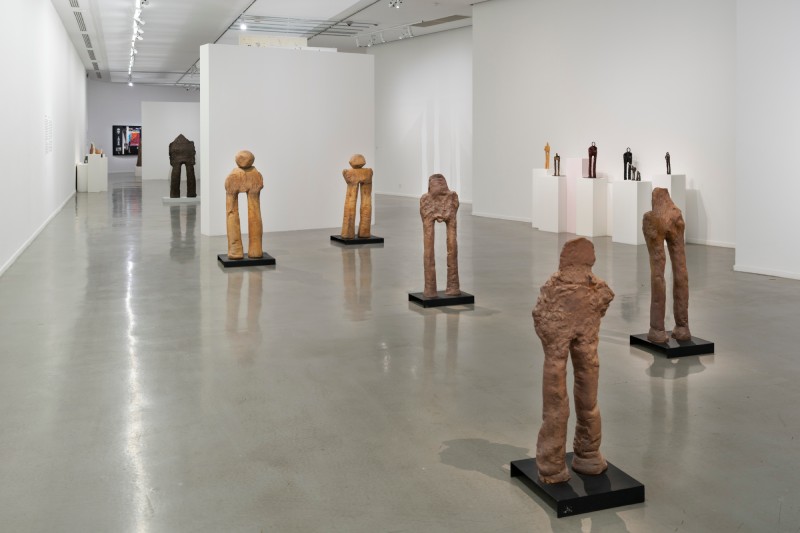
The first part of the exhibition focuses on Mesopotamian mythological stories whose heroes and deities have had a strong impact on Simone Fattal. Gilgamesh and Enkidu, the goddess Ishtar and the Babylonian demons inspire his totemic ceramic sculptures, figures with an archaic aesthetic. Thus the standing man or the warrior, of which the exhibition presents several examples “on bases of different heights, like a small human group”specifies Jessica Castex. Posed on two long, spread legs, the standing man embodies a “protective figure inherited from Lebanon”, country where the artist studied and then lived during the civil war, between two exiles in France and the United States. The Middle East also irrigates the entire exhibition, in particular the large collages: photographs of Lebanese, Syrian and Iraqi archaeological sites, Arab newspaper clippings on the Lebanese war and family archives compose a hollow portrait of Simone Fattal. We note that the succinct cartels do not give any historical details on the collages, encouraging visitors to have a formal rather than documentary understanding of the content.
View of Simone Fattal’s exhibition at the Museum of Modern Art in Paris.
© Nicolas Borel
© Adagp Paris 2026
Ruined house and ancient temple
In addition to mythological figures, Simone Fattal worked on nature and architecture, themes present in the last section of the exhibition. Paintings of vibrantly colored landscapes and recent sculptures of trees and clouds show “the relationship of the artist to the living and its evolutions”, continues the commissioner. The Lebanese coast inspired almost abstract paintings which show his mastery of color, a mastery also evident in the small ceramics of “houses”. These houses in the shape of open boxes are lined up here on a long white base, in no chronological order: ruined house, family home, ancient temple or ziggurat of southern Iraq, the theme constantly returns.
This corpus is nourished by a multitude of cultural references, barely mentioned in the cartels. Because Simone Fattal visited a number of archaeological sites in Syria and Lebanon, and also studied art history at the École du Louvre (the catalog develops these biographical elements). These references therefore come from a personal experience of architecture and archaeology, which the artist explains in an interesting video, placed at the end of the course when it could have served as a transition halfway through.
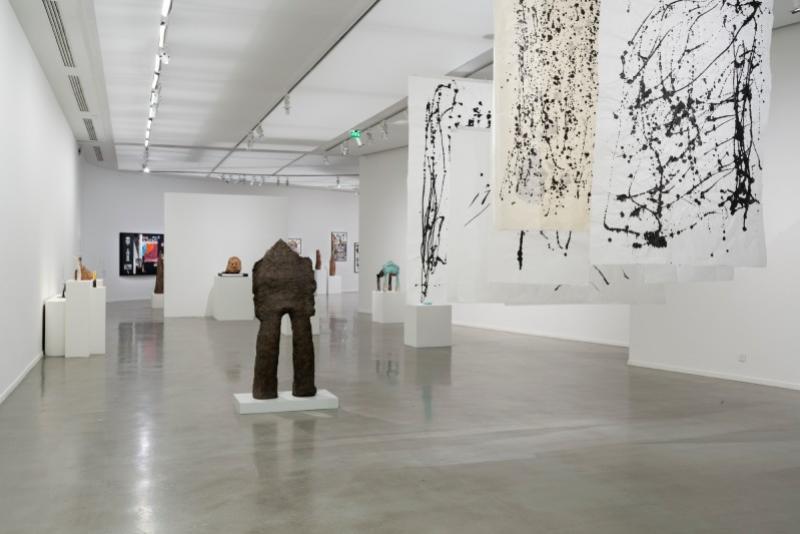
View of Simone Fattal’s exhibition at the Museum of Modern Art in Paris.
© Nicolas Borel
© Adagp Paris 2026