Coinciding with its second decade of activity, the University of Navarra Museum has begun a new stage under the artistic direction of Gabriel Pérez-Barreiro and with the purpose of reinforcing precisely what distinguishes it: its status as a museum within a university. Thus, its programming will seek to encourage the encounter of art with other fields of knowledge and, each year, will have as its common thread a theme that allows connections to be established between disciplines. The first will be attention, understood not only as an individual capacity, but also as a way of getting closer to others and everything around us.
In this context, “Live and direct: color, perception and experience” is presented, the exhibition with which the MUN begins this new journey and which can be visited until February 7, 2027. Its approach already responds to this desire to broaden perspectives by adding to the artistic curation of Gabriel Pérez-Barreiro the academic contribution of Nathaniel Barrett, philosopher and researcher at the Culture and Society Institute of the University of Navarra. Art, philosophy and science thus meet around an issue, that of color, which is part of our daily experience and to which, surely for this reason, we do not always pay too much attention.
It is not necessary, however, to delve into scientific or philosophical questions to enjoy this exhibition, in which color is presented, above all, to be experienced. It changes with the light, with what is next to it and also according to our position and our own way of perceiving it. As Barrett pointed out during his presentation, compared to an abstract conception that tends to think of colors one by one, it is interesting to observe what happens when they relate to each other. Something that, on the other hand, artists have been investigating for a long time.
The international and multigenerational tour spans almost a century of research and has been organized with a simple structure in which each artist basically occupies his or her own space. The starting point, with Josef Albers as the main protagonist, could not be more pertinent. Albers made the observation of color one of the axes of his work and teaching, first at the Bauhaus and later, in the United States, at Black Mountain College and Yale University. Rather than transmitting a closed theory, he proposed to his students exercises with which they learned to look and verify, through practice, to what extent our perception depends on the relationships between some colors and others.
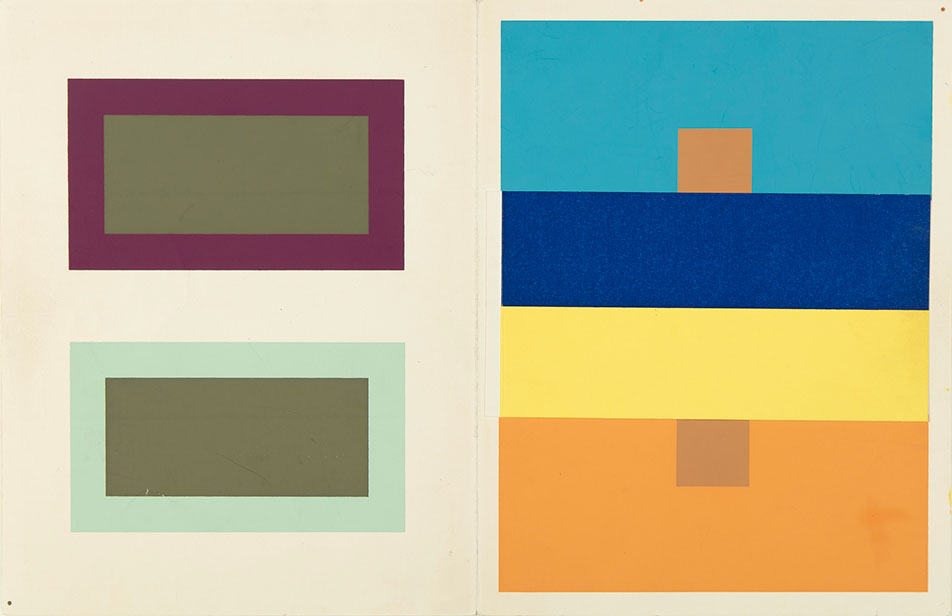
Josef Albers. Interaction of Color1963
In the first room you can see the serigraphs of Interaction of Colorbelonging to the original edition published by Yale University Press in 1963. The exercises that gave rise to these images, fundamental in Albers’s color pedagogy, posed seemingly simple questions—for example, how to make the same pigment look like two different colors—and their solutions were born from testing with cut-out colored papers. The work has been acquired on the occasion of the exhibition and is now part of the MUN Collection.
From Albers he moved on to Carlos Cruz-Diez—another great artistic reference linked to color—who focused much of his research on color and light. Faced with the traditional idea of color as a quality subordinated to form, Cruz-Diez understood it as a changing experience, which is transformed in space and time. In Chromosaturationinitially created in 1965, this investigation takes on a much more involving dimension: the visitor passes through three connected spaces illuminated respectively with red, green and blue light. Here the color is no longer contained in an object, it occupies the room and modifies what we see depending on our own sensitivity and how we move through it. Two more works by Cruz-Diez allow us to verify this same changing condition in another way: Physichromie no. 1022 (1975), from the BBVA Collection, and Chromointerférence spatiale Paris 18 Pegaso (2018), from the Hortensia Herrero Collection. In both, the viewer’s movement is part of what happens before their eyes.
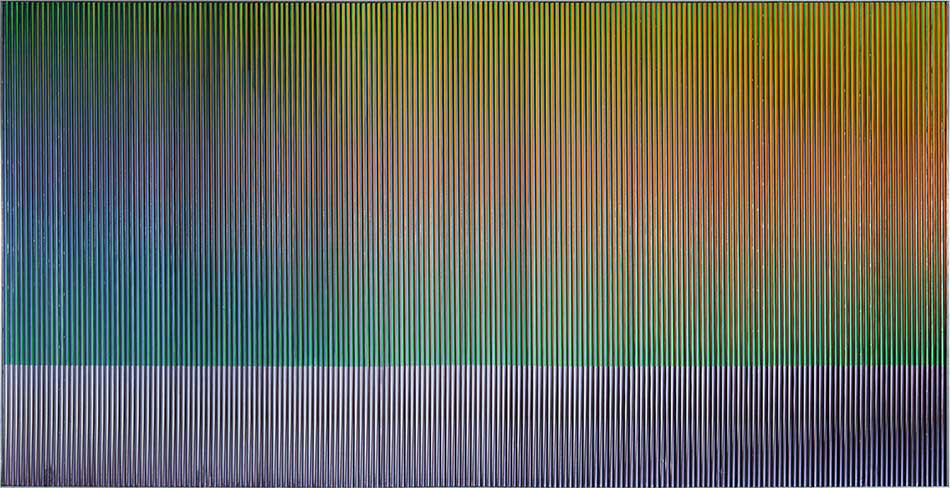
Carlos Cruz-Diez. Physichromie no. 1022, 1975
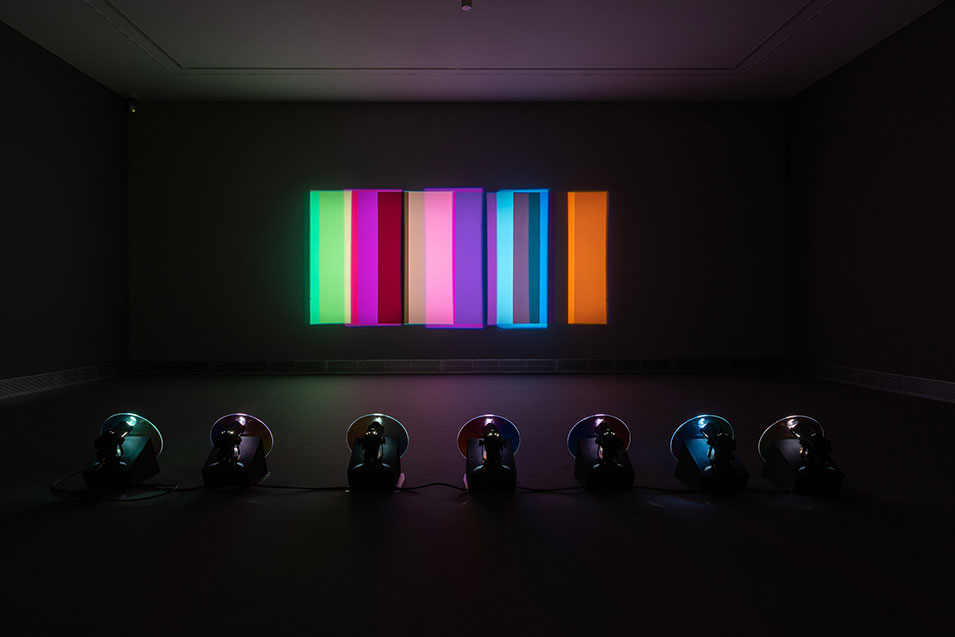
Karina Piesajovich. RGB/CMY2011-2026
RGB/CMY (2011/2026), by the Argentine Karina Peisajovich, is another of the works recently added to the MUN Collection. The installation faces two systems that we constantly manage: the RGB of the screens, based on red, green and blue light, and the CMY of printing, which uses cyan, magenta and yellow. The bands of light projected onto the painted stripes cause the colors to continually transform before us. In the artist’s work, her interest in the scientific properties of light and color and their emotional resonances come together.
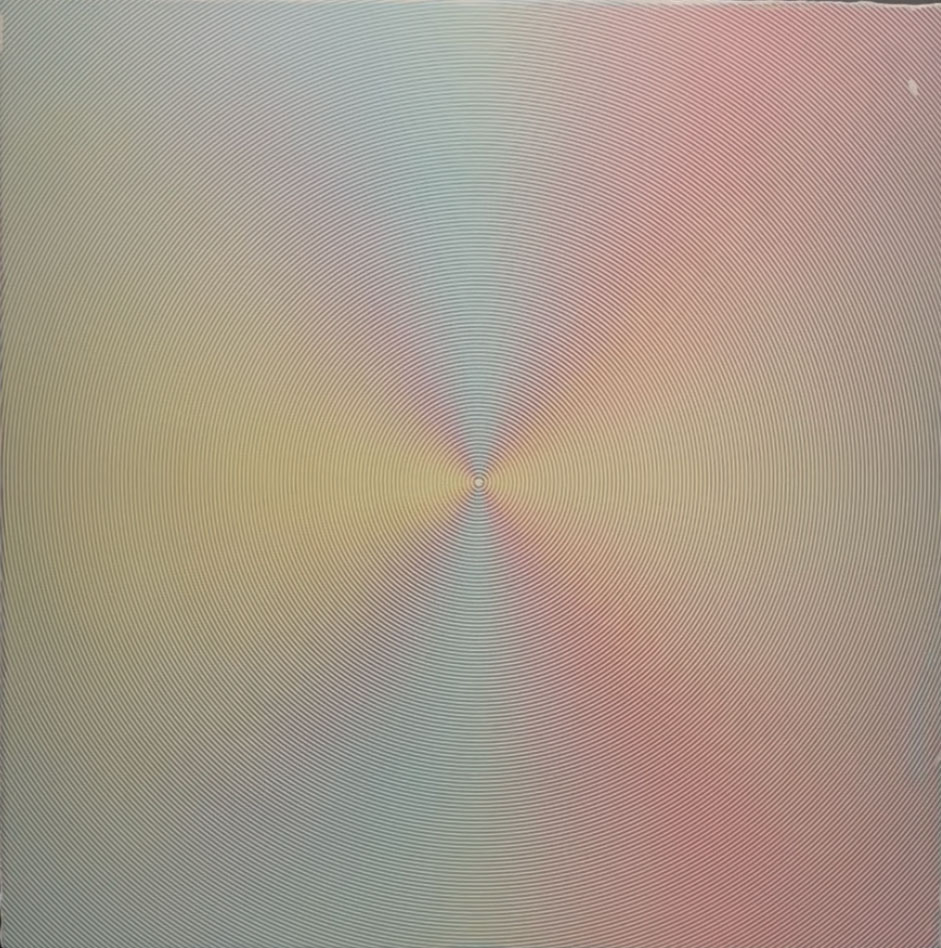
The work of Anoka Faruqee and David Driscoll also requires the movement of the viewer, although the result is very different. Their Interference Paintings They are constructed from patterns of concentric circles that, when superimposed, produce moiré effects. The surface appears to vibrate, move and even acquire volume. On a small scale, these effects are related to the so-called structural color, which does not depend on pigments but on the structure of a surface itself and which we find, for example, in the iridescent wings of some butterflies.
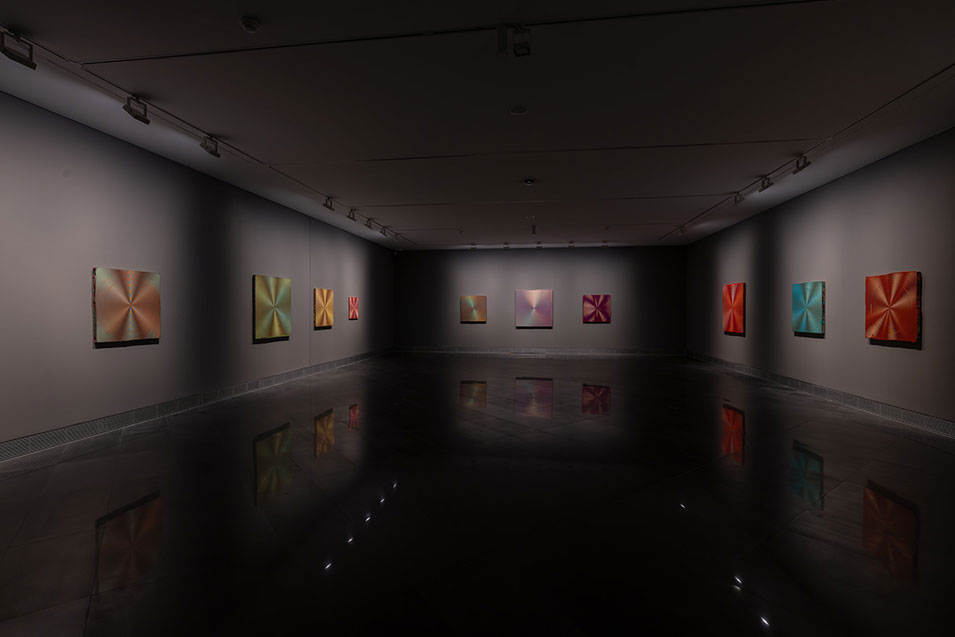
Room dedicated to the work of Anoka Faruqee & David Driscoll. MUN, 2026
The tour ends with Lineby the Los Dalton collective —Miguel Fructuoso, María Sánchez and Miguel Ángel Tornero—, a work that reflects on individual differences in our perception. Thirty volunteers with color blindness participated to make the version that we see in the MUN. Each one had to continue a line painted on the wall, choosing, among more than a hundred samples, the tone that they considered closest to the one used by the previous person, of which they could only see the last section. The resulting line, with its changes and discontinuities, makes visible something difficult to express in any other way: that we do not all see colors in the same way.
The exhibition continues outside the rooms, in the Atrium, with an interactive area designed so that the public can try, compare and continue asking themselves questions, fundamentally three: how do colors change? How are they produced? And how do they help us see? Among other materials, some butterflies are shown on loan from the Science Museum of the University of Navarra that allow us to observe the structural color present in nature. It is a space that takes the theme of color to other areas and invites the visitor to incorporate their own experience. Furthermore, on October 8, the Science Museum will inaugurate a parallel exhibition dedicated to color in the natural world, thus reinforcing the multidisciplinary nature of the project.
This crossing between disciplines will continue in the activities linked to the exhibition. It will be released in theaters on October 23 and 24. Resonancesa performance by Yaiza Pinillos and Olga Pericet arising from the MUN’s performing arts residency program, which will take some of these questions to movement and sound. The costumes and objects have been developed by Pinillos together with Fashion Design students from the Higher Technical School of Architecture. There will also be an interdisciplinary cycle of conferences organized with the Science Museum, workshops and meetings with artists.
“Live and direct” can be enjoyed simply by letting yourself be carried away by its spaces, the lights and the chromatic changes, but the exhibition also proposes stopping to look a little more closely at what we think we know and can appreciate its enormous richness. From Albers’ exercises to the line built by Los Dalton, the exhibition teaches us how color is changing, relative and, above all, different for each look.
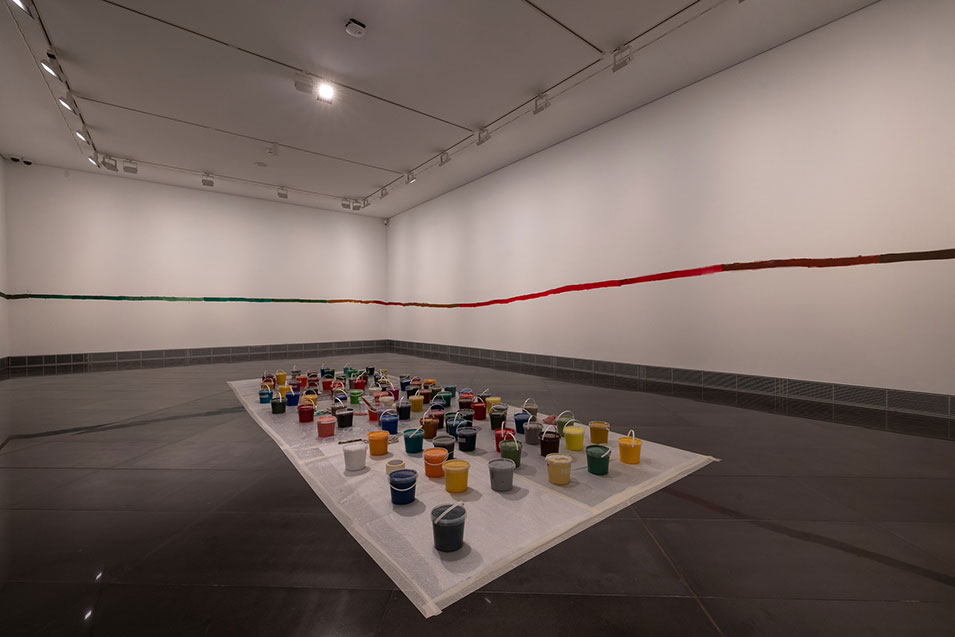
The Daltons. Line2023-2026
«Live and direct: color, perception and experience»
UNIVERSITY OF NAVARRA MUSEUM
University Campus, s/n
Pamplona
From September 16, 2026 to February 7, 2027