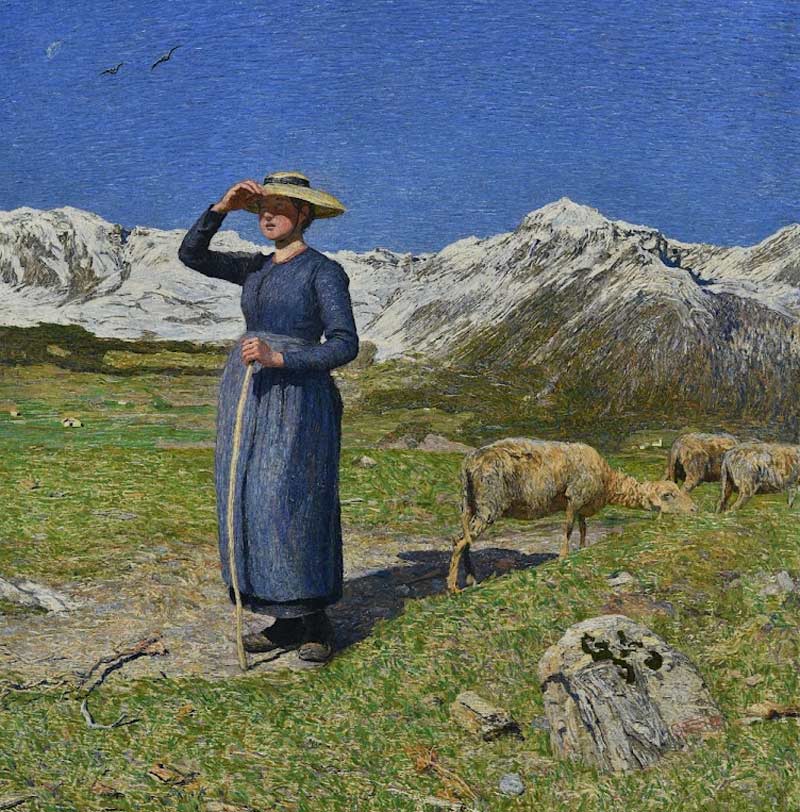
Paris. In 2021, visitors to the “Swiss Modernities” exhibition at the Musée d’Orsay were dazzled by Noon in the Alps (Mezzogiorno on the Alpi1891) (see ill. above) by Giovanni Segantini (1858-1899). The room text presented this artist in the company of Ferdinand Hodler, two painters “decisive for an entire generation”, to the “career […] international […] major figures of European painting and symbolism at the end of the 1890s. […] Segantini displays a sense of synthesis and simplification: his peasant subjects in mountain landscapes offer a meditation on man’s place in nature and the cycle of life. »
This approach had the merit of linking the painter to his national and European artistic environment, which only appears implicitly in the present exhibition. Perhaps the fact that one of the curators is Diana Segantini, his great-granddaughter (the other curator is the art historian Gabriella Belli), means that there is more emphasis on his personal life and on the choices that he himself put forward, such as only painting his landscapes outdoors, than on his place in the history of art. Especially since he built his legend, presenting himself as self-taught (even though he took painting lessons) and putting himself on stage “as an artist-prophet, inspired by Albrecht Dürer and Leonardo da Vinci” in a self-portrait executed when he was 35 years old.
The journey combines the story of a romantic life with the presentation of the work of a painter who seems to have practically come out of nowhere. It begins with childhood “marked by abandonment” (orphan, he was entrusted at 7 years old to a half-sister who could not take care of him). Then the scenography leads the audience on the path that literally elevated him since the evolution of his career as an artist was accompanied by moves, justified by a precarious economic situation as much as by the search for landscapes, leading him and his family ever higher into the Swiss Alps until his premature death, at an altitude of 2,700 meters. His last words, in an alpine chalet, would have been: “I want to see my mountains. » Journalists of the time elaborated extensively on this tragedy.
Giovanni Segantini (1858-1899), The two mothers1889, oil on canvas, 162 x 301 cm, Galleria d’Arte Moderna, Milan.
© Comune di Milano
Millet and Mauve: two pillars of Segantini
Apart from these personal difficulties, which the curators nuance in the catalog (we learn, for example, that the children’s education was ensured by “ specially recruited private teachers »a ruinous luxury), the visitor must gather the scattered information to reconstruct Segantini’s professional career beyond“the incredibly talented autodidact” that we are presented with. It begins in Milan under the influence of scapigliati (“bohemians”) and the painting My family (1881-1882) follows in the tradition of one of them, Tranquillo Cremona (1837-1878), whose works were sold by the art dealers Vittore and Alberto Grubicy de Dragon. However, Segantini met Vittore Grubicy at the end of the 1870s who became his advisor and merchant, paying him a salary from 1880. From 1882 to 1885, the same Grubicy stayed in The Hague and became friends there with the painter Anton Mauve. This artist from the Hague school, in line with that of Barbizon, cousin of Vincent van Gogh whose mentor he was in the early 1880s, is known for his paintings representing peasant life and in particular shepherds with their sheep or cows, paintings very popular with Anglo-Saxon amateurs, which must have interested Grubicy. In any case, Segantini adopted this theme from the 1880s. He, who could not travel because he did not have papers – he had not been declared in the civil registry – therefore based his iconography on two important influences received through his artistic entourage: that of Jean-François Millet (his different versions of The Last Labor of the daywho were very successful in the 1890s, are close to the Fagot carriers of Millet) and that of Mauve and her empathetic look at the peasants.
Grubicy knew Seurat’s pointillism, and Mauve was able to share with him van Gogh’s very personal research on divisionism. In 1886, the merchant pushed Segantini down this path. We can therefore be interested in van Gogh’s place in his work around light which he theorized and transmitted to those who gravitated around him, including his friend Giovanni Giacometti. The painter wrote a lot about art but did not, it seems, want to say what he owed to his predecessors.
In this exhibition, the first dedicated to him in France, it would have been interesting if the curators had shown his good knowledge of artists from the rest of Europe, supporting works and documents, the influences he received and those he himself exerted, for example on Wassily Kandinsky who claimed that he was “the most abstract of painters”. At least this last point is addressed with the exhibition “Für Giovanni Segantini” (“For Giovanni Segantini”) by Anselm Kiefer, presented at the same time by the Marmottan Museum, bringing together four tribute works by the German artist produced from 1988 to 2025.
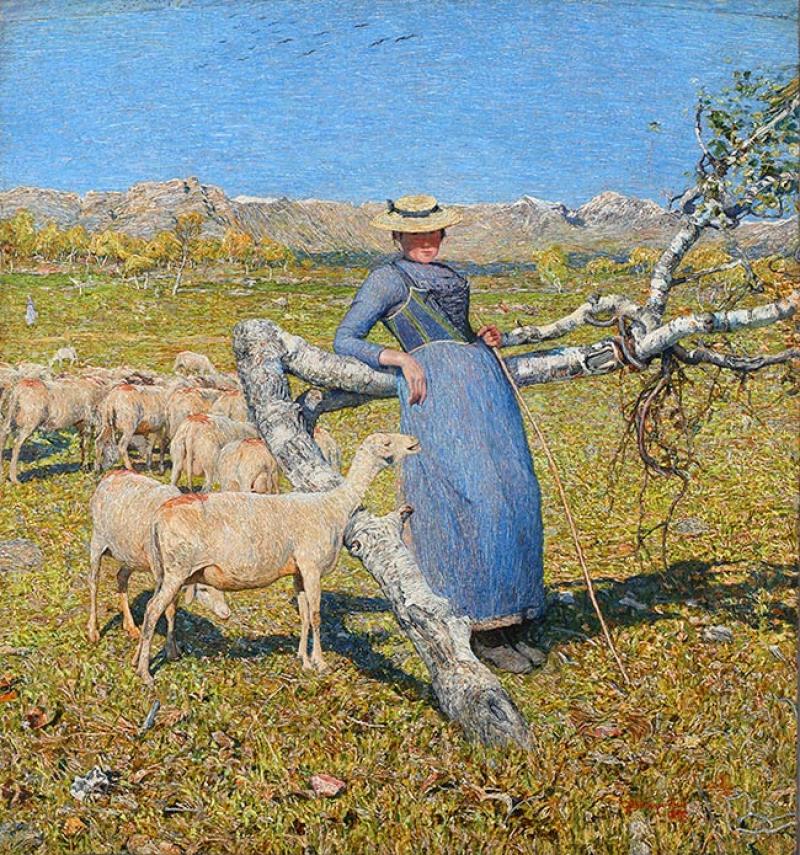
Giovanni Segantini (1858-1899), Noon in the Alps1892, oil on canvas, 86 x 80 x 2 cm, Ohara Museum of Art, Ohara Art Foundation, Kurashiki.
© Ohara Museum of Art, Ohara Art Foundation