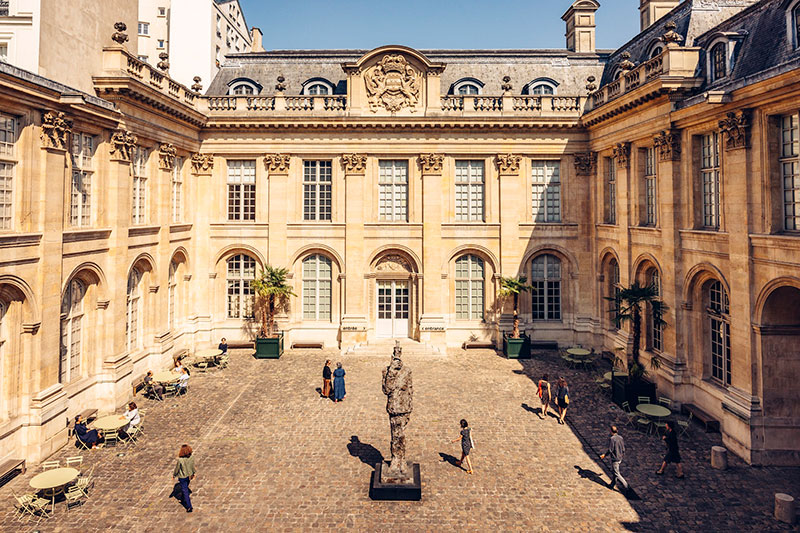
Paris. Almost thirty years after its inauguration in the Saint-Aignan hotel, in the 3rd arrondissement, the Museum of Art and History of Judaism (MAHJ) will renew its career in depth. “We have made the diagnosis of a permanent journey where the contextualization of works is not sufficient for an audience ignorant of Judaism, explains Paul Salmona, director of the MAHJ. We must also give an increased place to temporary exhibitions, an issue to attract the local public and show the vitality of the cultures of Judaism. »» The project, encrypted at 22 million euros, is largely funded by the City of Paris (€ 9 million) and the Ministry of Culture (€ 6.5 million), associated since 1998 and the creation of this museum. This budget is supplemented by 3 million from the state-region plan contract, the Promahj Foundation having to bring the remaining 3.5 million. This foundation will be able to count on the members of the MAHJ, the number of which has tripled in ten years (1,800).
The site will relate to the clos and the cover of the XVIIth century mansion – property of the city of Paris, client -, remedy for sealing problems, but also air conditioning, connecting the museum to the network of municipal freshness. Paris also provides a disused school located nearby, in which the museum offices and library will be installed. A move which makes it possible to release 600 square meters in the mansion, assigned to the permanent route (which gains 35 % of surfaces with 1,226 m²) and temporary exhibitions; These will have a more passable tray than current spaces, on the first floor. Two years of closure will be necessary, from the end of 2027 to 2030, to carry out this project.
Better known the history of Judaism in France
The permanent exhibition will now have an entry and an exit overlooking the bookstore. The new museography will insist on the history of Judaism in France: “This is one of the paradoxes of the permanent journey, underlines Paul Salmona, because France was a pole of attraction for the Jews of Europe and the Mediterranean periphery, with the uninterrupted presence after the medieval evictions of communities remaining in the Comtat Venaissin and in Alsace. However, our journey neglects this story of Jews in France, unlike other major European Jewish museums, who favor their national history, like those of Amsterdam or Berlin. »»
A large place will thus be granted in the 20th century, where the current exhibition stopped before the Second World War. Jewish resistances during the occupation, the symposia of Jewish intellectuals in French or the arrival of Jewish populations in North Africa in mainland France can be treated. The new course will also insist on the diversity of Jewish communities located on the territory, as well as the originality of the Jewish integration model in France. “It is also a political project, explains the director, Because there are few institutions that can arouse this knowledge of the Jews, not through the discrimination and persecution they have undergone, but through their culture. »»