Five years after its last Spanish retrospective, at the MACBA in Barcelona, the Reina Sofía Museum dedicates its first anthology in Madrid to Felix Gonzalez-Torres: it is titled “Sweet Revenge”, referring to the use that this Cuban author made of beauty as a form of social contestation halfway between celebration, criticism and resistance.
The production of González-Torres, who died in Miami when he was not yet forty years old, due to complications derived from AIDS, emerged in a very specific historical and geographical context: the American one between the mid-eighties and mid-nineties. With this exhibition, curated by Alejandro Cesarco and Nancy Spector, we seek to reinterpret it from a contemporary perspective open to the affective and attentive to its validity among current authors. As both have further emphasized, González-Torres fervently believed in the potential of art to promote change for the better, something that seems especially crucial today.
Throughout multiple interconnected rooms, more than fifty works come our way from institutions such as the Solomon R. Guggenheim Museum in New York, the San Francisco Museum of Modern Art or Glenstone, in Maryland, as well as from private collections.
This exhibition reminds us that the city of Madrid was an emotionally complex place for Gonzalez-Torres, who in 1971 was sent to Spain within the framework of a program aimed at transferring children from Cuba to keep them away from the regime. He remained in our country for a short time before moving to Puerto Rico and later to New York, where he would spend most of his adult life, and he did not return to Madrid until 1991, due to his participation in a group exhibition. This is how he remembered that first return in writing: …I returned to Madrid almost twenty years later—sweet revenge—.
It emphasizes, therefore, the exhibition in the Cuban’s use of the resources of difference, contradiction and paradox in his creations, many of them built on formal or conceptual opposition and therefore disconcerting. So much so that the public will be able to take some of them home, like stacks of paper or piles of candy that can be replaced again and again; and others in turn can be modified, such as luminous garlands, textual portraits or advertising billboards. Although the work is given to the viewer, it also demands an involvement that breaks their passivity: it challenges visitors, collectors and curators to participate in the creation and transmission of a changing meaning linked to times and settings.
In the context of the AIDS crisis, and as an HIV-positive gay individual, his work is marked by the loss of his partner, Ross Laycock, in 1991. His continuous pairings of identical objects (mirrors, clocks, lights) refer to erotic union and queer love, and escaped censorship through abstraction. Furthermore, he reinterpreted the visual languages of arte povera, conceptual art and minimalism from a particular approach: free and participatory.
Felix Gonzalez-Torres: Sweet revenge. Reina Sofía Museum, 2026. Photography: Roberto Ruiz
Felix Gonzalez-Torres’s installations respond to a network of principles, instructions and possibilities, to his personal experience and his political opinions. Some were produced for each presentation; others were reinterpreted each time they were shown, taking into account the variables of the place and its social, political and aesthetic contexts. All of this points to a performative aspect in González’s practice: rights and responsibilities that are interpreted and put into practice by the owners of the works, the curators who present them, by the public who disseminates them and by those who maintain them. The Cuban thus discusses, over and over again, the notions of authorship and permanence from flexibility.
The show starts with Untitled (Revenge) (1991), that sculpture made up of blue candies with transparent wrapping that González-Torres showed in 1991, in the exhibition “The Wild Garden” at the Caja de Pensiones Foundation in Madrid, and which constitutes the axis of “Dulce venzanga”.
We will also contemplate a textual portrait from 1989, perhaps a self-portrait, and early works influenced by his previous stay in Madrid, such as the photographic puzzle Untitled (Madrid 1971)from 1988. A pile of white sheets, Untitled (Passport)from 1991, refers both to the idea of travel and forced displacement, in addition to his distrust of linear methods of writing history and common representations of identity.
The tour continues with pieces linked to politics, the relationship between the public and the private and how these issues affect people’s lives; one of them is titled Public opinionwhich the author defined as a “fragile truce”, a temporary confluence of diverse attitudes that aspire to formulate a shared conviction in the collective sphere. For centuries, authorities have influenced the population to think and act homogeneously, but for the artist, in ideal situations, that public opinion is formed organically, from the bottom up, when value systems align and lead to collective action.
For the first time we will see the billboard in frieze format Untitled (Portrait of Austrian Airlines)from 1993, relating again to circulation and displacement, like, basically, all of his compositions. It has been updated by curators to reflect siege sites around the world in 2026, along with the years when global technology companies went public.
We will also see a selection of their pairings—two full-length mirrors placed a breath away, a double tomb, dancers performing a duet—that allude to romance, erotic union, the joy of loving and the fear of loss. Objects thus paired cannot be censored. However, González-Torres did not intend to go overboard by giving a specific meaning to these forms, but rather to show their possible poetic associations.
These pieces also point out that González-Torres’ art does not distinguish between the personal and the political, it transits between individual and collective stories, revealing their connections at a time when private behaviors are increasingly monitored and legislated.
His work, likewise, highlights that history is not linear: it does not stop, it returns to itself, it slips away. This is shown in a sculpture composed of a stack of red paper in which the names Himmler and Helms coexist.
The Cuban evaded mimetic representation by resorting to different forms of abstraction. The body is very present in his art, but rarely visible as such. He does appeal to contexts: his written portraits recognize that the life of an individual is inseparable from the historical events that precede and cross it. His diagrams translate data into visual forms, as in the artist’s blood test graphs with barely visible diagonal lines, ascending or descending, to track the physical health of the body.
Physically we will penetrate Untitled (Beginning)from 1994, a green curtain that presides over the entrance to one of the last rooms, and evokes the idea of thresholds, not only in their physical sense, but as exceptional events, moments of uncertainty and open possibilities. It works as a filter and colors the light.
The montage ends with a section dedicated to ephemeral materials that includes the sources of Gonzalez-Torres’ quotes present in the room texts of the entire exhibition, as well as different examples of printed material related to the exhibitions and installations carried out during the artist’s lifetime. Some of them reflect the development of their practice in a selection of invitations, press releases, statements and publications whose tone oscillates between ideological declaration and vulnerability.
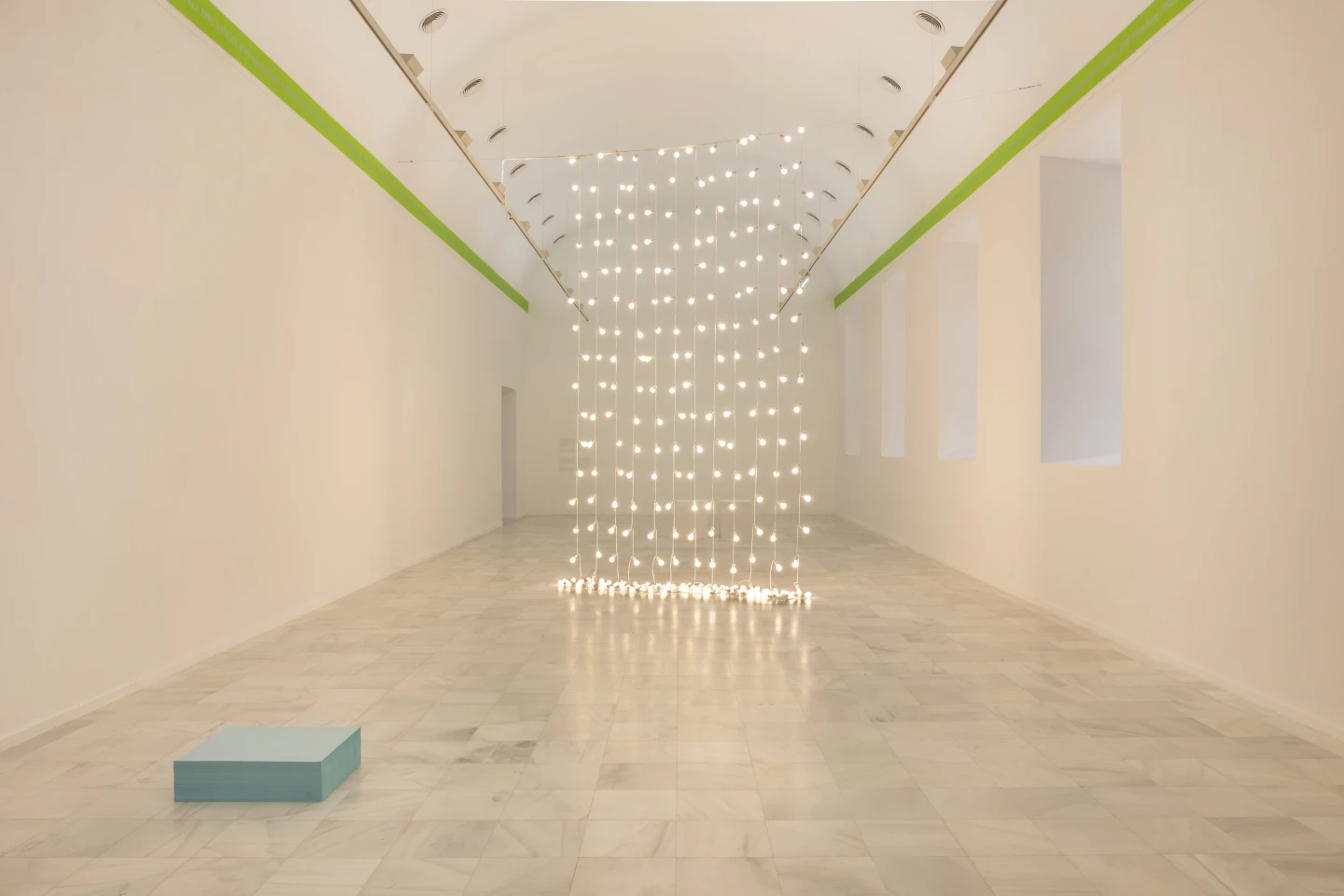
Felix Gonzalez-Torres: Sweet revenge. Reina Sofía Museum, 2026. Photography: Roberto Ruiz
“Felix González-Torres: Sweet revenge” .
NATIONAL MUSEUM REINA SOFÍA ART CENTER. MNCARS
C/ Santa Isabel, 52
Madrid
From May 27 to October 12, 2026