Discovered last April in a field in the Østerdalen valley in eastern Norway, the Mørstad hoard constitutes the largest set of Viking-era coins ever unearthed in this country. With more than 4,772 silver coins counted in May, projections anticipate a total exceeding 5,000 units at the end of the upcoming excavations according to the magazine Science and Life.
The hoard, officially named the Mørstad Hoard after the neighboring farm, contains silver coins minted between the 980s and the 1040s. More than 95% of the coins identified come from England and Germany, the two great monetary powers of early medieval Europe. The rest consists of a few Danish coins and a limited number of Norwegian coins.
The story of their discovery is classic. Two amateur prospectors, Vegard Sørlie and Rune Sætre, spotted 19 silver coins in a plowed field near the village of Rena, in the municipality of Åmot. Immediately suspecting that this was an important find, the two men stopped their search and immediately alerted county archaeologists, in accordance with guidelines from the Norwegian Directorate of Cultural Heritage. During the first day of professional excavations, the count exceeded 70 pieces, then 500, then 3,000 within a few weeks.
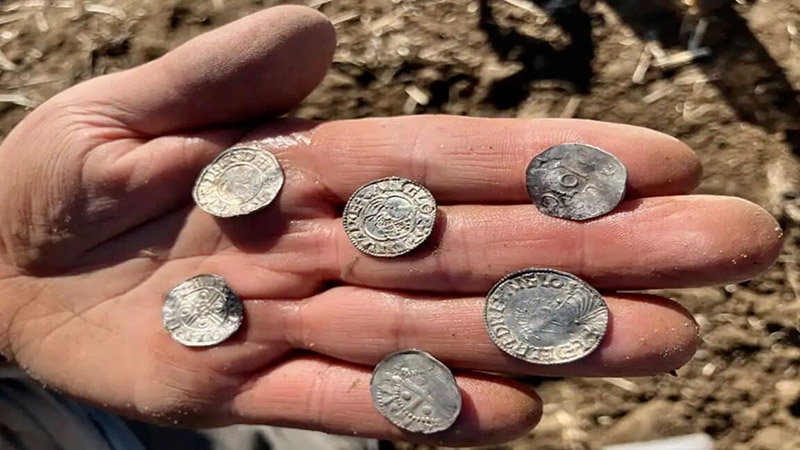
Numismatists at the Museum of Cultural History in Oslo have identified several mints dating from the reigns of Æthelred II of England, known as “the Without Council”, who ruled from 978 to 1016, of Knut the Great, ruler of England, Denmark and Norway who died in 1035, as well as Otto III, emperor of the Holy Roman Empire who died in 1002. Among these Discoveries also include a coin attributed to Harthacnut, king of Denmark around 1030-1035.
Coins from the Mørstad hoard.
© Innlandet County, 2026
The hoard also contains some fragments of silver cut into pieces, a common practice in the Viking era for transactions by weight. The state of conservation of the pieces surprises experts. This exceptional degree of conservation is due to the nature of the soil. The field where the coins lay is almost completely free of stones, which protected the silver from abrasion caused by centuries of plowing.
According to Professor Svein Harald Gullbekk, a numismatist at the Museum of Cultural History in Oslo, the treasure was buried around 1046-1047. This dating is based on the presence of the most recent coins, struck during the first years of the reign of Harald Hardrada, and a contemporary Danish coin. The moment is pivotal because it corresponds to the extreme end of the Viking Age and the beginning of the transition to medieval Norway.
Until the accession of Harald Hardrada (1046-1066), Norway did not have a unified national monetary system. Foreign currencies (English, German, Arab) dominated exchanges, often used not as a means of facial payment but by the weight of their money. It was precisely Harald Hardrada who, returning from Byzantium around 1045, introduced the first Norwegian national monetary system, establishing a currency called the mark. The few Norwegian coins present in the Mørstad treasure were therefore still freshly issued at the time of burial.
Researchers still don’t know for sure what led the owner(s) to never return for their belongings. Several hypotheses are put forward. The political instability which then shook Scandinavia, marked by conflicts and changes of dynasties, could have led to the abandonment of this fortune. Archaeologists also believe that it was a commercial reserve kept in a leather purse that has now disappeared, then dispersed by plowing over the centuries. Finally, some specialists evoke a possible ritual or funerary dimension, several Viking treasures having been interpreted as offerings intended for the afterlife.
Under the Norwegian Cultural Heritage Act, any archaeological discovery prior to the Reformation of 1537 automatically belongs to the state. The Mørstad treasure will therefore become part of the national collections and will become a major resource for research on the Viking Age and the Scandinavian early Middle Ages. There will be an exhibition dedicated to him at the Museum of Cultural History in Oslo, although museum officials say it will take time before the entire collection is visible to the public. The two discoverers, Rune Sætre and Vegard Sørlie, will receive a “discovery” bonus, shared equally with the owner of the land, in accordance with Norwegian law.