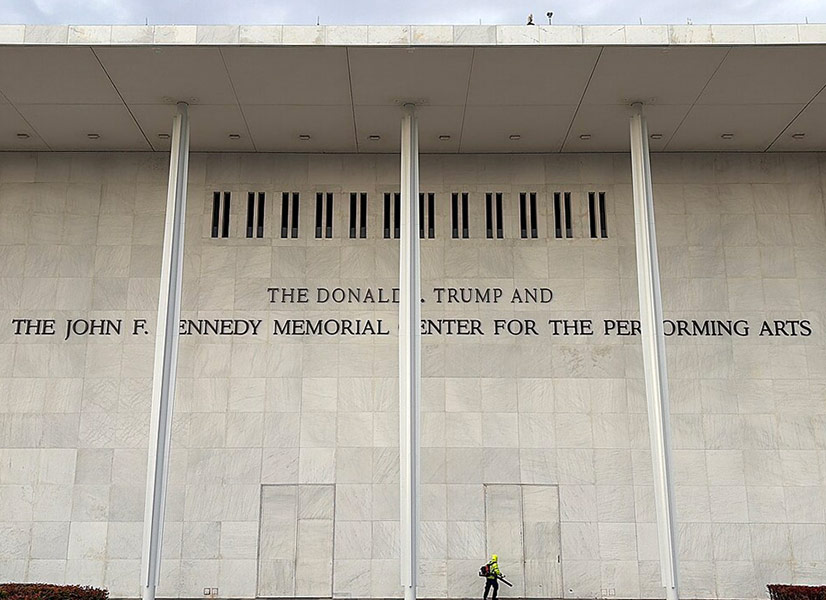
The facade of the Kennedy Center will have to return to being what it should never have ceased to be: that of the John F. Kennedy Center for the Performing Arts. On May 29, federal judge Christopher R. Cooper, of the District of Columbia Court, ordered the removal of Donald Trump’s name from the Washington cultural institution, which since last December had become the “Trump Kennedy Center” in the communication of its new direction. The judgment gives the defendants fourteen days to remove any physical or digital signage attributing the building to a name other than that of John F. Kennedy, correct the website and official documents, withdraw the trademark applications filed around the name “Trump Kennedy Center” and send the court a declaration attesting to their compliance.
The judge is not content with an observation of principle: he declares “null, void and without legal effect” the board resolution of December 18, 2025, which added Trump’s name to Kennedy’s. He issues a permanent injunction against any attempt to officially give the institution a name other than that established by Congress, unless a new law is adopted by it. “Congress gave the Kennedy Center its name, only Congress can change it”he wrote in his 94-page judgment.
The Kennedy Center is not a venue like any other. Established by Congress in 1958 as the National Cultural Center, it was renamed in 1964 in honor of John F. Kennedy, assassinated a few months earlier, before opening in 1971. A national center for the performing arts, a presidential memorial, a place of cultural policy and a 7-hectare campus on the banks of the Potomac, it is home to the National Symphony Orchestra, the Washington National Opera, the Kennedy Center Honors, the Mark Twain Prize and numerous educational programs.
The Kennedy Center in Washington DC
The legal proceedings arose from the complaint of Joyce Beatty, Democratic representative from Ohio and ex officio member of the board of the Kennedy Center. She contested both the change of name, the modification of the internal statutes which had deprived members of their right to vote, and the decision to close the establishment for two years for work. On the first two points, the judge basically agrees: the legal members cannot be transformed into administrators without voting rights by simple internal decision and the name of the center cannot be modified by the council.
The work component is more nuanced. The judge suspends the closure announced for July 4, but does not block any renovation. Kennedy Center management says the building requires urgent and significant restoration, funded by $257 million (220 million euros) approved by Congress. Its executive director, Matthew Floca, described infiltrations, outdated equipment and security risks. The court does not contest this work. He believes, however, that the two-year closure was ratified by the council under irregular conditions: the administrators would have learned of the project like the public, through an announcement by Donald Trump on Truth Social, before approving it on March 16 on the basis of an insufficient file, without contradictory analysis of the costs, the impact on programming, nor the consequences for the memorial function of the place.
The suspension of the closure is therefore a provisional decision. It prohibits implementing the March 16 decision, but leaves the council with the possibility of coming back with a new plan, provided it deliberates independently and prudently.
Donald Trump reacted with virulence as usual. On Truth Social, he personally attacked Judge Cooper, appointed under Barack Obama, accusing him of preventing a renovation that he considers essential. The president says the Kennedy Center would be “rusty”, ” rotten “ and infested, and that a complete closure would be necessary to avoid danger to the public. He also announced that he wanted “transfer” control of the institution to Congress, by asking the Department of Commerce to prepare the modalities. This path remains legally uncertain: the Kennedy Center has already been created by Congress and operates under a specific legal regime, with a statutory board of directors.
Kennedy Center spokeswoman Roma Daravi said the institution is confident it will succeed on appeal and will pursue all legal avenues to pursue the restoration. Trump and the board can therefore challenge the decision in the federal appeals court for the Washington Circuit. But, unless suspended by a higher court, the injunction to remove the name remains applicable within the fourteen-day period.