
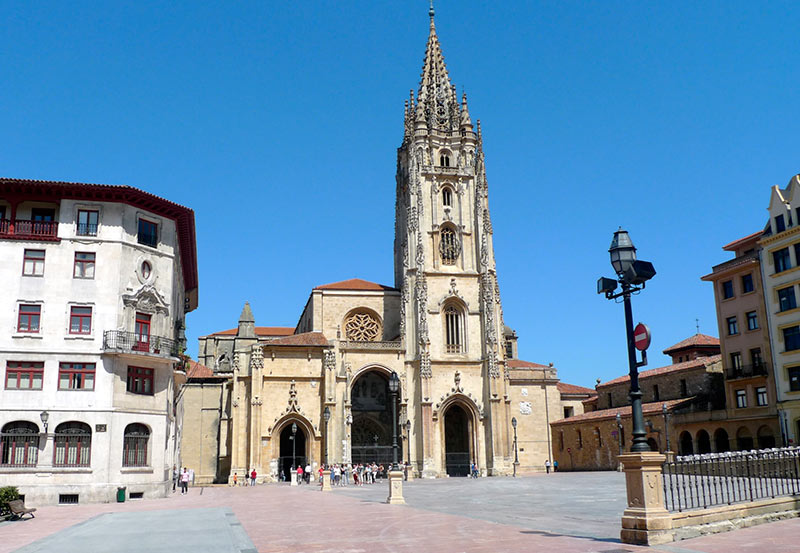
Spain. After Madrid (1992), Santiago de Compostela (2000), Salamanca (2002) and San Sebastian (2016), Spain will once again host the title of European Capital of Culture in 2031, which it will share with a Maltese city. On March 13, 2026, a European jury established the list of four finalists at the end of a process initiated several years previously. The final decision is expected in December 2026.
Since the 2010s, the jury has gradually abandoned large cities and projects backed by new cultural facilities in favor of medium-sized towns, with less spectacular projects but involving more residents. A change of direction of which the four Spanish cities selected have well understood the stakes.
Grenada: the strongest case
Granada is above all a university city. The capital of eastern Andalusia, it has 230,000 inhabitants, 60,000 students and one of the largest universities in Spain which nourishes a dense scientific research ecosystem and an active cultural scene. But the city is also home to a world tourist monument: the Alhambra attracts 2.7 million visitors per year, an attraction which has for years tended to folklorize its culture rather than renew it.
His project is based on the reconversion of several historic sites, the former San Luis convent, the Nasrid palace of Alcázar Genil, the former Azucarera sugar factory, and on existing festivals, including Cines del Sur, dedicated to Latin American and Asian cinema. A space dedicated to cultural innovation, the HUBIC, is planned to anchor contemporary creation in this heritage system. The application is the best constructed of the four: governance in place, projects identified. But as for the three other finalists, the overall budget has not yet been finalized. This is precisely what the jury asked to clarify before December 2026.
There remains a fundamental question. Granada suffers from marked social inequalities in its northern districts, and the jury will be careful that the programming is not concentrated solely around the Alhambra. The city is aware of this: the “Mi Barrio es Cultura” program plans to deploy cultural activities in the Distrito Norte, Chana and Zaidín neighborhoods. A signal, but one which must be translated concretely in the final file.
The Alhambra in Granada (Andalusia).
Oviedo: regional coherence as a bet
With its 220,000 inhabitants, Oviedo does not play in the same heritage category as Granada, and it knows it. The capital of Asturias, an industrial region whose reconversion is still in progress, the city focuses on something else, a territorial logic which brings together the 78 municipalities of the region in a common project, making culture a tool for opening up as much as an artistic program. Its UNESCO-listed pre-Romanesque heritage, its Príncipe Felipe auditorium and its university founded in 1608 give it solid institutional credibility. But its real material is elsewhere, in the industrial and mining memory of Asturias, alive, conflicting, still little exploited culturally.
The flagship project is the reconversion of the former La Vega arms factory into a cultural center, which the jury explicitly praised. He also highlighted the territorial anchoring of the project and its extension to the 78 municipalities of Asturias. The jury’s recommendations relate to international cooperation and external projection. These are the weak points to be filled by December 2026.
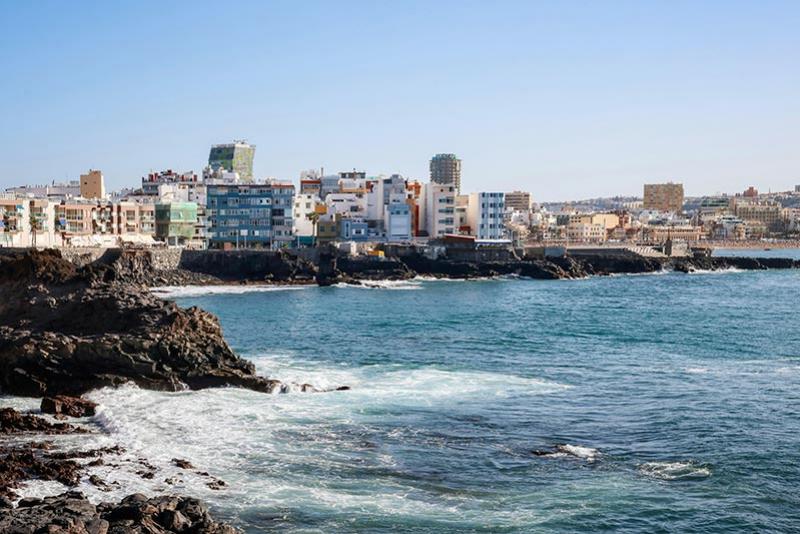
Las Palmas on the island of Gran Canaria.
Las Palmas de Gran Canaria: an island!
Gran Canaria is first and foremost an island, the largest of the Canaries, a Spanish archipelago located off the coast of Africa. With 380,000 inhabitants, the archipelago’s largest port and a diversified economy, the city of Las Palmas de Gran Canaria has a stature that its competitors do not have. Its Atlantic Center for Modern Art has established itself as a reference in contemporary art between Europe and Latin America, and its carnival is among the most important on the continent. Above all, its geographical position at the crossroads between Europe, Africa and Latin America is an argument that no other finalist can claim. If Valletta, Malta, won the title in 2018, Gran Canaria would be the first major non-Mediterranean island to achieve it.
The project relies on this Atlantic identity to reposition the island territories in the European cultural space. The hybridization between culture and sport is one of the most original ideas of the selection, with the association of the Gran Canaria basketball club with the candidacy, transforming events with several thousand spectators into creative spaces. But Valletta, capital of Malta, in 2018, and Paphos, in Cyprus, in 2017, have already embodied this insular and peripheral logic with a solidity that Las Palmas has not yet achieved. No overall budget for 2031 has been decided, and the file is largely based on the existing one. For a metropolis of this size, this is insufficient.
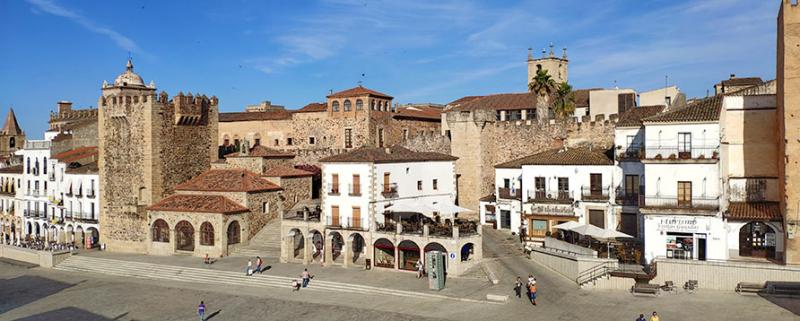
Panoramic view of Cáceres.
Cáceres: the conceptual outsider
Cáceres is the surprise of the selection. With 95,000 inhabitants, it is the smallest finalist city, and potentially one of the smallest European Capitals in the history of the program. Its medieval historic center, listed by UNESCO since 1986, and the establishment of the WOMAD world music festival for decades bear witness to an international cultural identity that few cities of this size can display. Its candidacy is based on the Euroregion EUROACE, a cross-border cooperation structure which brings together Spanish Extremadura, Alentejo and Central Portugal. This is undoubtedly the most authentic European dimension of the four files.
The project, based on artist residencies in rural areas, cultural routes crossing several municipalities and governance conceived as collective, is the most original of the selection. It is also the least advanced, no overall budget identified, programming still at the intention stage. Being small can become a story, Cáceres knows this and plays this card intelligently. If she won, she would go down in the history of the program as one of its smallest winners, alongside Sibiu in Romania, around 170,000 inhabitants, which won the title in 2007.
In Spain, the autonomous communities have their own cultural competences and budgets independent of the central government. Rafael Ivorra, Deputy Director General of International Relations at the Ministry of Culture, puts it clearly:“A European Capital of Culture requires coordination between administrations, the cultural sector, civil society and universities, with institutional stability and sufficient management capacity. » However, tensions between municipalities and autonomous communities are frequent, including on cultural issues.
The four finalists will have to submit their bid books revised between September and October, before the jury visits each city.


