The exhibition by painter Reggie Burrows Hodges (b. 1965) at the Malta International Contemporary Art Space (MICAS), entitled “Mela”, is in many ways a challenge, since it involves adapting an intimate and atmospheric painting to the volumes of a 17th century fortress converted into a museum space.
The title “Mela” is borrowed from an omnipresent discursive marker in the Maltese language, a particle which often precedes the expression of a thought. For the artist, this word sums up the attitude of immersion that he chose during his extended stay on the island in 2024-2025: soaking up Malta before painting. Reggie Burrows Hodges transposes his universe usually anchored in the African-American experience towards new motifs, which he draws from the construction sites which are redesigning the island, its rocky coasts and the persistent shadow of Caravaggio. The purpose of the exhibition is kept in broad terms. However, this intention comes up against a problem of architectural scale.
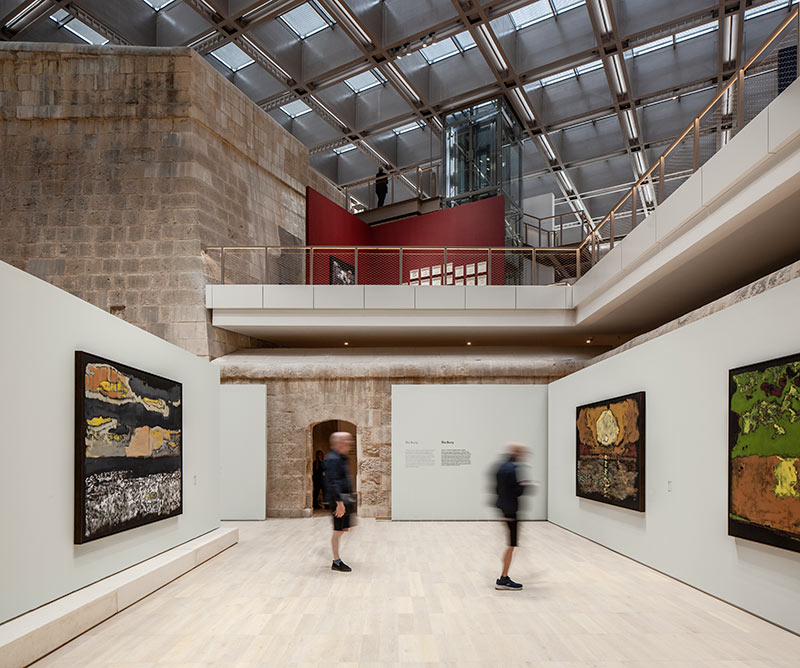
Reggie Burrows Hodges, The Buoy – Phoenix2025, acrylic and pastel on canvas, 161 x 257 cm.
© Photo Jens Ziehe
Courtesy The artist and Karma
Born in Compton, California, Reggie Burrows Hodges follows an atypical path. After studying theater at the University of Kansas, he founded a reggae-dub group in New York then became a professional tennis coach, before turning to painting. His style is immediately recognizable. He first covers the canvas with a black background, then makes the figures emerge from their environment, using gestural and vaporous touches mixing expressionist abstraction and narrative figuration. The silhouettes, without identifiable features, are an aesthetic choice linked to his experience as a black man in America. By refusing identification, he proposes a universal humanity without erasing the racial context which structures his vision.
Four groups structure the exhibition under the curatorship of Edith Devaney. The Labor series pays tribute to the workers who built MICAS. With Labor: Place of Honeythe artist represents the grid pattern of the roof still under construction, echoing the construction of the building. THE Seascapes are inspired by the waters surrounding the island and Maltese seaside customs. The series Buoy brings together the most abstract works. The artist also invests the exterior vault of the building with a sound installation inspired by the Neolithic musical traditions of Malta.
The centerpiece, Mamajamma (2025), a 4 x 8 meter canvas, is a response to The Beheading of Saint John the Baptist (1608) by Caravaggio, painted in Malta during the master’s exile. The artist transposes the violent scene into a game of Maltese water polo, suggesting sport as a new secular religion. The reference remains difficult to perceive without the mediation text. Additionally, hanging compromises its visual effectiveness. To observe it as a whole, the visitor must crane their neck, look for the angle, navigate between the levels.
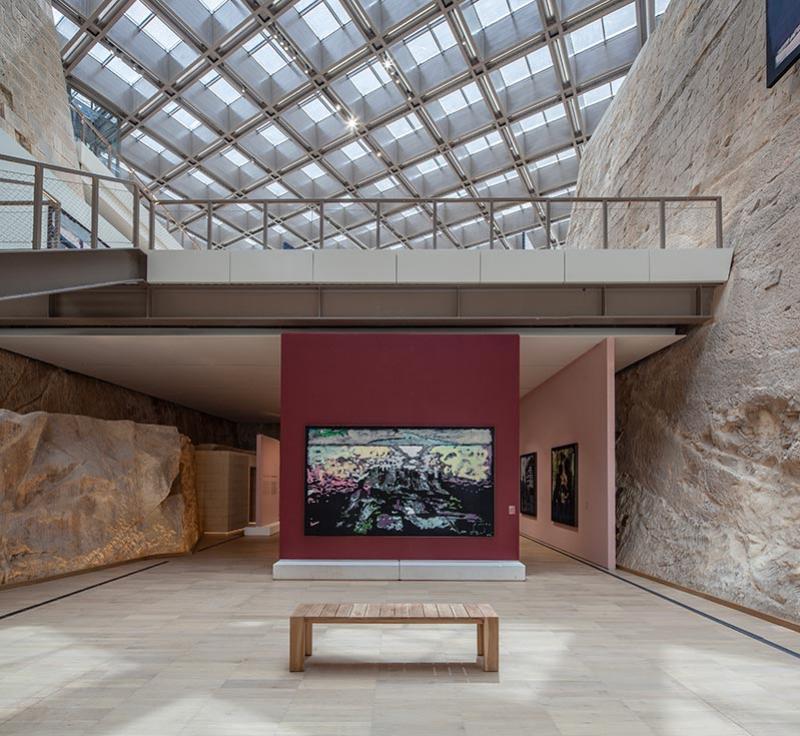
View of the exhibition “Mela” by Reggie Burrows Hodges at MICAS.
© Jens Ziehe
The MICAS is an 8,360 m² art center designed by the Florentine firm Ipostudio within the 17th century fortifications of the Knights of Saint John, topped with a framework of welded steel beams. Its levels are arranged in the bastions in a succession of very high volumes, opening onto the outside and the sea. This architecture serves the facilities. But for painting, even large format, the calculation becomes more complex. The verticality of the rooms and the multiplicity of levels disperse the eye instead of concentrating it on the painted surfaces. The architecture captures some of the attention that the exhibition sometimes struggles to retain.
However, we must do justice to the scenographic work of Cécile Degos. The question of light was treated rigorously. Using a black background in a painting carries a double risk. If the room is too dark, the figures dissolve. If it’s too bright, the reflections will flatten the surfaces. Aware of the exceptional nature of natural light, the scenographer partially obscured the roof, in order to diffuse the light and avoid the patterns projected on the ground. The lighting avoids both pitfalls, allowing the silhouettes to stand out with enough presence for the eye to perceive them without having to look for them.
Another judicious decision deserves to be noted, especially as it constitutes a first in the artist’s career. The paintings are hung here on painted picture rails. The raw canvas on which he works is highlighted. It stands out with more force than on a neutral background, while the depth of the blacks gains intensity and presence.
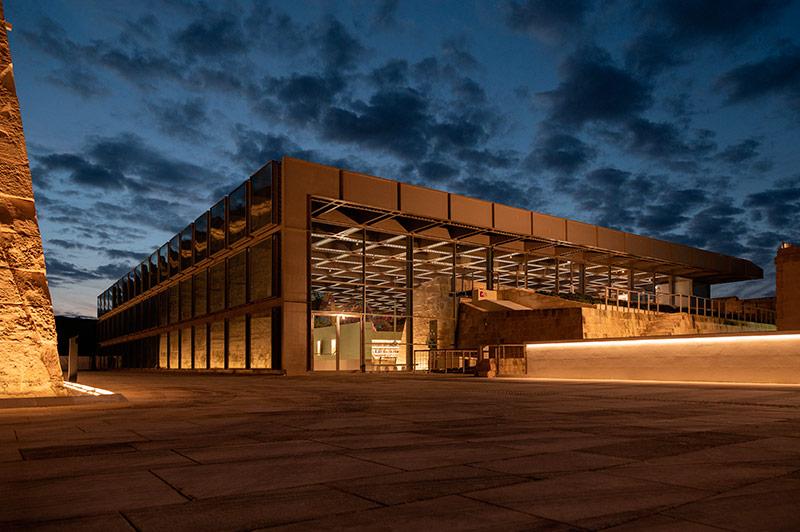
The Malta International Contemporary Art Space (MICAS).
© Sean Mallia