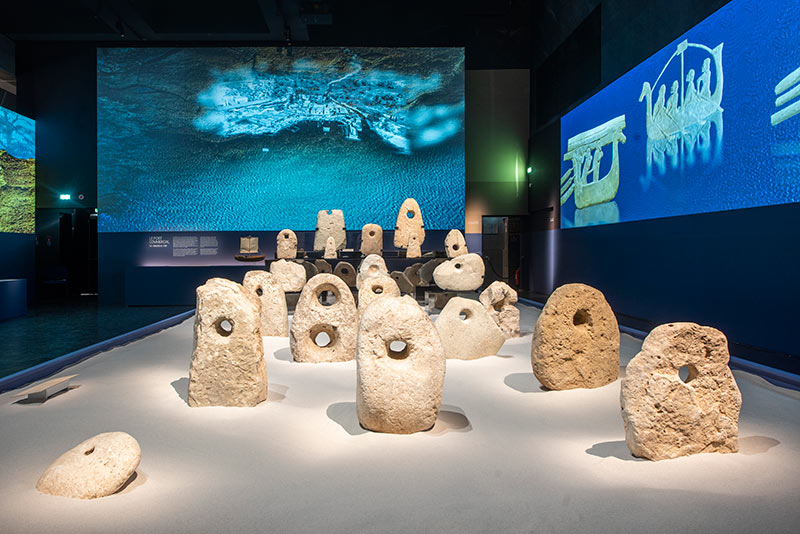
Paris. Co-produced with the General Directorate of Antiquities of Lebanon, the exhibition of the Institute of the Arab World (IMA) traces several millennia of a site occupied since Prehistory. Initially scheduled for the end of 2024, then canceled due to Israeli bombings, it was rescheduled for spring 2026: but several pieces from Lebanese collections are missing, as evidenced by the cartels and empty locations along the route. Located on a height of the coast, Byblos was “the oldest trading port of the Bronze Age”according to co-curator Élodie Bouffard of the IMA. This is the theme of the first part of the exhibition, centered on the sea and the commercial activities of Byblos (“Jbeil” in Arabic): a plateau covered with sand thus presents holed stone anchors, found in large numbers off the coast of Byblos (from the 3rd to the 1st millennium). These anchors, sometimes used as ex-votos, take on the appearance of sculptures, and are surrounded by large screens projecting reconstructions of the ancient port. The immersion remains pleasant thanks to the scenography by BGC Studio, which is also based on showcases dedicated to the cedar trade throughout the ancient Mediterranean.
View of the exhibition “Byblos, Millennium City of Lebanon” at the Arab World Institute.
© IMA / Alice Sidoli
Thousand-year-old weapons and jars
The rest of the exhibition presents pieces from Franco-Lebanese excavations on the site, such as these jars used to bury the deceased (5th millennium BC) discovered by the hundreds, and beautifully crafted weapons. Byblos delivered “one of the most important weapons depots in the ancient Near East according to Élodie Bouffard, and these weapons (from the 3rd to the 2nd millennium) are displayed in elegant display cases which highlight their ornaments. Room texts and labels recall that the site was plundered several times, but that certain parts were spared, explaining the exceptional discoveries: dozens of metal warrior figurines (2nd millennium) (see ill.) constitute the highlight of the exhibition, lined up in a long display case like works of art. The aesthetics of the figurines (slenderness, refinement of details, outfits) are clearly favored over the historical aspect, even if the context is specified on the cartels. The minimal lighting and dark gray walls somewhat hinder the reading of these cartels, but this is a desire to “highlight the pieces with cut-outs of light, because they are exceptional”. Exceptional indeed… such as the elements found in the underground necropolis, discovered in 2019. A small room immerses visitors in the atmosphere of this necropolis with large photos of the access shafts, as well as beautiful funerary ceramics (2nd millennium). The most remarkable pieces take place further away in built-in black-edged display cases, and reveal trade with Anatolia, Mesopotamia and Egypt for precious materials. The end of the exhibition quickly addresses the appearance of alphabetical writing (1st millennium) then the Greek, Persian and Roman conquests while the city becomes a place of pilgrimage with its numerous temples. The exhibition therefore gives a fairly rich vision of the Byblos site, with a deliberately aesthetic approach.
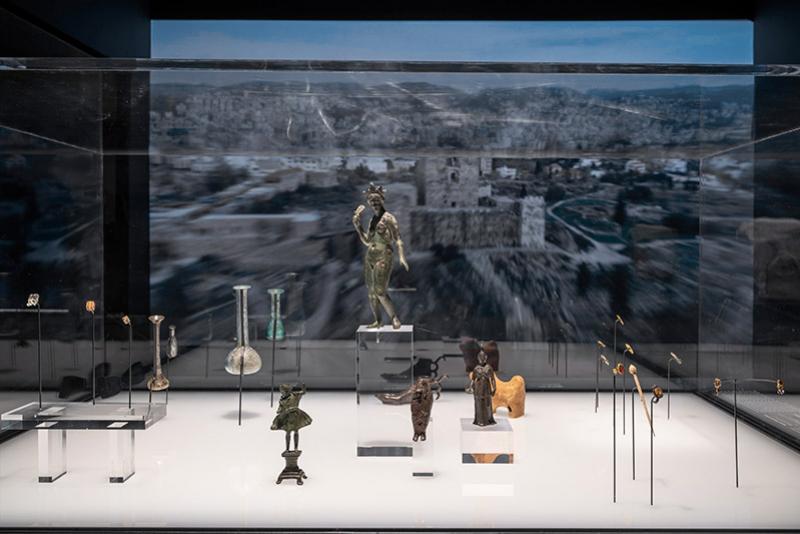
View of the exhibition “Byblos, Millennium City of Lebanon” at the Arab World Institute.
© IMA / Alice Sidoli