
Malaga,
It is not already clear that Kandinsky we should, as for a long time, the first expressions not figurative of the art of the early twentieth century, because today we know that the beginnings of abstraction were multiple and that Hilma AF Klint had a lot to do with them, but the Russian artist was read decisive contributions to the idea of an autonomous creation, free to the real the sensations that external causes. He did it both in his theoretical and purely artistic production and in his role as an editor and teacher.
Thanks to the donations and legacy of its widow, Nina Kandinsky, the Pompidou Center in Paris treasures the most extensive works fund of this author; Part of it can be seen until September in its Malaga subsidiary, in a retrospective that recalls its trajectory in Russia, Germany and France and is structured in five chapters, linked to its figurative beginnings, the genesis of abstract art in Munich, its return to Russia during the revolution, its teaching in the Bauhaus school and the last years of Parisians.
Throughout that route, the Andalusian Pompidou underlines the Don of Kandinsky for synesthesia, a phenomenon that we know today neurological and involuntary and that implies that who “suffers” perceives sensations of different senses jointly or crossed. In the case of this painter, the sense of the ear was associated with that of the view, so that sounds and colors were intimately united in their mind: it was able to see the music, a conclusion that came after going to a representation of the opera Lohengrinby Richard Wagner. Declared: I could mentally see all my colors, they were before my eyes. Wild lines, almost crazy, took shape before me. That experience would have a relationship with the notion of Total art work That we link to the opera itself and led him to compare the color palette with the timbre of each instrument, a correspondence system that would be his first step when articulating an aesthetic of dissonance that would make his way to abstraction.
After briefly forming law and economics, Kandinsky left his native country in 1896 to study painting in Munich, then the city of the Jugendstil (Art Nouveau), where I would learn the techniques of temperature paint and wood engraving. In 1901 he founded the association Phalanx And then an art school with the same name where she met the young painter Gabriele Münter, with which she would establish a fruitful relationship. In 1904, that school closed, the couple traveled through Europe, choosing the Netherlands as the first destination, then Tunisia and Italy, before finishing their journey in Paris. In those years (1906-1907), Kandinsky carried out a good number of oil studies, outdoors and spatula, in addition to multicolored scenes on black background that evoked several Russian stories. He was beginning to settle his abstract potential.
It was in the summer of 1908 when Kandinsky and Münter returned to Munich to settle. From there, seduced by the picturesque Murnau, her landscapes and her popular art, the summers went to this town to paint outdoors. That would be the enclave where a new expressive painting emerged: the broad strokes of Kandinsky were synthesized in masses of living tones, far from the limitations of mimesis. In December 1911, the author Moscow exposed the keys to his research on abstraction in his essay Of the spiritual in art: The harmony of colors should be based solely on the principle of resonance with the human soul. This base will be defined as the principle of inner need.
And the following year, he and his friend Franz Marc published the Almanaque Der Blaue Reiter, a revolutionary manifesto that defended the synthesis of the arts, without borders or labels. For both, the harmony of colors should be based only on the principle of resonance with the human soul.
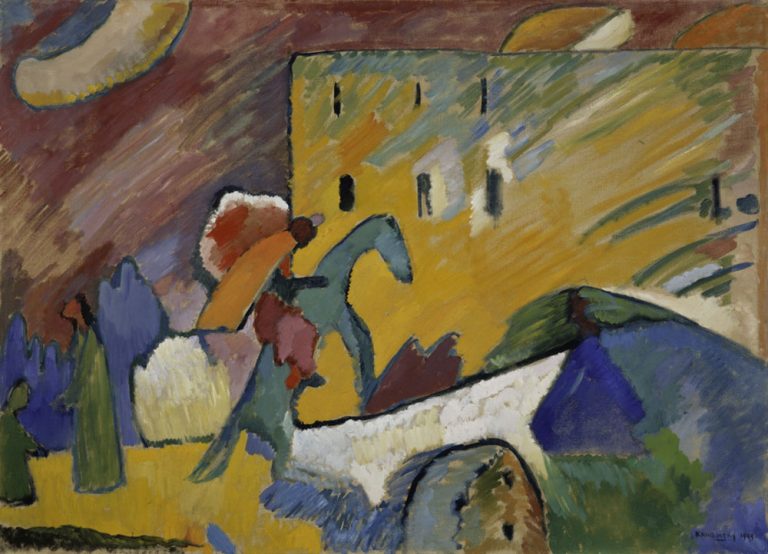
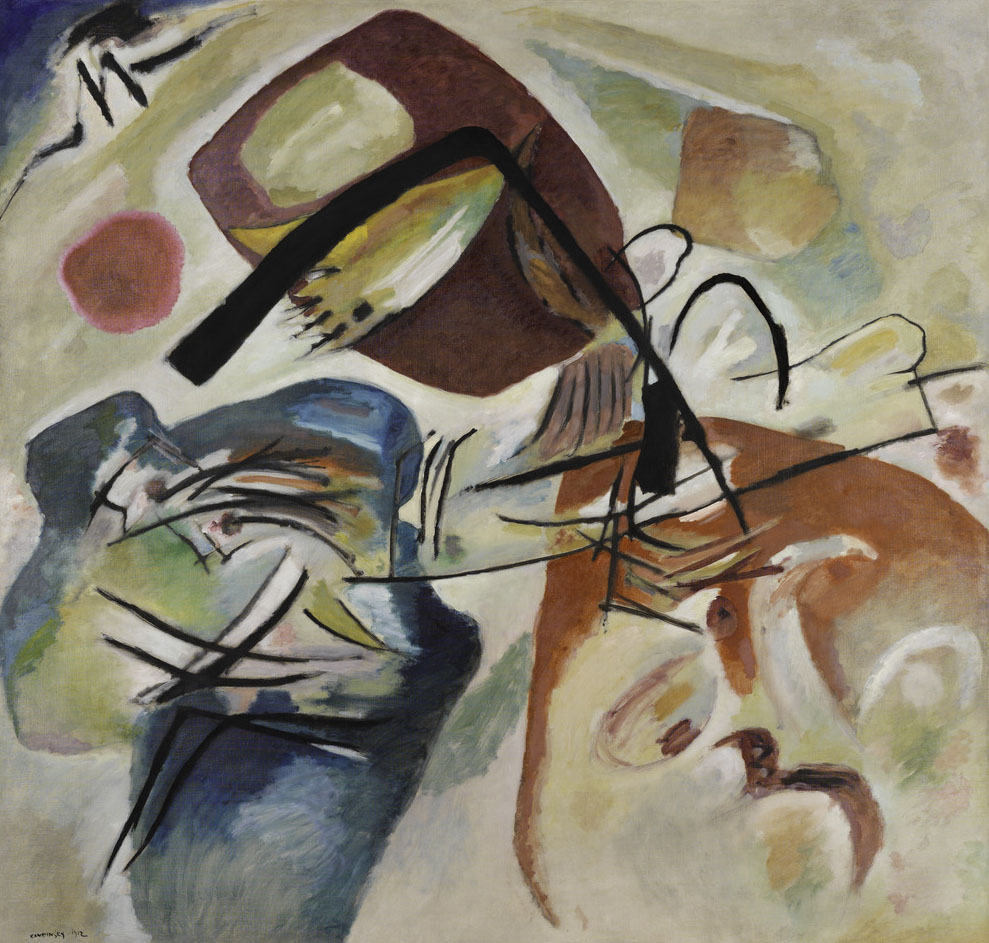
When, on August 1, 1914, Germany declared war on Russia, Kandinsky returned to his homeland. Given the situation, in 1915 he did not paint any oil, but abstract graphic works, in an austere tone, and in 1917 he temporarily resumed figurative painting during a summer with his new wife, Nina Andreïevskaïa. The war did not inspire abstractions.
After the October Revolution, he participated in the reorganization of the cultural institutions of the Bolshevik government and approached the artists of the suprematist and constructivist avant -garde, as it is glimpsed in their paintings, now of geometric cut and in a palette dull enhanced by primary colors. However, he did not neglect his aesthetic convictions nourished by spiritual values taken by outdated and misunderstood; In view of his progressive isolation, he settled again in Germany in the winter of 1921.
In the summer of 1922, he was officially appointed member of the Bauhaus School of Weimar, which had been founded in 1919 by the architect Walter Gropius about the principles of the synthesis of the arts and the transdisciplinarity that fit with his thesis. After being awarded the position of Master of formsKandinsky directed a mural painting workshop and worked with a good number of prestigious artists. His compositions gained graphic clarity; He referred to his creations from Weimar’s years as his Cold period.
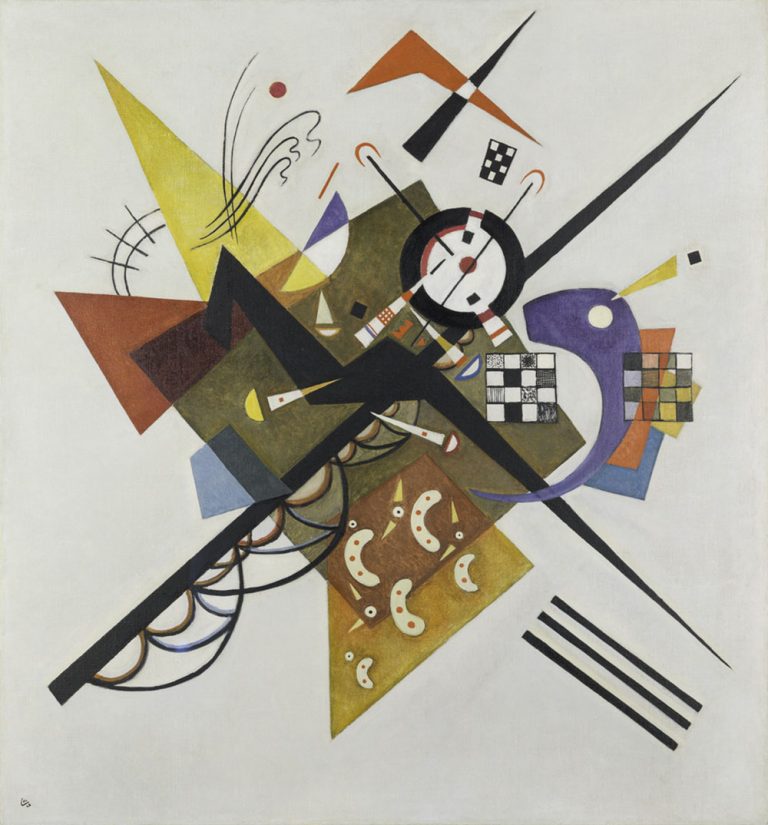
In 1926 his second great theoretical treaty arrived, Point and line on plane. For him it was a very fruitful stage: between 1925, the year in which the Bauhaus moved to Dessau, and 1933, when Hitler’s power caused the closure of the school, Kandinsky produced almost six hundred watercolors and paintings, before being forced to exile again, now in France. In December 33, marriage was established in Neuilly-Sur-Seine, near the capital. The light of this place, at a strong and subtle time, grows its palette with pastel and acidulated tones; His style of then combined the severe geometry of constructivism with the fantasy of biomorphism contemporaryly undertaken by the French surrealists.
His work evolved following them, especially with Jean Arp and Joan Miró. Also after the burst of World War II: he was forced to replace the printed canvases with wooden or cardboard supports and their colors darkened, while their compositions acquired greater precision and compositional rigor.

“Vassily Kandinsky. Pioneer of abstract art”
Center Pompidou Málaga
Doctor Carrillo Casaux Passage, s/n
Malaga
From March 28 to September 7, 2025


