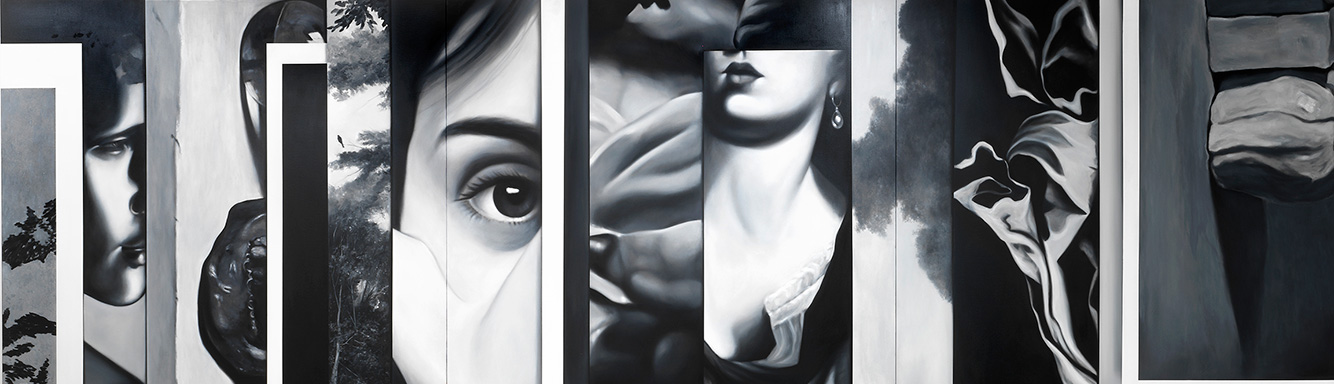
Alain Urrutia (Bilbao, 1981), an artist interested in the mental and visual construction of representation, plays in his paintings with what he shows and what he decides to hide. His images, always in black and white, seem to offer us fragments of stories that we never fully know. There are faces, objects, landscapes and references to other works of art, but also gaps, cuts and superimpositions that force us to stop. In “ABIAPUNTUA”, the exhibition that has just opened at the Collezione Maramotti, in Reggio Emilia, the artist proposes a tour of more than twenty unpublished paintings in which our way of looking takes on special meaning.
The title, ABIAPUNTUA, means “starting point” in Basque and is also the name of the painting with which the exhibition begins. From it begins an itinerary that crosses nine major themes related to the human experience, from origin and nature to community, myth, power or death. The works are distributed in different connected spaces and establish relationships with each other that we discover as we progress. There is a beginning, a journey and an end, although the latter ends up returning us to the beginning. The tour allows you to get closer to both the finished images and the process that made them possible.
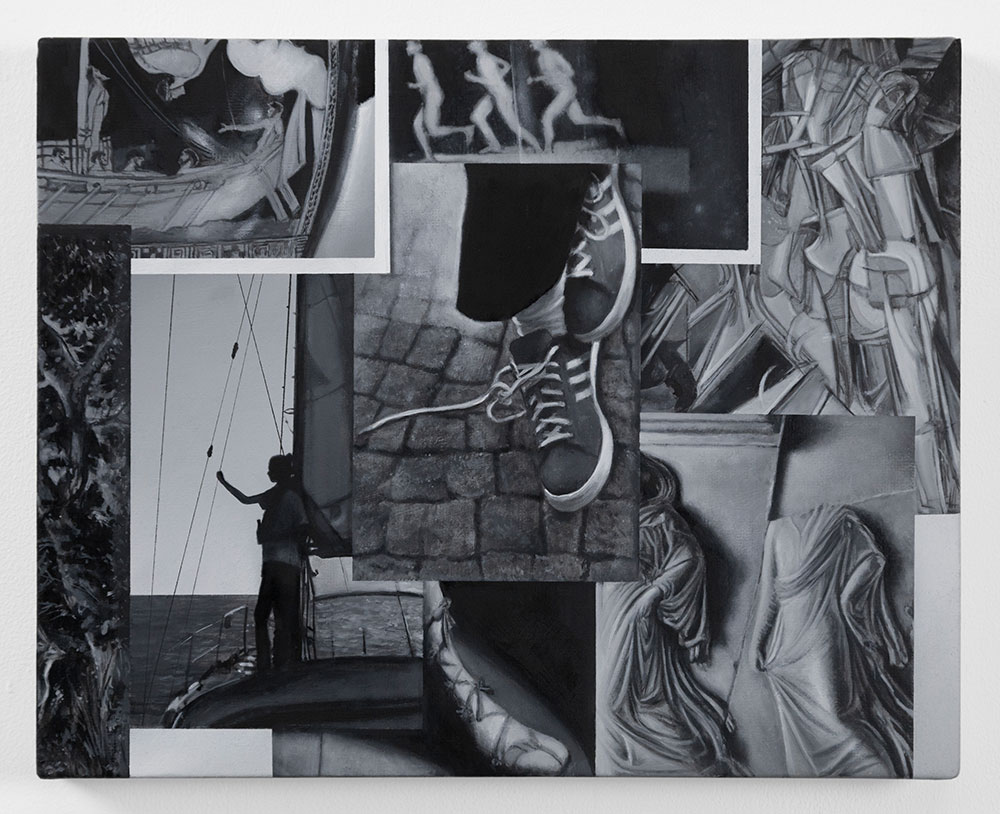
Alain Urrutia. ABIASCORE 3/9, 2025-2026. Oil on canvas. © Alain Urrutia
To understand how Urrutia works you have to know its particular image archive. For years he has been gathering photographs, film stills, reproductions of works of art and all kinds of visual references that catch his attention. It is a constantly growing personal collection, a kind of digital atlas in which images are grouped and establish new relationships. From that archive, which he shares with the public for the first time, his paintings are born. Urrutia selects, combines and transforms fragments of images from different periods and origins, a process reminiscent of Atlas Mnemosyne by Aby Warburg, in which the German art historian investigated the connections between visual motifs that reappear throughout history.
Black and white is a constant in Urrutia’s painting. But it is through a wide range of grays that the artist manages to give unity to images from very different periods and contexts, while evoking the visual language of cinema and historical photography. His technical mastery allows him to reproduce textures, lights and shadows with great precision, to the point that some paintings can be confused with photographs at first glance.
The works are presented in different formats. The larger ones offer an accumulation of superimposed images in vertical stripes, as if we spread the cards from a deck on a table. We barely see fragments of each one, but those small hints are enough to awaken our curiosity about what remains hidden. Other works, smaller in size, condense this abundance of references into equally overlapping compositions.
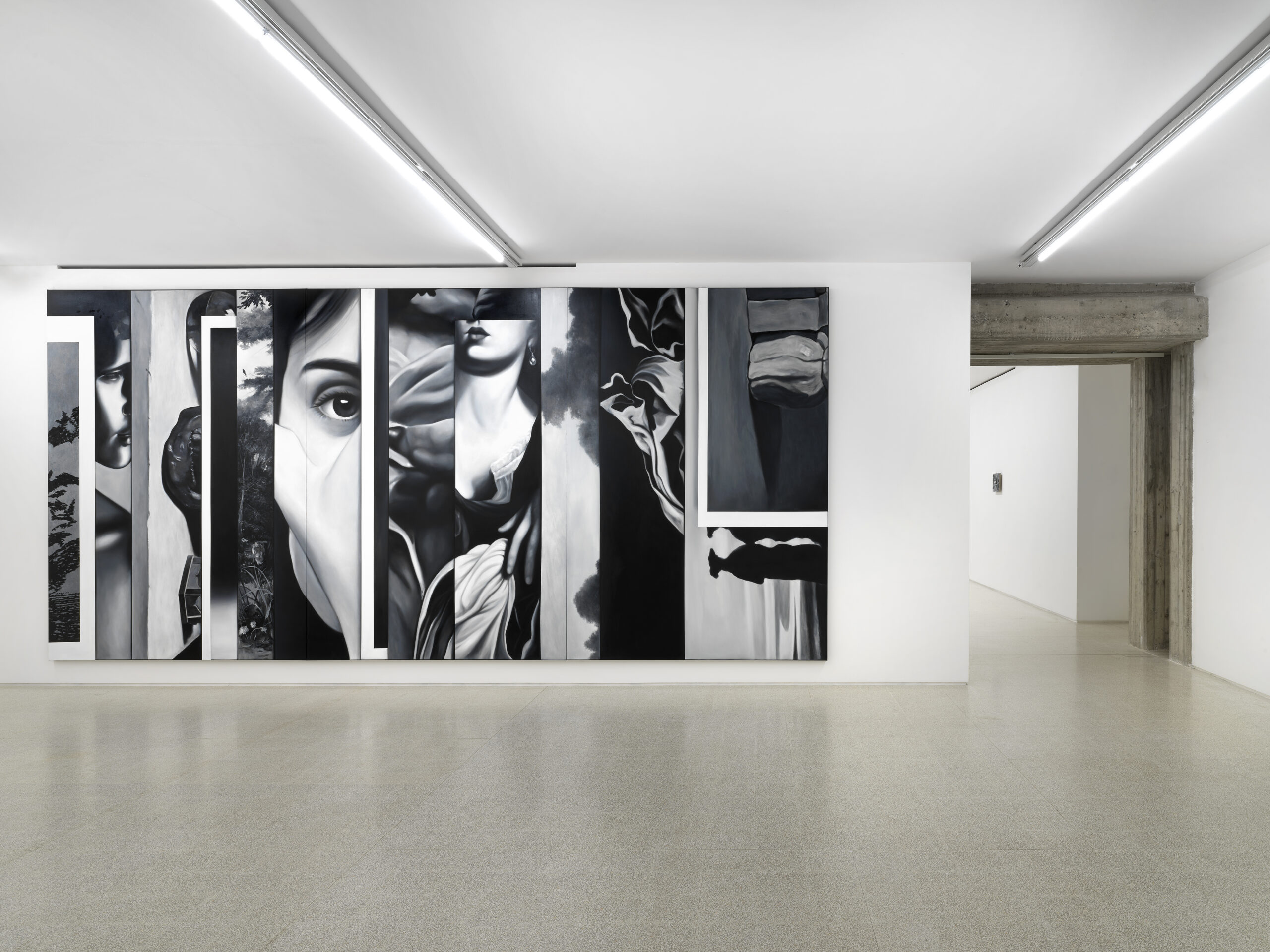
Alain Urrutia. «ABIAPUNTUA». View of the exhibition. Collezione Maramotti, Reggio Emilia. © Alain Urrutia. Photo: Dario Lasagni
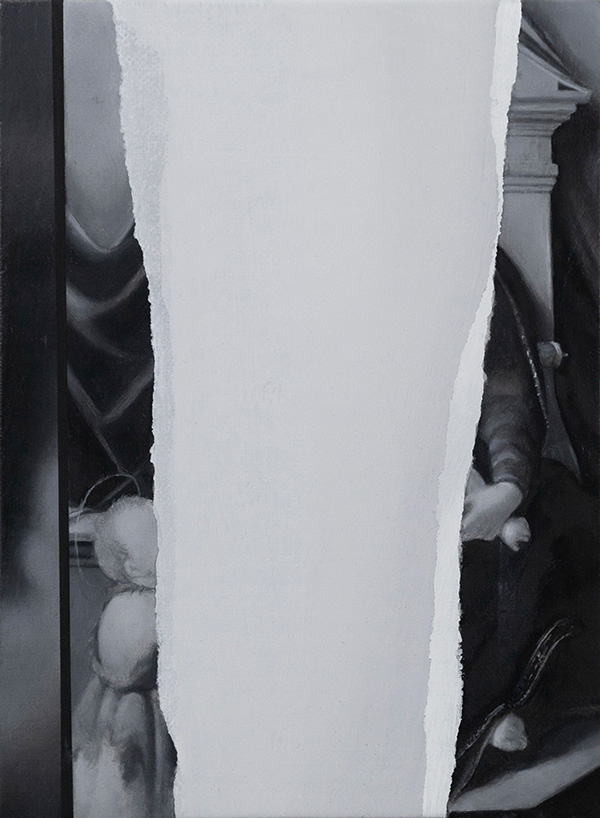
Alain Urrutia. HELMUGA 1/9, 2025-2026. Oil on linen on panel. © Alain Urrutia
We also find three intermediate format paintings that simulate posters that are superimposed and torn in their central part. This gesture has a very specific intention. As Urrutia himself explains, when we contemplate a painting we tend to concentrate our attention on the center, leaving the margins in the background. The artist simulates the disappearance of that part that would normally attract our gaze and invites us to look at the edges, in the corners, in what usually goes unnoticed. What is missing thus becomes as important as what we see. The viewer has to imagine, complete and establish their own relationships with images that are never fully shown.
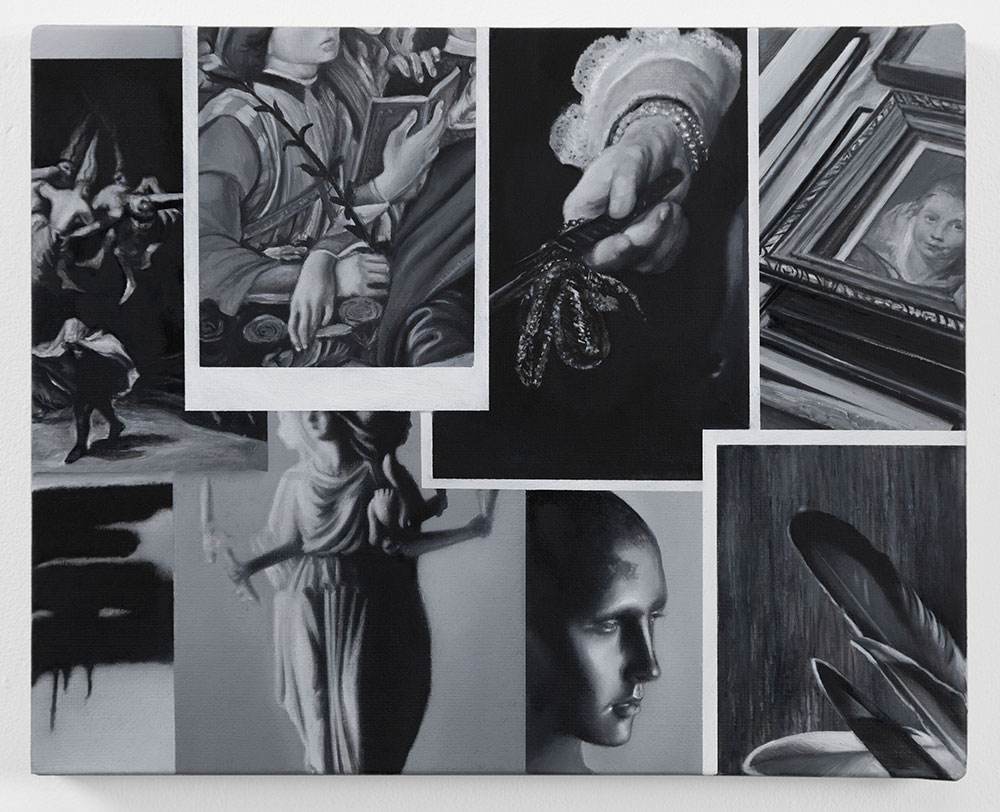
Alain Urrutia. ABIASCORE 2/9, 2025-2026. Oil on linen on panel. © Alain Urrutia
This game between the visible and the hidden continues in the large compositions, whose images we can also find in the small paintings, all but one. Discovering what is missing is in the hands of the visitor, who can retrace his steps and look for correspondences between some works and others.
The exhibition is completed with two videos that are projected in a separate room and in which we see images from Urrutia’s personal archive follow one another. To get to it we go through a corridor in which we find nine small paintings that recover isolated motifs from that wide visual repertoire: an eye, a feather, a flower… They are images that we have already been able to recognize, although partially hidden, in the previous compositions. Each of these small works is the result of a selection process based on a moodboarda grouping of images related to one of the nine major themes of the exhibition. By finding them now separated from the rest, we can dwell on details that perhaps had gone unnoticed and better understand how Urrutia arrives, among so many possibilities, at a specific image.
The two videos offer a more direct look at that archive. The images follow one another at different rhythms and allow us to approach a constantly growing visual repertoire, from which Urrutia extracts a good part of the materials with which he constructs his paintings.
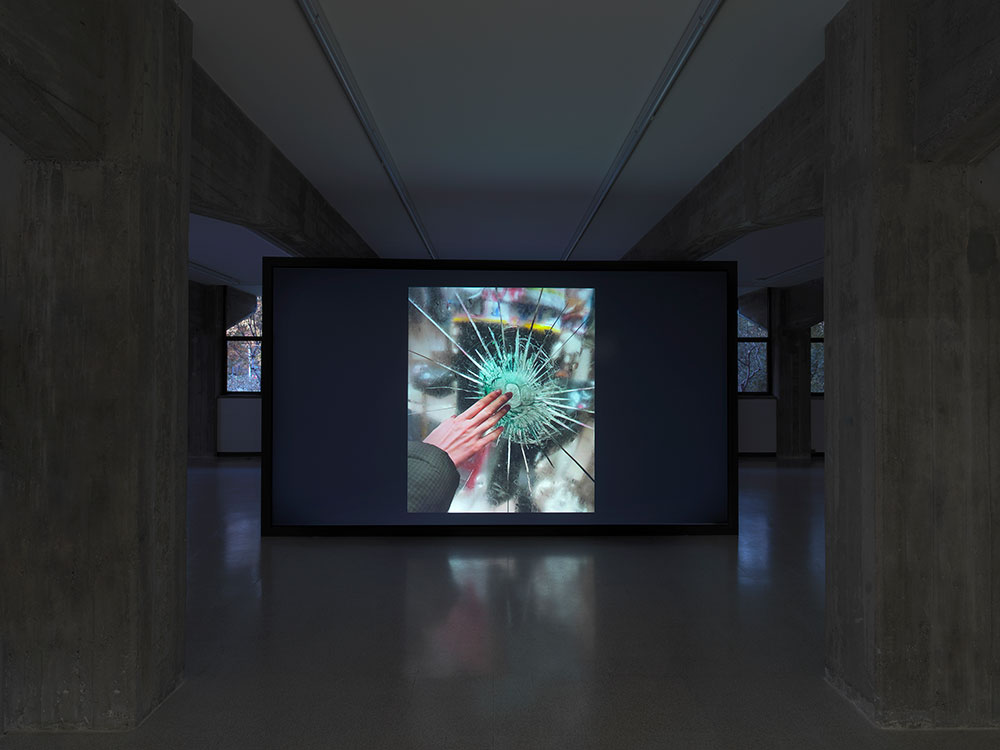
Alain Urrutia. «ABIAPUNTUA». View of the exhibition. Collezione Maramotti, Reggio Emilia. © Alain Urrutia. Photo: Dario Lasagni
This is an especially interesting part of this project in Reggio Emilia. Urrutia lets us enter his archive for the first time and learn part of the process behind his paintings, but they continue to retain their mystery. Knowing where the images come from does not necessarily mean understanding everything they tell us. The artist himself expresses it this way: “I move forward with the idea of revealing enough to show that there are things destined to remain hidden.”
The place where the exhibition is held also deserves a mention. The Collezione Maramotti occupies the former Max Mara factory, built in 1957 and transformed into an artistic space, preserving much of its industrial character, its large open spaces, the footprint on the pavements that reminds us that there were machines and work tables there before, and the presence of natural light. The collection was born from the passion for art of Achille Maramotti, founder of the fashion brand, who began collecting works in the 1950s and conceived the idea of sharing them with the public in the 1970s. Open since 2007, it has several hundred pieces by Italian and international artists, with special attention to painting from the second half of the 20th century and figures such as Alberto Burri, Lucio Fontana, Michelangelo Pistoletto, Francis Bacon, Cy Twombly, Jean-Michel Basquiat and Anselm Kiefer. Along with this permanent collection, it maintains a program of exhibitions and commissions from contemporary artists, such as this new project by Alain Urrutia.
«Alain Urrutia. ABIAPUNTUA »
Maramotti Collection
Via Fratelli Cervi 66
Reggio Emilia (Italy)
From November 8, 2026 to February 14, 2027