Santander,
The Botín Center presents the first major retrospective dedicated to the drawing of Marisol Escobar (Paris, 1930 – New York, 2016), an artist whose presence in the New York scene of the sixties was much more relevant than what is usually remembered today. Although for many this will be their first approach to Marisol’s work, what is truly significant about the exhibition is not so much rescuing her figure from the lethargy of the artistic canon as reviewing a part of her work that did demand in-depth research: her production on paper. Thanks to the collaboration with the Buffalo AKG Art Museum, the institution that safeguards his legacy, new drawings have been discovered and digitized that allow us to delve into this essential—and until now less studied—facet of his career.
Although it was sculpture that gave him international recognition, drawing always occupied a central place in his practice. These were not preparatory sketches or a secondary production, but rather an autonomous language from which the artist thought, observed and constructed images. In this exhibition we can see more than a hundred of them, dated between 1949 and 2016. Along with the drawings, the exhibition also includes some emblematic sculptures, such as Indian either Woman with Child and Two Lambsin addition to abundant archival material and several films that help situate Marisol’s complex personality.
Born in Paris in 1930 into a Venezuelan family, she spent her childhood between Caracas and the United States before settling permanently in New York. Known simply as “Marisol”—after eliminating her paternal surname from her signature—she developed a deeply unique work, always from a critical position that was difficult to pigeonhole. Her figures carved in wood, on a full scale and often inspired by public figures or family and social scenes, placed her at the center of a visual culture that was beginning to think about art in relation to the media, politics and everyday life. However, in the face of pop enthusiasm for mass culture, Marisol introduced an uncomfortable and ironic look, crossed by doubling, the mask and reflection on identity.
The exhibition at the Botín Center is structured around three “displacements”, three moments that run through both Marisol’s life and artistic practice, in which she herself claimed not to remember a single moment in her life in which she had not been drawing.
The first of these trips brings us closer to her formative years and a decisive episode in her biography: her mother’s suicide when she was eleven years old. From then on he reduced speech to what was strictly necessary and found in drawing a form of silent and constant observation. Rather than abandoning communication, he began to express himself from other places: the look, the gesture, the repetition of images. Drawing became a space from which to record experiences without having to explain them.
It is Marisol herself who greets the visitor at the entrance to the exhibition through a film shot by Andy Warhol, where she appears posing almost motionless next to the sculpture. Women and Dog (1963-64), now preserved in the Whitney Museum of American Art. The scene captures a moment in which the artist was already beginning to attract enormous public attention. After studying in Los Angeles, Marisol traveled to Paris to study at the École des Beaux-Arts and the Académie Julian, although she soon returned disappointed and settled in New York. There he studied at the Art Students League with Yasuo Kuniyoshi and later at the Hans Hofmann school, whose influence was decisive. Hofmann taught almost without words, something that Marisol would remember years later as a deeply visual experience.
His first exhibition at Leo Castelli’s gallery, in 1957, marked the beginning of his public recognition. However, much of the criticism focused more on his image than on his work. The New York Times even suggested that his sculptures could have been found “in some South American jungle,” while the magazine life He insisted on presenting her as “the Latin beauty.” Uncomfortable with this media exposure, Marisol decided to go to Rome. In a letter from that period, Castelli wrote to him: “How can you leave when everything is about to begin?” That phrase gives the exhibition its title and well summarizes a constant in the artist’s life: the need to move, disappear and start again.
Back in New York, Marisol participated in fundamental exhibitions at the Museum of Modern Art such as “The Art of Assemblage” (1961) or “Americans” (1963). She represented Venezuela at the 1968 Venice Biennale and was one of the few women present at Documenta IV in Kassel that same year. He worked alongside Warhol and appeared frequently in media such as life, Glamor either The New York Timesbecoming a central figure in the New York art scene.
In those years he began to incorporate molds of his own face and hands into sculptures, as we see in the bronze study for My Mom and Me (1968), a sculpture that he kept throughout his life. The use of the mold introduces a new condition, the body can be repeated and reorganized within the same image, something that is also reflected in the drawings. The body fragments, multiplies and transforms into a mask. Lips, profiles and hands stop functioning as individual features and become repeatable signs, moveable between different images. The drawing then functions as a rehearsal space where anatomy becomes variable and mutable. The mask will be precisely one of the central elements of this stage. A good example is Indian (1969), one of the sculptures present in the exhibition. The work reuses the commercial iconography of the so-called cigar store Indianthe indigenous figures traditionally located at the entrance to American tobacco shops. By incorporating her own face into the sculpture, Marisol introduces a deliberately uncomfortable identification that questions both cultural stereotypes and the ethical limits of any representation of the “other.” Seen today, the piece continues to raise questions about cultural appropriation, identity, and public visibility.
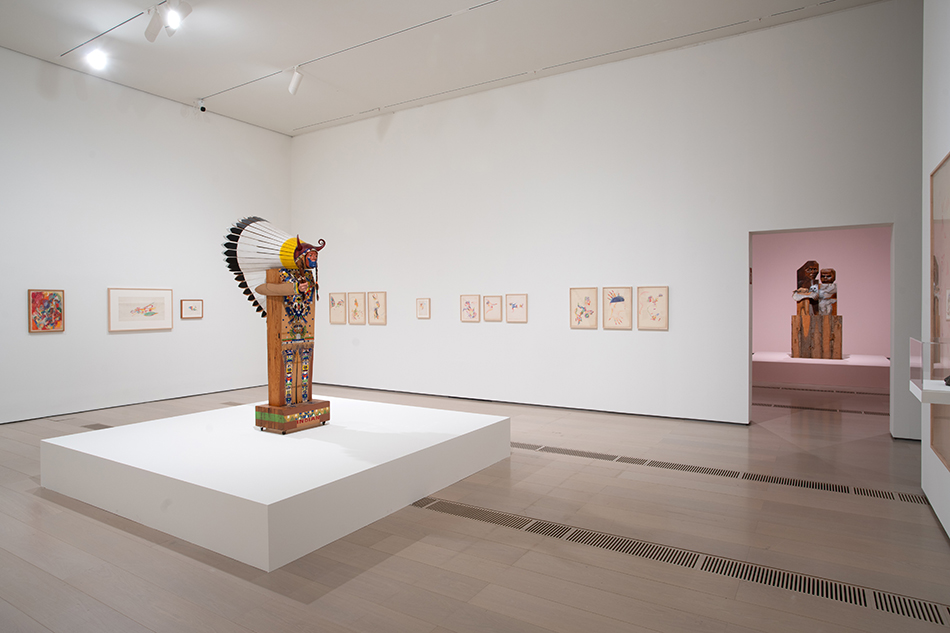
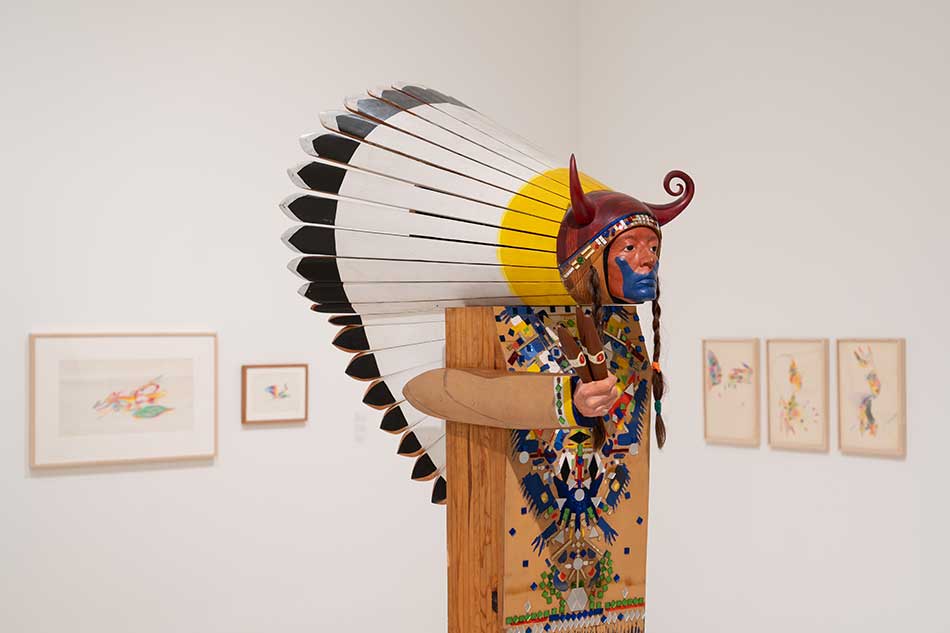
As the exhibition texts point out, in Marisol’s work “identity appears as a changing image: sometimes a face, sometimes a mask, sometimes a trace and sometimes a shared scene.”
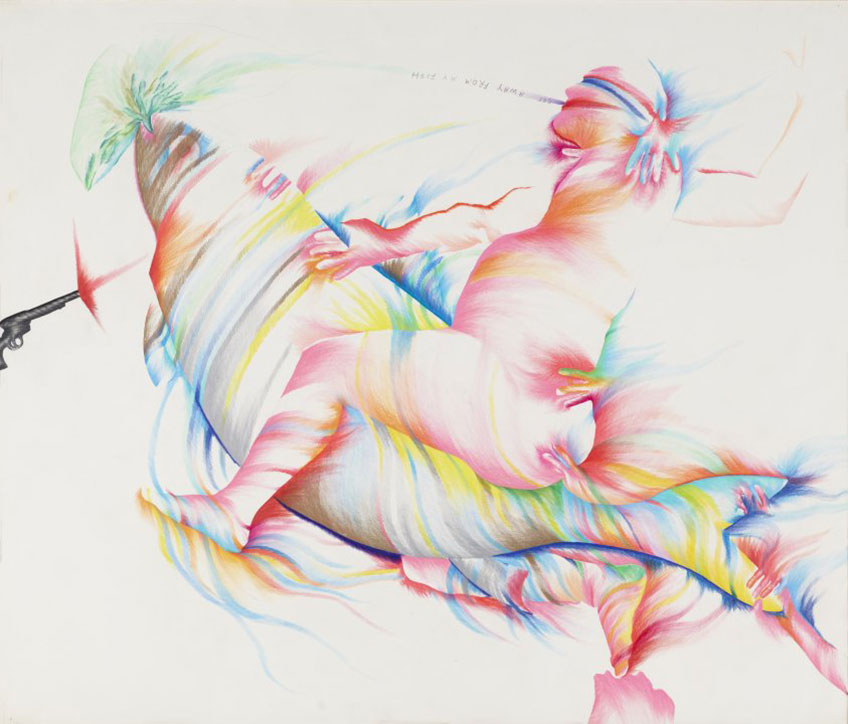
The second trip places us in the seventies, after a series of trips through Southeast Asia and Polynesia that profoundly transformed his outlook. In the midst of protests against the Vietnam War, indigenous movements and struggles for civil rights in the United States, Marisol interrupted her growing presence in the artistic circuit to travel for long periods. In his drawings from this period, color acquires a new intensity, bodies multiply and written texts appear to accompany the images. Issues linked to gender and indigenous communities also become more visible. Works such as the aforementioned sculpture Woman with Child and Two Lambs (1995), introduce a representation of motherhood far from any idealization. This same room highlights drawings like Get Away from My Fish (1975) or Chief Joseph (ca. 1974-1980).
During these years his work in dance and theater also acquired great importance. Collaborations with the choreographer Martha Graham or with Elisa Monte expanded drawing to set design and costumes. In projects like Equatorial (1978) or Caviar (1970), made for the choreographer Louis Falco, the body stops being solely represented and becomes movement, surface and transformation.
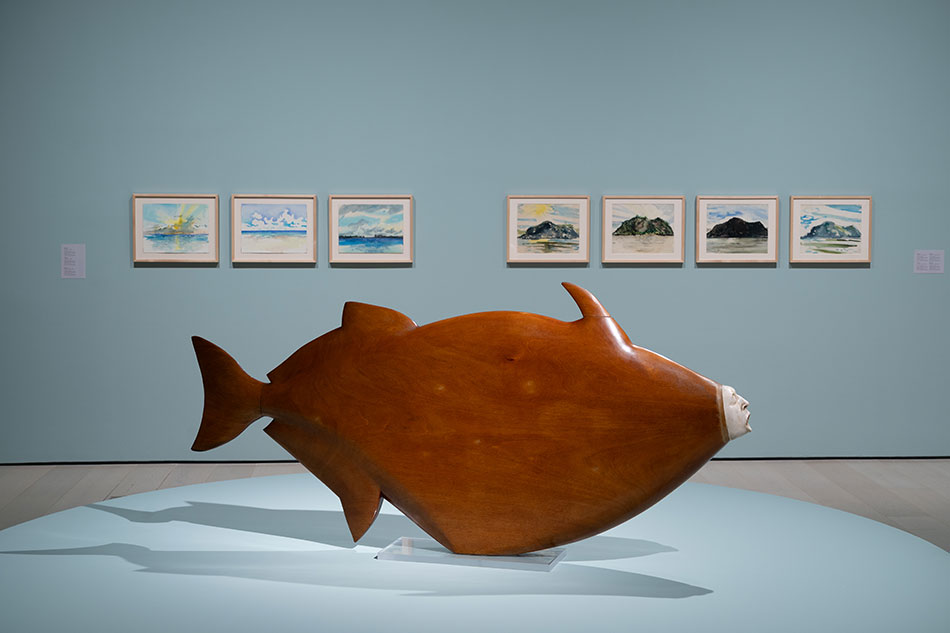
This second trip concludes with another of Marisol’s great obsessions: the underwater world. After his participation in the 1968 Venice Biennale, he undertook a long trip through India and Thailand during which he developed an intense fascination with marine life. 8 mm films, watercolors, pastels and sculptures such as Triggerfish I (1970) show ambiguous forms situated between the biological organism and the mechanical artifact. A concern typical of the time also resonates in them: the relationship between nature, technology and scientific exploration in the midst of the Cold War.
The exhibition ends with a third displacement, perhaps the most intimate and least physical of all. In the last years of her life, Marisol had to face Alzheimer’s, a disease that progressively deteriorated her memory and language. Still, he continued drawing until the end. When memory began to fragment, her work became increasingly linked to everyday life: her study, nearby objects, or the presence of her caregiver.
Upon her death, on April 30, 2016, Marisol bequeathed her archive, her library, her works, and her New York apartment to the Buffalo AKG Art Museum, which allowed us to continue expanding the study of the artist’s work.
One of the most surprising issues of this exhibition, which has been curated by Laura Vallés Vilchéz, is to see to what extent many of the themes that ran through Marisol’s entire career are still valid: the construction of identity, the public representation of women, the relationship between image and mask, the importance of care or even illness and the fragility of memory.
“Marisol: When everything is about to begin”
LOOT CENTER
Pereda Gardens
Santander
From May 23 to October 25, 2026