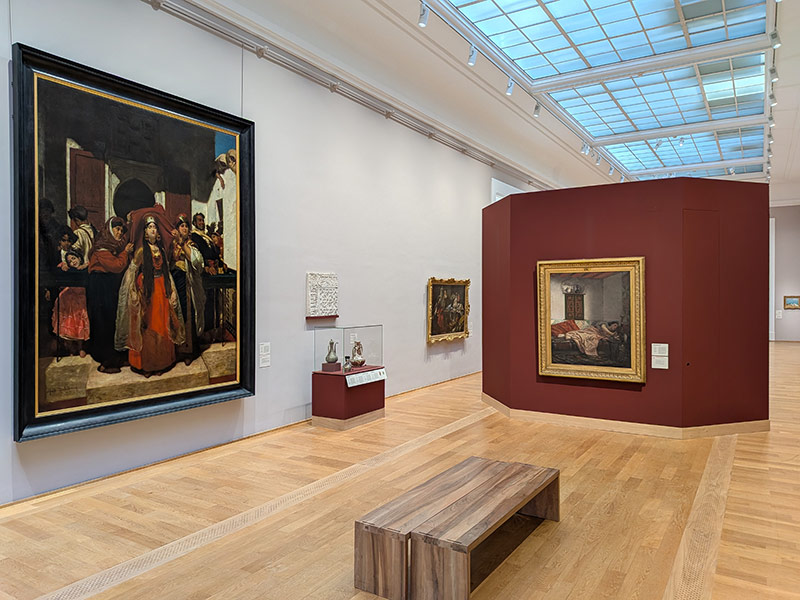
Lille (Hauts-de-France). If society and ethnology museums have been examining the origins of their collections for several years, fine arts museums seem to have barely started this reflection according to Alice Fleury, director of collections at the Palais des Beaux-Arts in Lille. The museum has been undergoing renovation in stages since 2017, with a rearrangement of the permanent route which will see, in 2026, the opening of a gallery dedicated to the arts of the colonial period. This 250 m2 gallery, entitled “Inspirations from the distance”, presents “the influence of elsewhere on French artists of the 18th centurye and XIXe centuries »explains the director. In addition to orientalist paintings, the room exhibits sculptures and art objects, notably several pieces of earthenware and porcelain rarely shown: more than a third of the works in this room come from the reserves, as Frédéric Mougenot, curator of antiques and ceramics at the museum, explains. The gallery takes place in the middle of the chronological tour (classical Spanish and Italian paintings, united provinces 16th-17th centuries, impressionism, symbolism), but offers thematic lighting on “the first globalization”.
A free route
Five sections punctuate the route which can be visited in no precise order, between busts of male figures, canvases of Algerian landscapes, or 18th century coffee pots and snuff boxes. “The museum does not have works directly related to slavery, so we had to approach this subject differently,” explains the curator, adding that the window display on products resulting from colonization (tea, coffee, tobacco, chocolate, sugar) coexists with a famous quote from Voltaire in the scenography (“This is the price you eat sugar for in Europe”Candide, 1759, chapter XIX). Tactile devices allow visitors to be active, for example to determine whether ceramics are original Chinese porcelain, or French earthenware with Chinese decorations.
Orientalism obviously occupies a large place there, even if the term is rarely used. A large painting by Benjamin Constant depicting a harem shows how the artist transcribed “a realistic intention with details” like decorative objects, even though he has obviously never seen the inside of a harem. The painting cartels also remind us that certain painters did not go to Morocco or Algeria, even though they owned objects made in these countries. Because artists collected all kinds of “oriental” artifacts, and integrated them into their paintings. It was about creating an exotic universe based on a real world, as shown The Jewish Bride (1879), (see ill.) by Alfred Dehodencq, painter who lived in Morocco: a woman in traditional wedding attire advances into the center of the canvas “in a production inspired by biblical references” explains Frédéric Mougenot. With this gallery, the display of which will last at least four years, the museum is beginning an in-depth reflection on its collections within the new permanent exhibition.