Three decades after his death in New York, where he had also been born in 1933, the Guggenheim Museum dedicates an exhibition to Dan Flavin’s production in the first two decades of his career: those between the sixties and the eighties. Curated by Lauuren Hinkson, it shares the title with what was the first exhibition of her fluorescent pieces, in 1964 at the Kaymar gallery in her hometown: “Some Light.”
Self-taught, Flavin had studied Art History at Columbia University for two years and, in the late fifties, he began his creative journey under the influence of Jasper Johns (who not long ago passed through the same center) and abstract expressionism. His earliest individual work had taken place, in fact, only three years before that in Kaymar: at the Judson Gallery, in 1961. He began creating collages and photographs, but he soon incorporated light as a plastic material, after reflecting on its possibilities as a caretaker of the American Museum of Natural History: he did so by introducing it into painted wooden boxes which he equipped with light bulbs. It was the beginning of his series Icons (1963), composed of simple compositions formed by vertical lights that underline the energy of color and that provoke a particular atmosphere that, according to some critics, invites mysticism and reflection.
The same year he carried out Diagonal of May 25presented at the Green Gallery in New York and dedicated to Brancusi, in which he used fluorescent tubes for the first time, since then the unique element of his work. The use of industrial materials and modular units linked him directly to the minimalist movement and, in fact, in 1966 he participated in the presentation exhibition of this movement, called “Primary Structures”, at the Jewish Museum in New York.
Light and color became, at that very early time, the center of his production with the help of new industrial technologies: with them he transformed the atmosphere of the places where they were installed through the optical effects that arise when combining white or colored fluorescent tubes. He investigated different color variations and intensities, which were adjusted depending on the size, quantity and arrangement of the tubes, which could be vertical, horizontal or diagonal. Adhering to meticulously thought out limits, he used commercial equipment in ten colors and four standard sizes, without ever altering its basic format.
If his first works were based on lights placed on walls or floors, in accordance with simple modular repetitions and spatial guidelines, as we say, previously determined, he gradually sought to generate more direct relationships with the surrounding area, generating what he called “situations”, devised in response to specific environments. It was a matter of time, and so it happened, that his works grew in scale and ambition, until they occupied entire rooms with complex chromatic groupings. Its luminosity was as limited as it was ethereal.
The exhibition in Bilbao opens with a set of his first experiments with fluorescent light, after putting aside the canvas and beginning to use a material available to everyone: that industrial fluorescent tube, which he then found in sizes of 61, 122, 183 and 244 cm. He made that domestic luminaire the raw material of his compositions and electric light, in his words, one more tool. We will be able to see works made in daylight, cold white and warm white, on walls, floors and corners.
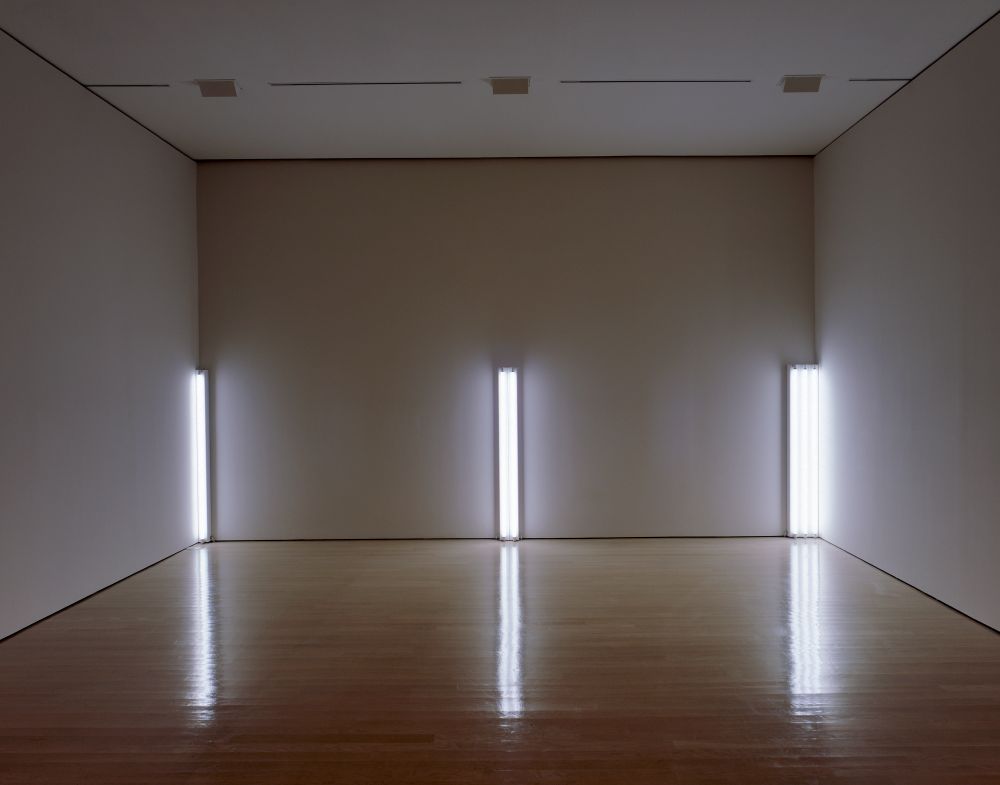
Dan Flavin. The nominal three (for William of Okham)1963. Solomon R. Guggenheim Museum, New York Panza Collection, donation 91.3698 © Dan Flavin, VEGAP, Bilbao 2026. Photography: Erika Ede
Highlights The nominal three (for William of Okham) (1963), in which vertical daylight tubes attached to the wall in the form of a growing sequence pay tribute to that medieval philosopher, who already defended in the 14th century that reality resides in concrete things and not in universal abstractions. Flavin shares his theory, which is why here the viewer sees the light and its source, not a representation of it.
And two other untitled works transfer this same approach to space: in one of them, cold and warm white lights converge at the junction of two walls, until that corner seems to dissolve; In the other, a semi-elliptic arc of cold white light tubes separates from the wall and unfolds on the floor, converting the entire room where it is exhibited into a container for its light.
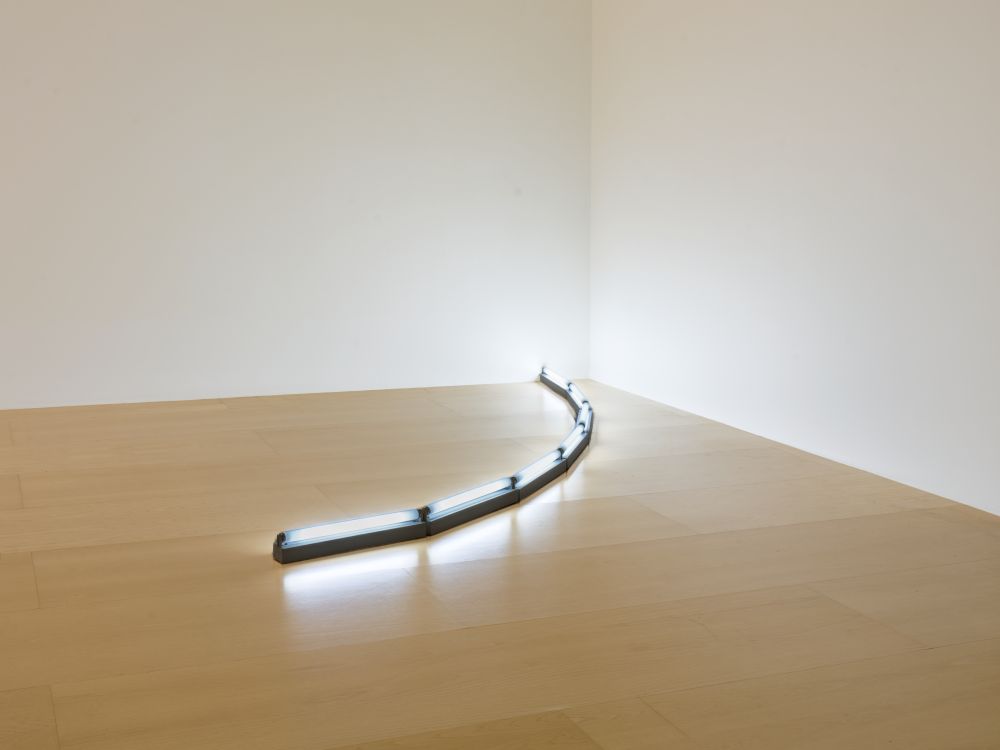
Dan Flavin. Untitled, 1964. Solomon R. Guggenheim Museum, New York Panza Collection 91.3700 © Dan Flavin, VEGAP, Bilbao 2026. Photography: Erika Ede
By the mid-sixties, the exhibition halls themselves had become one of the essential elements of the drifts of the American, who became aware that they could be altered through lighting, through carefully arranged equipment. Greens crossing greens (dedicated to Piet Mondrian, who was missing green) (1966) is made up of fluorescent tubes of that color integrated into a structure of posts and lintels that physically blocks access to one of the rooms, thus reversing the traditional museum experience.
Another of the essential pieces in the tour, Artificial blue, red and blue fluorescent light barrier (for Flavin Starbuck Judd) (1968), was the first Flavin barrier conceived as a free-standing structure. From wall to wall, it is made up of overlapping rectangular modules of red and blue tubes, as if generating a fence. Thus, this device directs and hinders the viewer’s passage, flooding the room with color. Wherever blue and red lights hit a surface at the same time—on the wall or on the closest visitors—the tones intermingle, producing a refined violet. The work thus demonstrates, on the scale of an entire room, the artist’s idea that light can create a volume of color by itself.
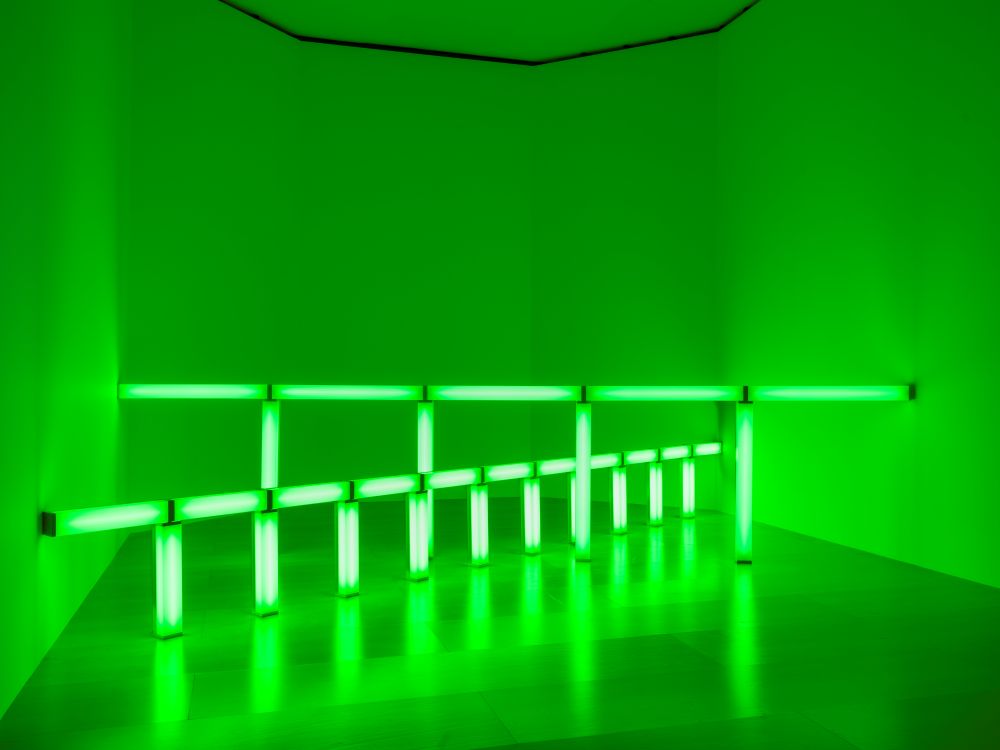
Dan Flavin. Greens crossing greens (dedicated to Piet Mondrian, who was missing green)1966. Solomon R. Guggenheim Museum, New York Panza Collection, 91.3705 © Dan Flavin, VEGAP, Bilbao 2026. Photography: Erika Ede
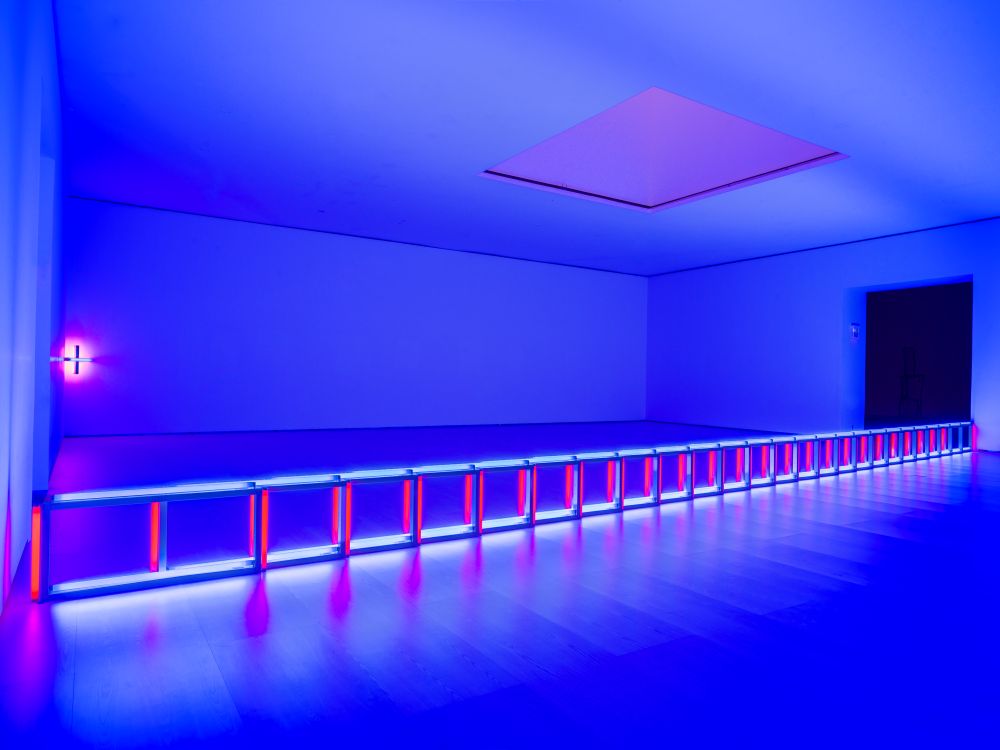
Dan Flavin. Artificial blue, red, and blue fluorescent light barrier (dedicated to Flavin Starbuck Judd)1968. Solomon R. Guggenheim Museum, New York Panza Collection, 91.3707 © Dan Flavin, VEGAP, Bilbao 2026. Photography: Erika Ede
Already at the beginning of the seventies, the American began to design spaces conducive to its light, so as not to limit itself to adapting to the existing architecture. He conceived the first of them, dedicated to Jan and Ron Greenberg – he did not avoid tributes – for his 1973 solo exhibition at the Saint Louis Art Museum in Missouri. Two rows of tubes joined together split a hallway in half: on one side, the light is green and, on the other, yellow. The row ends with a hole the width of a tube that allows us to see the other color, whose source we will not appreciate at first; To see it, we will have to turn around and enter through the other side of the hallway. In this way, Flavin proposes a game of concealment and revelation.
We have seen that the New Yorker dedicated many of his proposals, or entire series, to specific people. One of the most important in Bilbao comes from the Dia Art Foundation: these are seven of the thirty-nine monuments that it provided between 1964 and 1990 to Vladimir Tatlin. Made with fluorescent tubes of cold white light, fixed to the wall and reaching the floor, where their light is concentrated, they rise in a staircase to a single vertex, evoking both the Monument to the Third International of Russian like the skyscrapers of New York.
The last pieces collected date from the 1980s, when Flavin expanded his variations with the arrival on the market of then new types of fluorescent tubes and lamps. Untitled (affectionately dedicated to Margo) (1986) was his starting point for the development of a light system that varies a fixed series of colors through a progression of arrangements. For these pieces he chose pink and yellow, which he associated with the chromatic stridency of Los Angeles and which he had often combined before.
As to Untitled (in honor of Leo on his gallery’s 30th anniversary)proposed for an exhibition at Leo Castelli’s gallery in New York, is part of the grid structures in which he had been investigating since the seventies, born from his square corner compositions of the late sixties. An equal number of tubes are oriented forward and backward, projecting a strip of color towards the viewer and another towards the corner behind. As in all his projects, instead of reducing the space to a plane of color on the wall, the fluorescent light permeates the surrounding air and makes the architecture dissolve, sublimating it.
He considered his legacy less “a doing” and more “a thinking.”
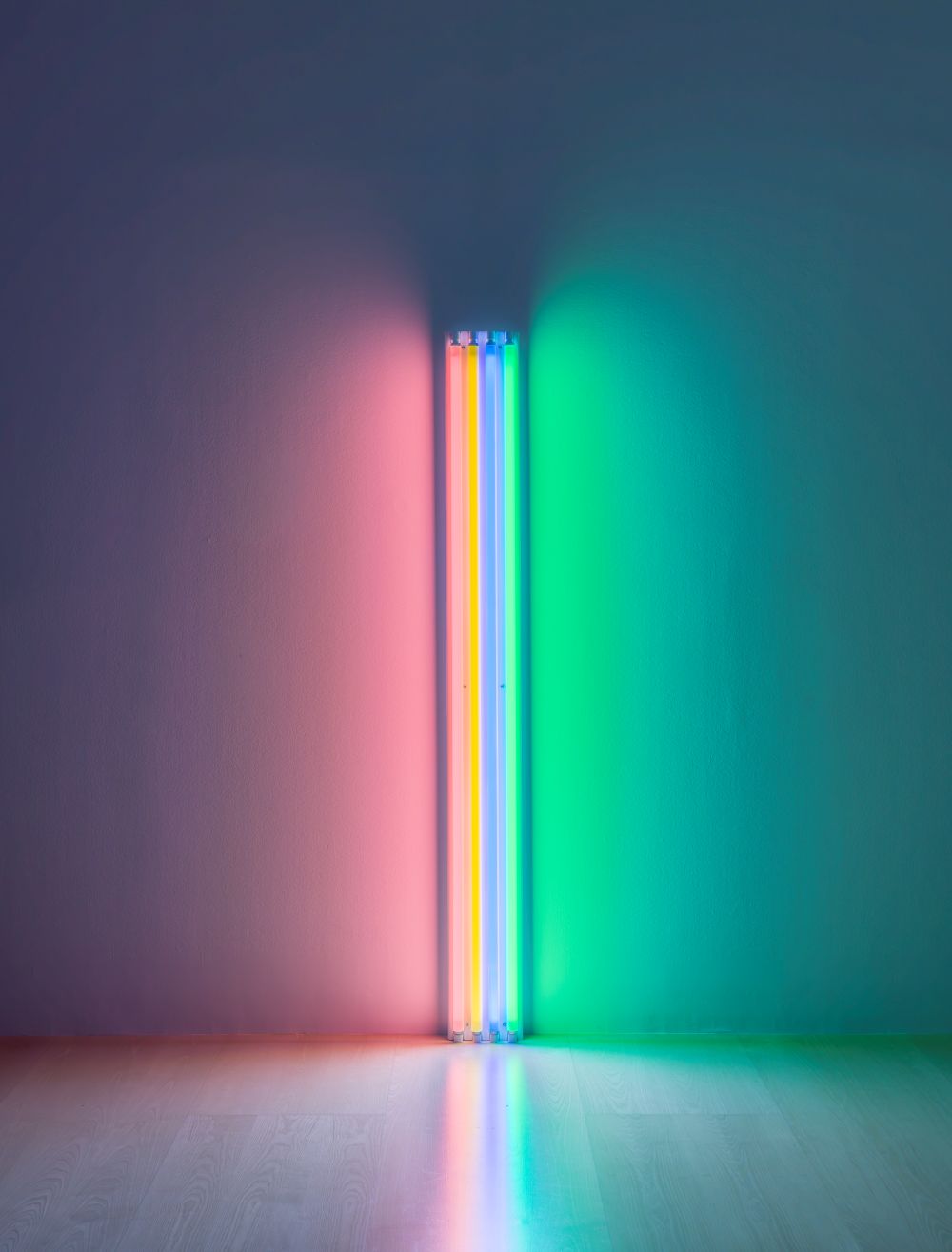
Dan Flavin. Untitled (dedicated to Henri Matisse)1964. Solomon R. Guggenheim Museum, New York Panza Collection, donation 92.4113 © Dan Flavin, VEGAP, Bilbao 2026 Photography: David Heald
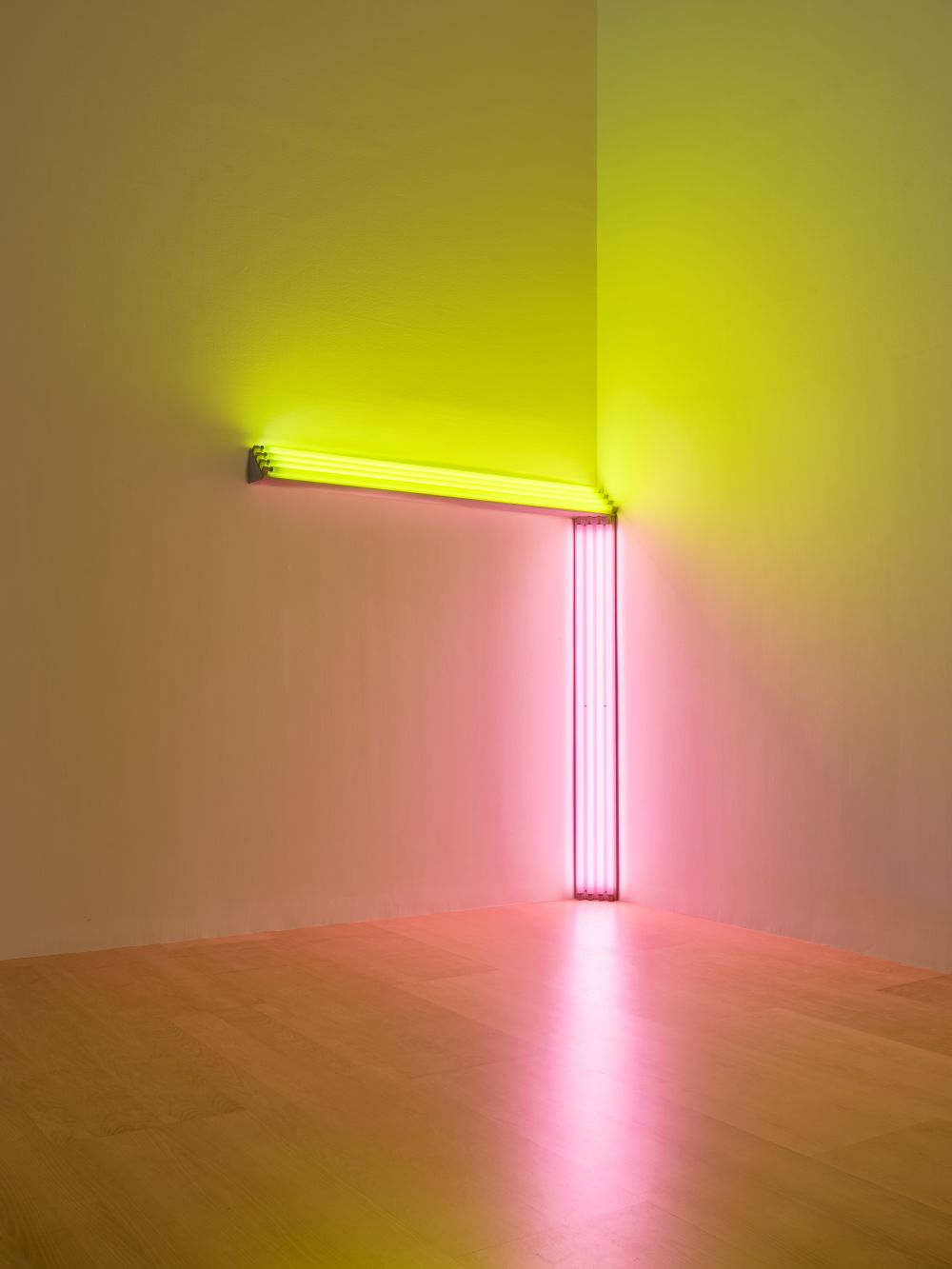
Dan Flavin. Untitled (affectionately dedicated to Margo)1986. Panza Collection, donation to Fondo per l’Ambiente Italiano, 1996 Permanent loan to the Solomon R. Guggenheim Foundation, New York L200.93 © Dan Flavin, VEGAP, Bilbao 2026. Photography: Erika Ede
«Dan Flavin: Some light»
GUGGENHEIM MUSEUM BILBAO
Abandoibarra Avenue, 2
Bilbao
From November 11, 2026 to April 4, 2027