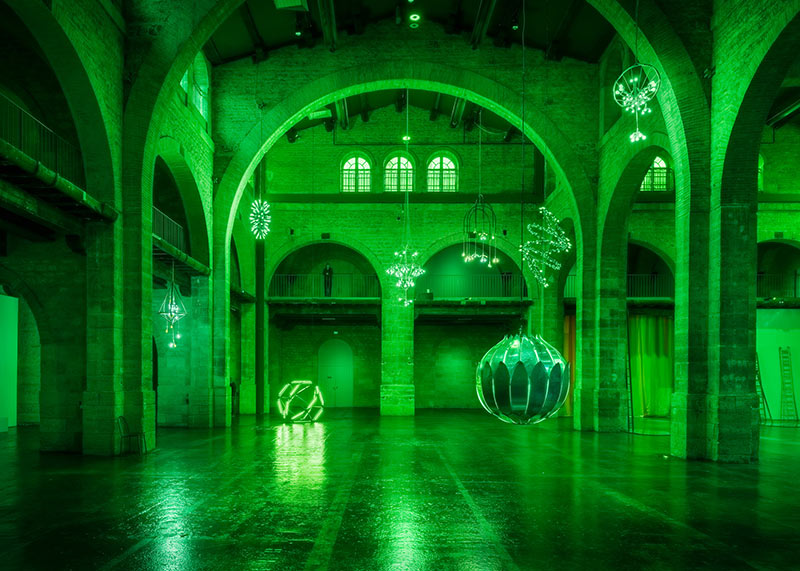
Bordeaux. Two years after transforming one of the rooms of the Hong Kong pavilion of the Venice Biennale into an aquarium store bathed in fluorescent purple light, Trevor Yeung (born in 1988) composes a new immersive installation resembling a starscape in the large nave of the Center for Contemporary Plastic Arts (CAPC). The artist’s first institutional monographic exhibition in Europe, the “Garden of the Nine Suns” (see ill.) offers a visual revisitation of the Chinese cosmogonic myth of the ten Suns. According to legend, at the time of Emperor Yao, ten solar stars populated the heavens. But nine of them were shot down by the celestial archer Yi after they decided to rise into the sky simultaneously, causing the crops on Earth to be destroyed. The Hong Kong artist disseminates his nine fallen suns, produced specifically for the Bordeaux museum, in a magical environment immersed in a green light annihilating all the other colors of the rainbow.
Bright constellation
To construct his emerald-colored starscape, Trevor Yeung placed two light sources called “Insectron” at the ends of the nave – green lamp insect repellents used in museum storage rooms to protect works of art from pests. The artist also covered all the windows with green filters in order to obscure any lighting likely to recompose the chromatic spectrum. Sometimes suspended, sometimes placed on the ground, the nine light sculptures which represent the mythical suns form a diverse corpus: all are made up of a metal frame but their appearance and the strength of their shine vary greatly, the artist having worked on the light intensity, the shape and the thickness of the bulbs placed within them. One star has the silhouette of a three-legged raven (in the legend, the ten suns each took this shape), another resembles a cut diamond, and yet another takes the shape of an upturned candelabra. The most poetic sculpture is certainly the sun, analogous to a spiral galaxy, which forms several disks where countless sparkling stars orbit. On the mezzanines of the nave, night lights in the shape of mushrooms and plastic vegetation are grouped at the edge of the platforms and form signage indicating the way to the visitor.
Trevor Yeung, Garden of the nine suns2026, view of the installation at the CAPC in Bordeaux.
© Arthur Pequin
A participatory installation
Many parts of the exhibition are also interactive: certain elements react differently depending on the lighting, the visitor is invited to use the flashlight on their phone so that new perceptual phenomena are revealed. One of the nine stars, Passive Moonwhich does not produce its own light, for example begins to flicker when a flash is aimed at it – the effect is only visible to the person holding the light source. A huge scaffolding structure in the shape of a double arch, Rainbow Ribboned Bridgelocated at the back of the nave, is just waiting for visitors to adorn themselves in its most beautiful finery. It is the public who, by climbing its steps and tying ribbons of different colors distributed at the entrance to the exhibition on its metal bars, gradually builds a sort of monumental wishing tree and recomposes the seven colors of the rainbow: all the shades from red to purple begin to shine in contact with the light of the flashlight.
Trevor Yeung was also not content with carrying out work on monumentality. By focusing his attention on the tiniest, almost imperceptible variations in light, the artist takes the visitor into a complete aesthetic experience, thought through down to the smallest details. The floor of the nave, coated with a varnish mixed with an iridescent powder, only reveals its glittery shades at certain times of the day, when the sun’s rays pass through the windows and touch it. As magical as it is fun, the “Garden of the Nine Suns” can only arouse wonder.