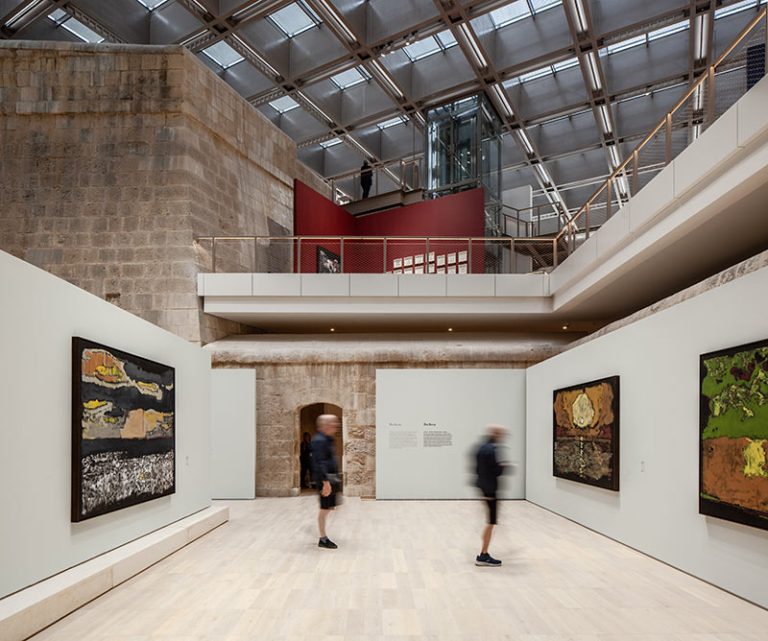
Nantes (Loire-Atlantique). A museum that looks like a cabinet of curiosities, with as its centerpiece the case where the embalmed heart of Anne of Brittany (1477-1514) was kept… For its first exhibition since its reopening with great fanfare in June 2024, the Dobrée Museum opts for a ready-made subject: the human heart.
Although the duchess’s golden case could not leave the permanent collections due to logistical constraints, it marks the starting point of a reflection around the heart, as both an organ and a symbol. A motif which, if it seems overused by its daily omnipresence, remains rarely explored in all its polysemy. “The main challenge of this exhibition is that we could have done a thousand! The theme seems so obvious, hearts are everywhere, even in the “likes” on social networks. The difficulty was therefore to sort it out. underlines Julie Pellegrin, director of the museum, who is curating the exhibition alongside historian Yann Lignereux, a specialist in the modern era.
The choice was made to introduce the subject more scientific than artistic: stethoscopes, educational boards, skin models, artificial hearts, medical research works… To the sound of the pulse of the artist Édouard Boyer (born in 1966), whose rhythm makes certain picture rails vibrate, the visitor plunges into a short anatomical history of the heart before discovering the multiple meanings with which it has been invested. “We start from the interior of the body, from the concrete, from the organ, to move towards the union of two beings, religious union, universal union, explains the commissioner. We asked ourselves the question of the chronological route since it is reassuring, but we ultimately chose a route which allows us to pull lots of threads! »
The subject, necessarily narrow, remains dense: medieval courtly heart, incarnation of married life, religious motif or even political symbol and commitment. The exhibition combines art, science and history with coherence, supported by a readable scenography even if it would have benefited from a little more fantasy with regard to the subject.
An ingenious wooden device surrounds the tomb statue of Antoinette de Fontette, a striking 16th century sculpture where the chatelaine brandishes a red heart, echoing her motto “My heart belongs to God”. Not far away, ex-votos and devotional hearts, designed to contain prayers, confirm the importance of the heart in the Christian religion, from Egyptian amulets to satirical lithographs from the 19th century, including a medieval mirror valve representing an offering of a heart… Among the most interesting pieces is a selection of precious cardiotaphs in lead or silver, intended to collect the heart of the deceased. And among the most unknown, several pieces testifying to local history like a series of taolennou from the 19th century, Breton allegorical paintings intended for religious teaching which place the heart at the center of the composition. A map of hearts, imagined by a Breton missionary priest in 1633, also attests to the wide diffusion of the motif in Christian iconography. “In all religious texts, the heart is present as a symbol of faith and emotional exchange between the god in whom one believes and the believer. But in terms of representation, it is really Catholicism which spreads this bilobed motif. specifies Julie Pellegrin.
Well-chosen works of contemporary art
Although it is very rich, the corpus nevertheless contains too many reproductions: dozens of facsimiles of manuscripts, replicas of paintings or posters punctuate the route, at the risk of sometimes giving priority to the discourse over the visiting experience. The resurgence of the heart in pop culture, in particular, is touched upon through only a few images of tattoos or reproductions of Valentine’s Day cards. The contemporary heritage is much better asserted in the integration, in each section, of a few well-chosen installations, which aptly dialogue with the rest of the works presented. Among the anatomical instruments, painting Human Heart by Andy Warhol (1979), from the Thaddaeus Ropac collection, uses a heart taken from a medical atlas to honor an order from the National Institute of Health (NIH) of the United States. Within the sacred devotional imagery stands Keith Haring’s triptych titled The Life of Christ (1990), usually visible in the Saint-Eustache church in Paris; this one takes up the codes of the Christian altarpiece by raising the heart to the rank of symbol of universal love, in homage to AIDS patients. Installation Heart by Christian Boltanski (2005) concludes the tour with the staging, in a room plunged into darkness, of a light bulb which turns on and off to the rhythm of the pulse of the artist, who has since disappeared. A beautiful final point, slow, deep, haunting.