Before New York became a sprawling metropolis, its rolling hills, deep valleys, and tidal salt marshes were part of a larger estuarine ecosystem that was home to countless flora and fauna. This included fresh bodies of water like Collect Pond in Lower Manhattan and massive oyster beds along the harbor’s more than 500 miles of shoreline, both cared for and relied on by the Indigenous Lenape peoples. This rich, yet often underknown history—quite literally buried beneath New York’s surface—is what Alan Michelson has spent the last 40 years uncovering.
Though Michelson began making large-scale abstract nature paintings with mixed materials, he expanded that interest in the late 1980s to site-specific installations and sculpture, directly “examining sites, not only for their physical qualities, but for their lost temporal qualities; in a way, their histories,” he explained in a video interview from his New York studio.
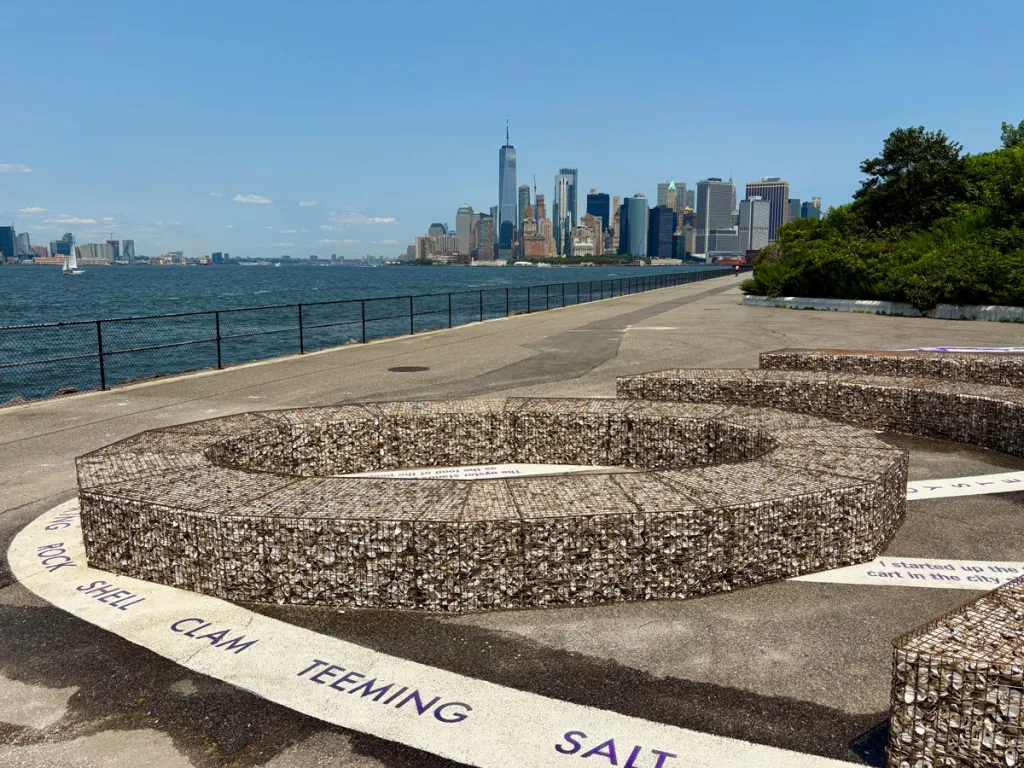
His latest entry into this way of working is Oyster (2026), a massive outdoor installation that goes on view today on the western promenade of Governors Island. Arranged in the shape of the titular mollusk and measuring 40 cubic yards, Oyster is made of hundreds of thousands of recycled oyster shells that have been donated by Billion Oyster Project, a nonprofit that aims to rebuild New York Harbor by rehabilitating its oyster reefs.
Michelson began working with the organization in 2021 and, in the years since, he became inspired by the communal aspect of the oysters that once brought together the Lenape and others, as well as the shellfish’s luminous quality. But years of overharvesting, human pollution, and dredging had decimated New York’s once populous oyster beds. While the Billion Oyster Project is working toward a pragmatic solution to solving this problem, Michelson has come up with his own artful intervention.
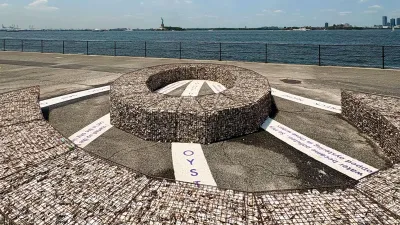
View of Alan Michelson’s The Oyster (2026) during its installation.
Commissioned by More Art in partnership with Billion Oyster Project and Governors Island Arts/Courtesy the artist
Overlooking New York’s harbor, Oyster will soon serve as a gathering place for those visiting the island to “contemplate the harbor before the ships came, before Europeans, and imagine that landscape and the abundance and the bounty that was available to the people there and the life ways that sustained it,” Michelson said, adding that he sees it as an artwork “where people can think about whether or not they want this sort of extractive regime to continue.”
With OysterMichelson offers a sustainable path forward in which he hopes nature-based solutions will “not only be embraced by Native people, but can bridge some of these cultural differences toward a better collective future.”
A significant portion of the donated oysters are likely thousands of years old. “It points to this much bigger time scale,” said Dylan Gauthier, an associate curator at the nonprofit More Art, which commissioned the project. “It’s not just pre-European; it’s probably even pre-Lenape—ancestors of the Indigenous groups that we know now.”
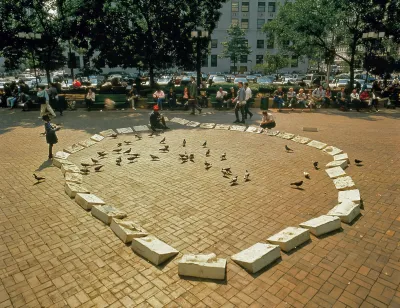
Alan Michelson, Earth’s Eye1990.
Courtesy the artist
That connection to history, and those who were here before us, has been a point of interest for Michelson for over 35 years. When working on his first installation project of this kind, Earth’s Eye (1990), at Collect Pond, he said of this time, “I discovered that not only was there a big pond there, but there was a huge shell midden left over from countless generations of Lenape and their ancestors fishing and eating shells.”
Earth’s Eye was a collection of 40 concrete markers installed on the site of the now-buried Collect Pond. Michelson arranged them in the body of water’s original shape prior to its pollution by colonial industry and its filling-in at the beginning of the 19th century. Each marker contained a relief cast referencing the natural and social history of the pond.
As a member of the Mohawk, one of the Six Nations of the Haudenosaunee Confederacy, Michelson said approaching waterways “from a perspective of an earlier set of life ways that were attached to the waters” became a central part of his practice as a way to document and resurface traces of Indigenous presence in New York, despite centuries of erasure.
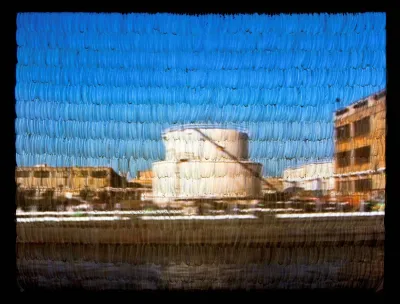
Alan Michelson, Mespat2001.
Courtesy the artist
Eager to continue this documentation, Michelson sailed up the heavily polluted Newtown Creek, a three-and-a-half-mile tributary of the East River that forms part of the border between Brooklyn and Queens, to record the once abundant site for his 2001 video installation Mespator “bad water place” as dubbed by the Lenape, who were displaced from the area by Dutch colonists in 1642. The site later became a dumping ground for raw sewage and industry in the mid-19th century, as well as a 17 million-gallon oil spill in the 1950s, before being designated a Superfund site eligible for a long-term federally funded cleanup in 2010.
Capturing what was left of the waterway and projecting the footage onto a large screen of sewn white turkey feathers, “turned out to be a very rich vein for me to explore,” Michelson said, “because I started with video, photography, and other means that are evidentiary, that are real” and paired it with turkey feathers, “this symbolic material that’s [not only] associated with Indigenous people, but also with nature, and provides an almost iridescent surface on which to project video.”
Michelson’s inclination toward luminosity—a quality revered by the Mohawk for its metaphysical properties—would soon become a mainstay of the artist’s subsequent works, including his return to Newtown Creek and the Gowanus Canal in Brooklyn for the video installation Midden (2021), which projected footage of the waterways onto oyster shells.
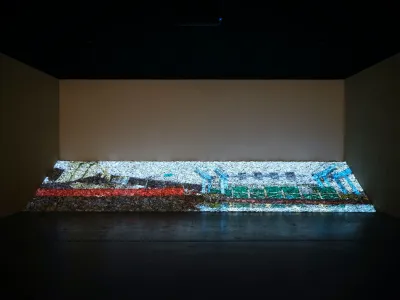
Installation view of Alan Michelson’s Midden (2021) in Greater New York 2021, at MoMA PS1, New York.
Photo Noel Woodford/Courtesy MoMA PS1
Two similarly concerned works by Michelson are currently on view at the Museum of Fine Arts, Boston, as part of the institution’s commemoration of the 250th anniversary of the US’s founding. The first, Hanödaga:yas (Town Destroyer): Reflect (2024), is a continuation of an earlier series featuring a life-size stainless-steel bust of George Washington based on Jean-Antoine Houdon’s 1786 marble version. During the Revolutionary War, the Haudenosaunee (Iroquois Confederacy) began calling General Washington hanödaga:yasor the “town destroyer,” after he ordered the brutal seizure of their homelands, decimating some 60 villages in the process. At the MFA Boston, Hanödaga:yas has been installed near Thomas Sully’s massive 1819 painting The Passage of the Delaware heroicizing Washington; onto Michelson’s bust are the fraught colonial legacies projected that undergird the nation’s very establishment.
Also at the MFA Boston is The Knowledge Keepers (2024), a pair of monumental cast sculptures depicting contemporary Aquinnah Wampanoag artist and activist Julia Marden and Nipmuc artist Andre StrongBearHeart Gaines, Jr. Fabricated in bronze gilded with platinum, they respond to Cyrus Dallin’s 1909 life-size sculpture Appeal to the Great Spiritwhich depicts a generic, nearly naked Indigenous man on a horse with arms wide open in a moment of surrender. It has stood in the MFA’s entrance plaza since 1912. Taking on the trope of the “vanishing Indian,” The Knowledge Keepers presents a counternarrative: the Indigenous peoples of these lands never disappeared.
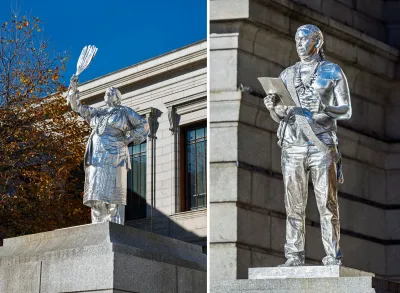
From left, Alan Michelson: The Knowledge Keepers: Julia Marden (2024) and The Knowledge Keepers: André Strongbearheart Gaines (2024), installed outside the Museum of Fine Arts, Boston.
Courtesy the artist
In honor of that legacy, Michelson often inserts Indigenous sovereignty into historically fraught public spaces. Interwoven through Oysterfor example, is a stencil-painted text in a purple wampum palette that offers a poetic reflection on the oysters that were once there: “It tasted of seawater … of brine and flesh … and somehow … of the future,” reads a savory quote by Anthony Bourdain. Another explains oysters’ aquatic benefits: “Ka mau te wehi! Oysters are incredible, ingenious—the ultimate water filtration system! We get to harness their superpowers. Once they’re in place, then sit back and let nature do its thing. It’s pretty amazing,” said Te Aonehe Nuku, a recent graduate of the New York Harbor School’s ocean engineering department.
Oyster will be further activated with a choral and percussion performance by Oneida and Ojibwe artist Danielle Jagelski over Indigenous Peoples Day weekend in October before it’s dismantled after November 30. But that doesn’t mean the sculpture won’t continue to live on as part of an oyster restoration reef project. Michelson joked that he is “tickled by the idea of doing large-scale submersible public art,” even if that means it’ll be submerged in a different form than how it appeared on land. Gauthier, one of the curators, sees it as creating “reciprocity between humans and oysters” with “two functions” that translate communal Lenape traditions of fishing and feasting into both an artwork and living marine infrastructure.
Throughout it all, Michelson has dedicated himself to thinking about the possibilities of art. “One thing I’ve come to ask myself over this long career,” he reflected, “is, ‘What can this artwork be? What can it do?’”