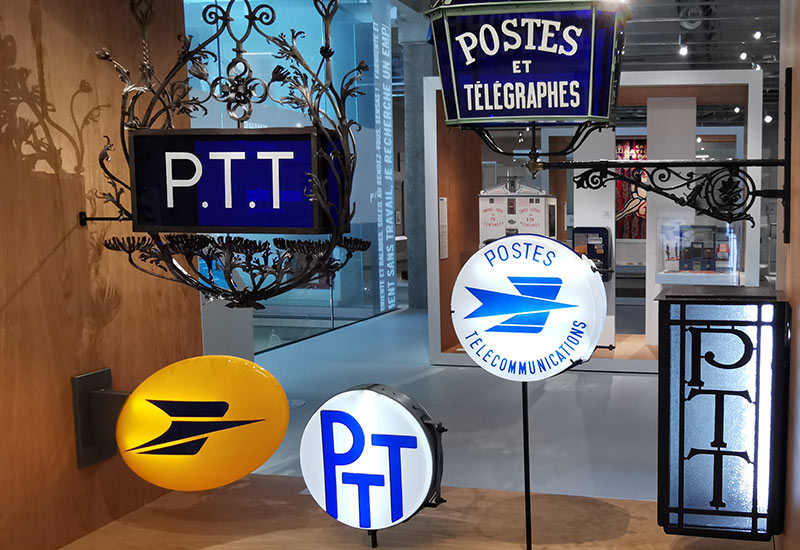
Paris. As it celebrates its 80th anniversary, the Postal Museum has just changed its name to that of 1946, “Postal Museum”. The institution has also modified its logo and its graphic identity: a large blue and white “M” made up of acronyms linked to postal services now adorns the facade and the communication media. “Originally a company museum and now a company museum”according to its director, Guillaume Goy, the Postal Museum displays an identity less linked to the La Poste group and more focused on “the universal”. The programming partly reflects this change with temporary exhibitions focused on more social themes. The approximately 600 square meters of the permanent exhibition (which would require modernization) open up perspectives on countries other than France, but the museum still constitutes “a showcase for the La Poste group”as Guillaume Goy recognizes.
Because the establishment remains a corporate museum that La Poste is keen to promote. All of the staff (36 jobs including 11 for scientific activity) are employed by La Poste, just as the 5,000 square meter building located near Montparnasse station is made available to the museum free of charge. On the budget side, the museum announces 1 million euros for programming and communication, we can therefore estimate the total budget at 4 or 5 million euros, based on an evaluation of the payroll and rents charged in the neighborhood. With the auditorium housed within the building, La Poste has a venue for events and internal communication. After the long works undertaken from 2012 to 2018 and the impact of the confinements linked to the Covid-19 pandemic, the museum must return to its pre-closure attendance, i.e. 150,000 visitors: in 2025, it welcomed only 50,000. Guillaume Goy says he is confident and is aiming for 70,000 visitors in 2026 before returning to the pre-work figures.
The work uniform
In this spirit, the current exhibition focuses on the uniforms and work outfits of postal employees since the 18th century, pieces from a collection rarely exhibited. Inspired by military uniforms and reserved for men (cocked hat, leather boots, embroidered jacket), the uniforms of postal workers and postmen gained diversity in the 19th century: the rural postman wears a blue blouse with a red collar whereas in town he is dressed in navy blue, like the police.
Postal worker uniforms.
© Postal Museum
The exhibition curators, Didier Filoche and Élodie Goëssant, emphasize the evolution of labor law and its influence on workers’ uniforms (stronger fabrics, reinforced rain gear). In the 20th century, women gained visibility, and uniforms were inspired by the outfits of flight attendants or those designed by great couturiers, following fashion trends. Competitions bring out the new uniforms of the 1980s and 1990s, presented at the end of the course with those of the SNCF and the RATP since the end of the 1990s: we see the evolution towards graphic and easily recognizable outfits in public companies, far from military and police uniforms.