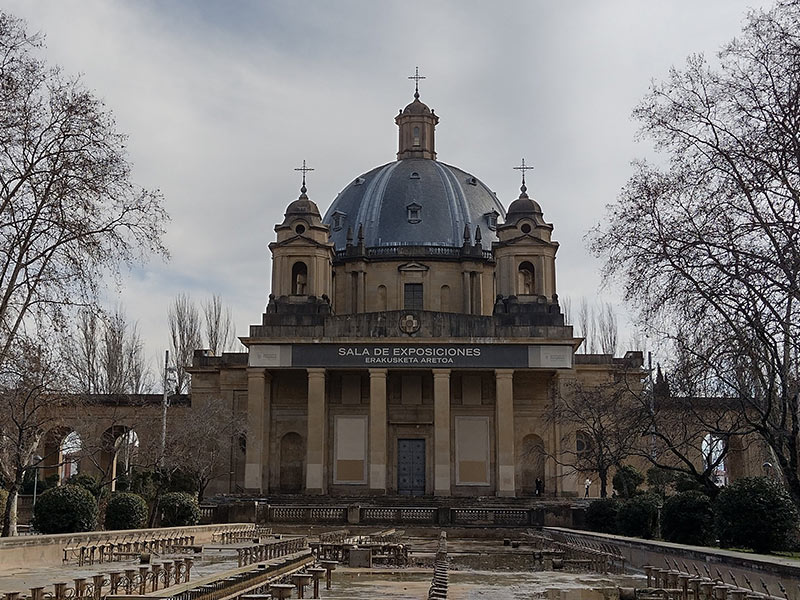
Pamplona (Navarra) definitely wants to turn the page of the past. The city will launch an international architectural competition to reconvert the Monumento a los Caídos into a museum dedicated to democratic memory and the denunciation of fascism. Erected by architects José Yárnoz and Víctor Eusa, this monument was originally designed to glorify the military coup of 1936 and the Franco regime (1936-1975). Inaugurated in 1952 under the name “Navarre to its Crusade dead”, it is the largest monument to the glory of Francoism in an urban center in Spain, and the second on a national scale after the Valle de Cuelgamuros (formerly Valle de los Caídos).
Although Navarre was not a place of fighting, the repression there was particularly violent. Nearly 3,000 victims were executed or disappeared. Until 2016, the monument housed the crypt of Franco’s generals Emilio Mola (1887-1937) and José Sanjurjo (1872-1936), both of whom died in an air accident. The monument was also used for masses and commemorations exalting the regime.
The reconversion of the building is made possible by a political agreement concluded in November 2024 at Pamplona town hall. The municipal majority (center-left coalition) decided to preserve the monument, to abolish its honorary status and to transform it into an anti-fascist memorial center. For the promoters of this solution, destroying the building would have “favored the memory of the executioners”. Including it in a museum project allows, on the contrary, a total break with the anti-democratic values that it embodied.
The procedure follows the provisions of the Political Agreement relating to the transformation of the War Memorial and the creation of the Centro de Interpretación of Maravillas Lamberto, a 14-year-old Navarrese victim, raped and murdered in 1936. This agreement was approved by the City Council on February 6, 2025.
The competition was presented by Joxe Abaurrea San Juan, municipal councilor responsible for urban planning, housing and the 2030 Agenda. A jury will select up to five proposals, each awarded 20,000 euros. The projects will then be submitted to residents, whose opinions will participate in the choice of the winner. The filing deadline is two months from publication in the Official Journal of the European Union. The project plans to integrate the future museum into the urban fabric by reclassifying the building, the adjacent Liberty Square, the Serapio Esparza park and the surrounding streets.
This initiative is part of the broader framework of memory policies carried out in Spain for several years, in particular the national law of Democratic Memory of 2022 and the foral law 29/2018 in Navarre, which allows the designation of places of memory. Pamplona thus aims to become a “Ciudad con Memoria”, in a network with other memorial institutions in Europe and around the world.
Although Spain does not yet have a national museum dedicated to the Civil War or the Franco dictatorship, several regional sites play a structuring role. The Valle de Cuelgamuros, near Madrid, long a place of Franco pilgrimage, is in the process of being recontextualized. In 2025, an international architectural competition decided on the future of the monument. The winning project, entitled “The base and the cross”, provides for the removal of the monumental staircase leading to the basilica, replaced by a large through crack, designed as a narrative passage.
Other Spanish sites are also experiencing reinterpretations of their past. Inaugurated in 2008 in La Jonquera, the Museu Memorial de l’Exili is dedicated to the Retirada (exodus of republican refugees at the end of the civil war) and to the diaspora resulting from this exile. In Toledo, the Alcázar, once a propaganda myth, has housed the Army Museum since 2010, which offers a contextualized reading. Finally, the Documentary Center of Historical Memory (Salamanca) preserves and exhibits the archives of Francoism. It constitutes one of the main public funds over the period.