In Berlin, the construction site of the Berlin Modern museum has been crystallizing the expectations and frustrations of the German cultural community for several years. According to the German media Monopoldelays and additional costs are piling up for the future museum, now weakened by humidity problems. Located at the Cultural Forum, between the Philharmonie and the New National Gallery, the building will bring together the 20th century art collections of the National Gallery, the Marx collection, Ulla and Heiner Pietzsch, as well as funds from the Prints Cabinet and the Art Library. The challenge goes beyond the creation of new equipment. The aim is to offer the capital a place where European and international modernities can interact freely, in a space finally adapted to today’s constrained collections.
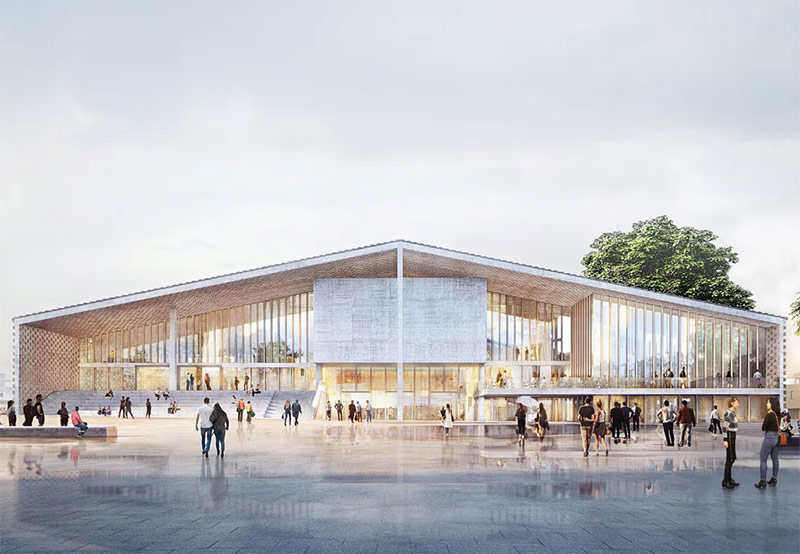
The Swiss agency Herzog & de Meuron won the competition in 2016. The building adopts an austere silhouette, with a gabled roof evoking an urban barn. This sobriety responds to the dense context of the Cultural Forum, where the Philharmonie by German architect Hans Scharoun and the New National Gallery by Ludwig Mies van der Rohe already dominate. Inside, the plan is organized around a cross axis, distributing four sets of rooms, a central atrium and modular platforms, completed by educational spaces, a restaurant and an underground connection with the New National Gallery.
The calendar kept shifting. Launched at the end of 2019, the project saw its first stone laid in February 2024. The opening, first hoped for mid-2020, was postponed to 2028 then to 2029. At the same time, costs have increased significantly. The 200 million euros voted in 2014 increased to 364, then to 450 and finally to 526 million according to the budget reports. The Prussian Cultural Heritage Foundation has admitted an amount of 507 million euros, which is an absolute record for a German museum.
In the spring, further damage affected the structural work, especially in the lower levels. High winter humidity, sensitive concrete and poor ventilation have led to the appearance of mold, algae and bacteria on new surfaces. The humid nature of the land, although identified for a long time, has raised doubts about the initial evaluation of the site. The Prussian Cultural Heritage Foundation has reorganized the work and is preparing a remediation. The building is now eight months behind schedule. Delivery, scheduled for 2029, is therefore postponed to 2030, with a public opening planned for the middle of the year, subject to further contingencies.
The criticisms are rife. Architecturally, the sobriety of the volume disappoints some, who consider it too banal for such an issue. The budgetary drift fuels political tensions, while the management of the site is singled out. Finally, on the museum level, Berlin remains deprived of a tool worthy of its modern collections, which are still largely invisible. The foundation reminds us that, without this building, an essential part of these works would remain invisible.