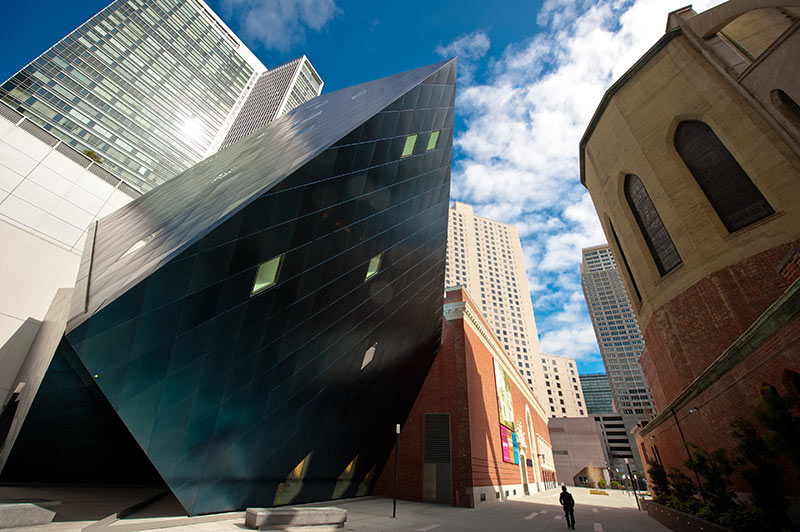
In San Francisco, in the Yerba Buena neighborhood, the Contemporary Jewish Museum (CJM) building had been closed to the public for more than a year. A few days ago, the institution finally announced its sale.
The building, inaugurated on June 8, 2008, was designed by Daniel Libeskind, also the author of the Jewish Museum in Berlin. The design is based on the Hebrew expression “L’Chaim” (“To life”), from which it declines the letters “chet” and “yud”. The “Yud”, a blue volume pierced with 36 diamond-shaped windows, hosts exhibition spaces, sound installations and events. The “Chet” brings together the reception hall, the educational spaces and part of the galleries. The whole extends over 6,000 m².
The building weighs on the financial balance of the institution. The CJM, without a permanent collection, must ensure the operation of a large-scale building, designed for temporary exhibitions, educational programs and events, and based on heavy technical equipment — air conditioning, security, lighting, maintenance of the metal structure. The whole thing generates high operating and maintenance costs.
Financial data shows a deficit of more than $5.9 million (5 million euros), while its revenues do not cover its expenses. Donations, from foundations, individual donors and the local Jewish community, are no longer enough to fund staff, programs, building maintenance and repayment of the construction loan. Contracted at the time of the inauguration, this loan represents approximately 1.5 million dollars (1.3 million euros) in annual charges, or a significant part of the overall operating budget.
The CJM closed its galleries to the public in December 2024, for an announced period of at least one year. The museum then undertook a gradual reduction of its staff, approximately two thirds of the 30 employees being affected, in order to reduce its operating budget from 7.5 to 3 million dollars (6.5 to 2.5 million euros). But today the decision has been made to sell the building at 736 Mission Street. The CJM presents this measure as “strategic”, aiming to dissociate the institution from a building that has become “beyond its capacity” to be financed. The institution remains unclear about its future: a more modest location? the programming of exhibitions in partner locations? Support for artists?