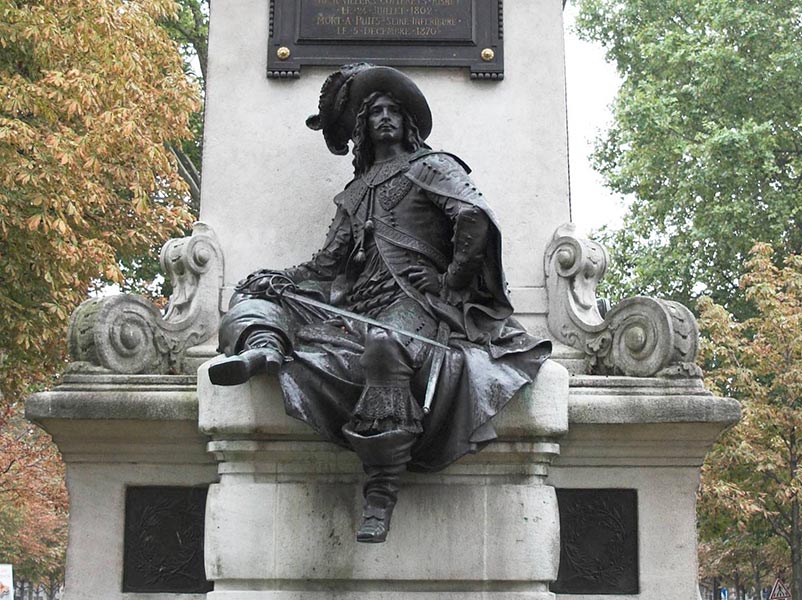
The hero of the Three Musketeers, popularized by Alexandre Dumas, could correspond to an officer whose grave, dating from the 17th century, has just been discovered in Maastricht, in the Netherlands. In February, in the church of Saint-Pierre-et-Saint-Paul in the village of Wolder, a subsidence of the ground revealed, under the paving of the nave, an almost complete skeleton. It could be Charles de Batz de Castelmore, known as d’Artagnan.
The musketeer died on June 25, 1673, during the siege of Maastricht, during the Dutch War. Captain-lieutenant of Louis XIV’s musketeers, he was killed in combat. He was probably hit by a musket shot in the chest or throat, while leading an attack near the ramparts, near the Tongersepoort, the old city gate. His body was not repatriated to France. Like other officers who died in the field, he was buried on site, in the Catholic parish closest to the battlefield, in this case in Wolder, where the royal camp was located.
From the 2000s, historian Odile Bordaz reconstructed the topography of the siege and located the French camp in the immediate vicinity of Wolder. She suggests that the village church may have served as a burial place. The absence of mention in the parish registers is compatible with practices of rapid burials in times of war, without registration or formal ceremony. In 2008, by cross-referencing French and Dutch military archives, she identified this church as a plausible site. His work, however, encountered skepticism from the diocese and the absence of archaeological investigations.
In 2023, an attempt at geophysical prospecting financed by private funds, with the assistance of archaeologist Wim Dijkman, who has been working on the issue for almost thirty years, and an audiovisual production company, was canceled by the parish council shortly before its implementation.
The discovery is fortuitous. Opening the floor reveals a masonry tomb located on the site of the old main altar, an area traditionally reserved for high-ranking burials. Deacon Jos Valke was immediately alerted. An emergency search is carried out under the direction of Wim Dijkman.
The material elements are significant. Fragments of oxidized lead were observed at the level of the ribcage, consistent with the impact of a musket ball. French pieces from the 17th century have also been found, including at least one dated 1660.
The skeleton was transferred to an archaeological institute in Deventer for analysis. Samples, particularly dental samples, were sent to Munich in order to extract ancient DNA and compare it to that of descendants of the Batz de Castelmore line. At the same time, anthropological analyzes must specify the sex, age at death, stature and possible trauma, in order to verify compatibility with the expected profile of an officer of around sixty years old.
This convergence of indices does not allow, at this stage, to establish certainty. No nominative elements were found in the tomb. The hypothesis of another French officer of comparable rank remains. Likewise, the inevitable degradation of ancient DNA could limit the scope of genetic comparisons.
Dumas was not directly inspired by the archives on Charles de Batz de Castelmore. He mainly drew on the Memoirs of M. d’Artagnan by Gatien de Courtilz de Sandras, published at the beginning of the 18th century and kept at the BnF. These Memoirs are already a largely fictionalized version of the real d’Artagnan. The historical d’Artagnan, that of Courtilz and that of Dumas have several common features, even if they are three distinct figures.