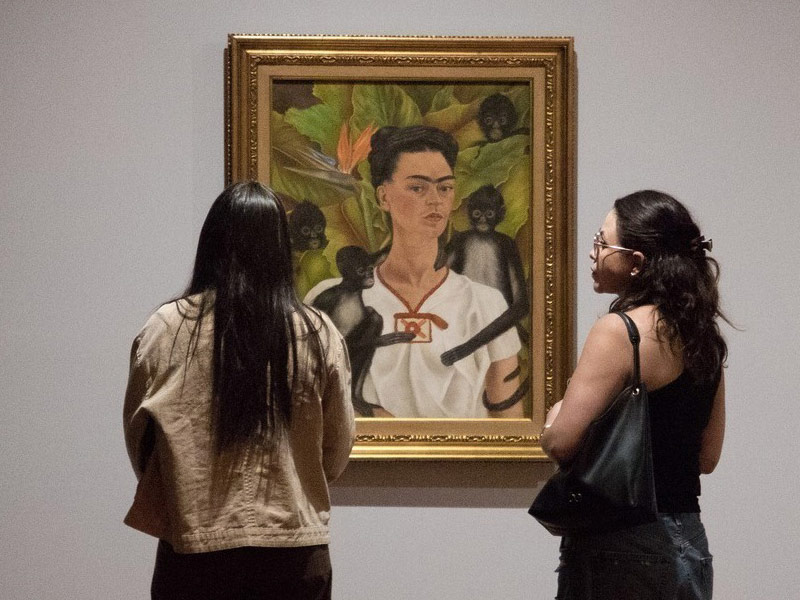
In Mexico, some 380 artists, art dealers, historians and jurists denounce a “public disaster” after the announcement of the transfer to Spain of the Gelman collection. Created by Jacques and Natasha Gelman between 1943 and 1998, a Russian-Mexican couple who made their fortune in Mexican cinema, this collection brings together one of the richest private collections of Mexican art of the 20th century. It notably includes around fifteen Frida Kahlo works (including Viva la Vida, 1954), around ten Diego Rivera works, as well as works by David Alfaro Siqueiros, José Clemente Orozco, María Izquierdo and around forty Gunther Gerzso. The initial core of 95 works has been increased to around 400 over the years.
Since February, the exhibition of part of this collection has enjoyed unprecedented success at the Museo de Arte Moderno in Mexico. More than 120,000 visitors in a few weeks to discover around 70 works. These record-breaking queues not only celebrate Frida Kahlo, Diego Rivera or Rufino Tamayo, but express an urgency: this may be the last chance to see this ensemble in Mexico before its announced departure to Spain in July. This “treasure” must in fact join the Faro Santander, a new museum supported by the Spanish bank in Santander (city in northern Spain), under the label “Colección Gelman Santander”.
The will of Natasha Gelman, who died in 1998, stipulated that the ensemble should remain united, exhibited in a private museum in Mexico and bear her name. This desire was gradually altered between legal disputes, the absence of public intervention, then the withdrawal of the works from national circuits in 2008. Since then, they have circulated abroad without a permanent place of exhibition.
In 2023, the collection was sold in great secrecy to the Mexican Zambrano family, linked to the Cemex cement group. No trace in Mexican cultural registers, no public call for tenders, no pre-emption by the State. In January 2026, Banco Santander becomes the manager and distributor of this collection, the Zambrano family remaining the owner without the precise clauses of this agreement being known. The collection is estimated to be worth the equivalent of 250 million euros.
In Mexico, the Instituto Nacional de Bellas Artes y Literatura (INBAL) and the Secretaría de Cultura announced that the collection could leave the territory between June 2026 and 2030, but must return to Mexico every two years from 2028. 27 of the 70 works presented, as well as a significant part of the 160 works intended for Spain, are in fact classified “monumentos artísticos” This status prohibits any permanent exit from the territory and regulates international loans.
Culture Secretary Claudia Curiel de Icaza insists that the collection “remains Mexican,” with no sale or transfer of ownership. Banco Santander, for its part, presents a partnership limited to five years, with no intention of acquisition. These assurances are, however, weakened by contradictions appearing in certain documents, as well as by the declarations of the director of Faro Santander, Daniel Vega Pérez de Arlucea, referring to a “permanent presence” in Spain.