In Lake Neuchâtel (Switzerland), a Roman cargo from the beginning of the 1st century AD was unearthed during two underwater excavation campaigns carried out in 2025 and 2026 by the Office of Cantonal Archeology of Neuchâtel, in collaboration with the Octopus Foundation and the State Archaeological Service of Fribourg. The official announcement was made last March by the cantonal authorities.
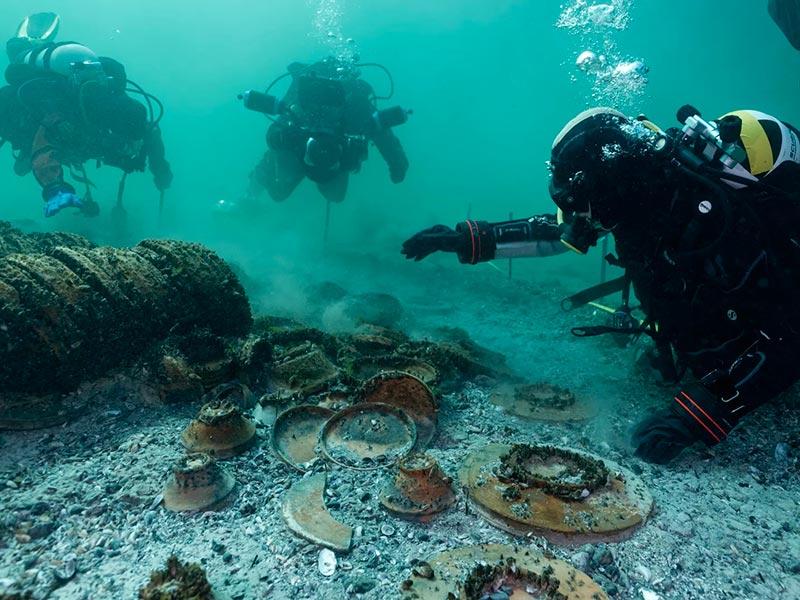
The site was spotted at the end of November 2024 during an aerial photography campaign as part of the health monitoring of lake beds, which revealed a dark anomaly. Underwater archaeologists carried out a first verification dive a few days later, discovering a pile of well-preserved ceramics, initially mistaken for World War II mines. An excavation operation was initiated in March 2025 for two weeks, then continued during a second campaign at the beginning of March 2026 for almost four weeks.
The cargo is dated between 20 and 50 AD. This chronology is based on several concordant elements, notably the analysis of a wooden element dated to 17 AD, and the study of a fibula attributable to the time of Emperor Tiberius (14-37 AD).
In total, more than 1,000 objects were recovered. The set mainly includes ceramics, such as tableware (dishes, plates, cups, bowls) produced on the Swiss Plateau, as well as amphorae intended for the transport of foodstuffs, in particular olive oil from Spain. Some containers still contained food remains, currently being analyzed.
The cargo also includes tools and utensils linked to the daily life of boatmen, elements of harness and several vehicle parts, including chariot wheels preserved in exceptional condition, with no known equivalent in Switzerland. An entire wicker basket, preserved in the lake’s chalk, contained six ceramic objects distinct from the rest of the load, interpreted as tableware and provisions intended for the sailors.
Among the metal objects, archaeologists found at least two glaive-type swords, one of which still preserved in its sheath, a dagger, a belt buckle and the mentioned fibula. These artifacts suggest a context of circulation under the protection of legionnaires; the cargo could be intended to supply a Roman military base located in the region, such as the camp of Vindonissa on the Aare, where a legion of around 6,000 men was stationed.
The good state of conservation is linked to the conditions of the lake environment: the objects were covered with fine sediments and chalk, which limited their degradation and allowed the preservation of fragile organic materials, such as wicker and wood. The objects are currently in the cleaning and restoration phase at the Laténium, the archaeological museum of Neuchâtel, where elements previously invisible underwater, such as seals, food traces or straw protections, could be identified.
The discovery was not immediately made public. The authorities deferred its communication in order to limit the risks of looting, malicious intent and damage. The site was exposed to several threats, including lake bottom erosion and nautical activities, particularly recreational boat anchoring and fishing nets.
The boat itself has not been located at this stage. Research must continue in order to locate the wreck, clarify the conditions of the shipwreck and better understand Roman trade networks. An exhibition is planned at the Laténium in 2027, accompanied by a book and a documentary film.